What would it take for your organization to become truly superintelligent in the age of AI? In this episode, Kevin sits down with Stephen Wunker to explore how leaders must move beyond simply layering AI onto existing processes and instead rethink their organizations from first principles. Steve uses the metaphor of the octopus, with its distributed intelligence and interconnected yet autonomous arms, to explain how AI enables a shift from rigid, top-down hierarchies to flexible, horizontally connected “work charts” where information gets to the right people at the right time. They discuss why electrification and the railroads offer powerful historical parallels, what most organizations are getting wrong about AI adoption, and why middle managers are not becoming obsolete but must evolve into change leaders. This conversation challenges leaders to stop bolting AI onto yesterday’s structures and instead reimagine how work gets done.
00:00:08:11 - 00:00:40:19
Kevin Eikenberry
This is the second time we've talked about something called the octopus as a metaphor for our organizations. Today we will explore that metaphor as a way to help us build a super intelligent organization. Stick around to learn what that is and how you can use AI to transform your business into a super intelligent business. Welcome to another episode of the Remarkable Leadership Podcast, where we are helping leaders like you and organizations like yours make a bigger difference.
00:00:40:19 - 00:01:04:15
Kevin Eikenberry
Becoming the leaders and organizations you were meant to be. If you are listening to this podcast, you could join us in the future live to get this information sooner so you can apply it more quickly on your favorite social media platforms. You can find out where and when and how and all about those live episodes by joining our Facebook or LinkedIn groups.
00:01:04:15 - 00:01:30:17
Kevin Eikenberry
Just two of the platforms where these are live streamed. First. Just go to remarkable podcast com slash Facebook or remarkable podcast.com/linkedin to get all of the details. If you like what you are hearing today and want help in developing the leaders in your organization. Let's talk. Reach out to us at info at Kevin eikenberry.com and we'll schedule time to learn more about your needs and share how we might help.
00:01:30:19 - 00:01:59:13
Kevin Eikenberry
And having said that, let me bring in our guest. Introduce him and we'll dive in. His name is Eve Walker. He is the managing director of New Markets Advisory, global consulting firm that helps ambitious innovators, including 29 of the fortune 500 companies, find their next wave of growth. He's founded four companies, developed one of the world's first smartphones, and worked with AI initiatives for over a dozen years.
00:01:59:15 - 00:02:24:11
Kevin Eikenberry
A longtime collaborator of the Harvard business excuse me, a longtime collaborator with Harvard Business School legend Clayton Christensen, he's considered one of the world's leading authorities on innovation. He's written over 100 articles for the Harvard Business Review, Forbes and others authored four bestselling books. His newest book he's coauthored is called AI and the Octopus Organization Building the Super Intelligent Firm.
00:02:24:11 - 00:02:41:17
Kevin Eikenberry
Steve, welcome. Glad you're here. We are going to dive in, and we're going to be a little shorter than some episodes because Steve's got a client. So we're going to dive in. We're going to talk about let's get going on this. So Steve, why this book? Why now? Why this book?
00:02:41:19 - 00:03:09:02
Steve Wunker
You know, there's so much written about AI and Kevin, and yet there's almost nothing about how management and organizations have to change to get the most out of AI. It's like we're writing about electricity as a technology, but we're not saying, hey, this can create an assembly line, this can create a totally new basis of competition. So yeah, a technology's great, but we need to broaden the lens and think about the system of work.
00:03:09:02 - 00:03:13:04
Steve Wunker
That's where the real potential for change lies.
00:03:13:06 - 00:03:33:04
Kevin Eikenberry
Okay. Octopus organization. Like why this metaphor? It is the metaphor of the book. And I said it's the second episode. Second episode we've had we had someone else on recently. I got both of your books within, like a week of each other. So make make sure we understand why that's the metaphor that you're using here.
00:03:33:06 - 00:03:57:21
Steve Wunker
You bet. So the concept of octopus organization was originated by my coauthor, Jonathan Brill, who's the futurist at Amazon about four years ago. And he used it mainly as a metaphor for adaptability. But as he and I were talking about this book, we realized as we just delved into understanding octopuses, among many other things, they've got a weird biology.
00:03:57:23 - 00:04:29:11
Steve Wunker
They, have nine brains, one central brain, and then a brain in each of the arms, two thirds of the brain tissue in an octopus is actually not in its head. And that led us to realize, as we delve into a little bit more, that octopuses are a great analogy for distributed intelligence. Each arm can sense and think and act independently, while also being totally aware of what else is going on in its organization, if you will.
00:04:29:11 - 00:04:58:14
Steve Wunker
What all the other arms are doing, and that a lot of central brain focus on what's actually really important and strategic, like how to escape, you know, that shark that's coming out the. So if we can be like octopuses, not only are we very adaptable, but we're able to undertake things in massively parallel fashion, act and react very quickly close to the front line, and do it with awareness about everything else that's happening in the organization.
00:04:58:14 - 00:05:01:12
Steve Wunker
These are all things that I enables.
00:05:01:14 - 00:05:26:09
Kevin Eikenberry
So you just use the phrase distributed intelligence. And I think if people were listening, they they already see the correlations for themselves. But the book isn't about distributed intelligence, about what you're calling a super intelligent organization. So we should probably define that before we go any further. What do you mean by that? What is that? What should that look like to us?
00:05:26:11 - 00:05:47:23
Steve Wunker
So super intelligence refers to being smarter than humans, but that does not mean that we just turn over the keys to the machines and let them do the work. That that's a make a fallacy in the popular press about AI. It's going to be better than humans. And so humans just turn it over and who knows what we all do?
00:05:47:23 - 00:06:16:18
Steve Wunker
We get granted our golf games. No, it doesn't work that way. The intelligence in an organization actually arises from collaboration. If you just measure a numbers of neurons, an anthill is going to win that contest. The reason that humans can build civilizations is that we collaborate. We build on each other. And so I can actually be the, the, the, the catalyst for doing that.
00:06:16:18 - 00:06:47:13
Steve Wunker
It enables the right information, go to the right people at the right time, and connects people from across an organization and then a turbocharged some of the things that they want to do, oftentimes doing things that humans shouldn't be doing or won't be doing because they don't have the time, and sometimes doing things that humans can't do as well, all of that together becomes one is really superintelligent, an organization that simply could not exist before AI.
00:06:47:15 - 00:07:16:17
Kevin Eikenberry
So I told you this before we went live, that one of the one of the things I love about the book is that you start like everything for everyone who's listing everyone. Everything we've said so far is about looking ahead. And yet, Steve, you started by looking back. And I think that context is very helpful for us. So, if and again, we're not talking about writing a prompt, we're not talking about we're not talking about an LLM and that sort of thing right here.
00:07:16:17 - 00:07:38:03
Kevin Eikenberry
We're talking about AI in a bigger context. So I'd like you to help us put this coming transformation in a historical context. I know you can because you wrote about everything. Hope was put this because I think this will help people a lot. I really do think it will.
00:07:38:05 - 00:08:02:19
Steve Wunker
So, you know, Kevin, as you mentioned, I worked with Clay Christiansen for many years, and he's most known for concepts like disruptive innovation and jobs to be done. But if you really delve into his work, you see where they came from, which was that he was a student of business history. He was a big proponent of understanding the patterns in business history, to distill what then that means for what happens in the future.
00:08:02:21 - 00:08:28:21
Steve Wunker
In our case, we look at several historical examples. But let's take for instance, electrification, which is probably the closest parallel to the dissemination of AI in terms of just totally remaking an economy. The winners in electrification were not the factories that replaced their steam powered machines with electric machines. I mean, that was nice and it was certainly more productive and more reliable.
00:08:28:22 - 00:08:55:18
Steve Wunker
So it should be done. But the real winners were people like Henry Ford, who could fundamentally rethink the system of production and create innovations like the assembly line. The assembly line could not have existed without electricity. But it wasn't just an electrical innovation. It was rethinking the whole system of work. So we need to be like Ford and rethink that whole system of work to get the true benefits out of AI.
00:08:55:20 - 00:09:19:16
Kevin Eikenberry
The other thing that you talk about is the railroads, and you talked about how, and the thing that I think is so interesting about that is that railroads helped us create a way of working that has really, in some ways, been in existence all the way up until now. And you're suggesting, that we can't we can't live that way anymore.
00:09:19:18 - 00:09:28:12
Kevin Eikenberry
The octopus helps us think about that, but we can't live that more that way. If we're going to go further. When I say anything more about that.
00:09:28:14 - 00:09:55:19
Steve Wunker
The first org chart, that was ever created was in 1855, the New York and Erie Railway, and it described a very classic top down organization. It, you know, it's telling that on some of those early railways, the telegraphs worked in one direction only. It says a lot about what people needed or wanted to know.
00:09:55:21 - 00:10:21:13
Steve Wunker
And so we have these these top down organizations with these codes of work. And sometimes we've created innovations on that, like matrices. But fundamentally it's still top down and enables us to really rethink how work is done. So the real way work actually happens in organizations doesn't a core to the org chart. It's not in these top down cone shaped hierarchies.
00:10:21:15 - 00:10:50:02
Steve Wunker
It's across. It's in the horizontals, whether it's within some function or across functions. That's how people actually get stuff done, not through just relaying things up and down the telegraph in railroad sort of fashion. With AI, we can toss aside the org chart and think about what Microsoft calls work charts. We can disaggregate the work into its unit components that are needed to create outputs, and then really rethink from first principles.
00:10:50:04 - 00:11:16:20
Steve Wunker
How would you do this in an AI first way? Where is AI exclusively going to do the work? Where is it a cyborg of human plus AI? Where are humans only doing this? And then how do I create the connective tissue between those humans so that the right information comes to the right people at the right time? Now, I'm sure they'll still have reporting lines, but the real work is done in those horizontals.
00:11:16:20 - 00:11:31:12
Steve Wunker
I make that possible. So we need to steam railway is log pass. We need to toss aside the organizational models of 170 years ago, and update that with what AI now enables us to do.
00:11:31:14 - 00:11:59:13
Kevin Eikenberry
And let's be clear, I think this this gets lost to you and you talk about in the book, but this gets lost to you. Like that approach to managing the business made sense in the context to a large degree, in the context of what the work needed to be. Our work context is totally different today, right? So all of what we're talking today, I really love this idea of we have to rebuild from first principles rather than bolting on AI.
00:11:59:15 - 00:12:18:12
Kevin Eikenberry
Right. So how should we be thinking about AI? Because you say in the book it's not a tool or it's not only a tool. So how should we be fundamentally thinking about it as the starting point to help us do the things you're suggesting?
00:12:18:14 - 00:12:45:14
Steve Wunker
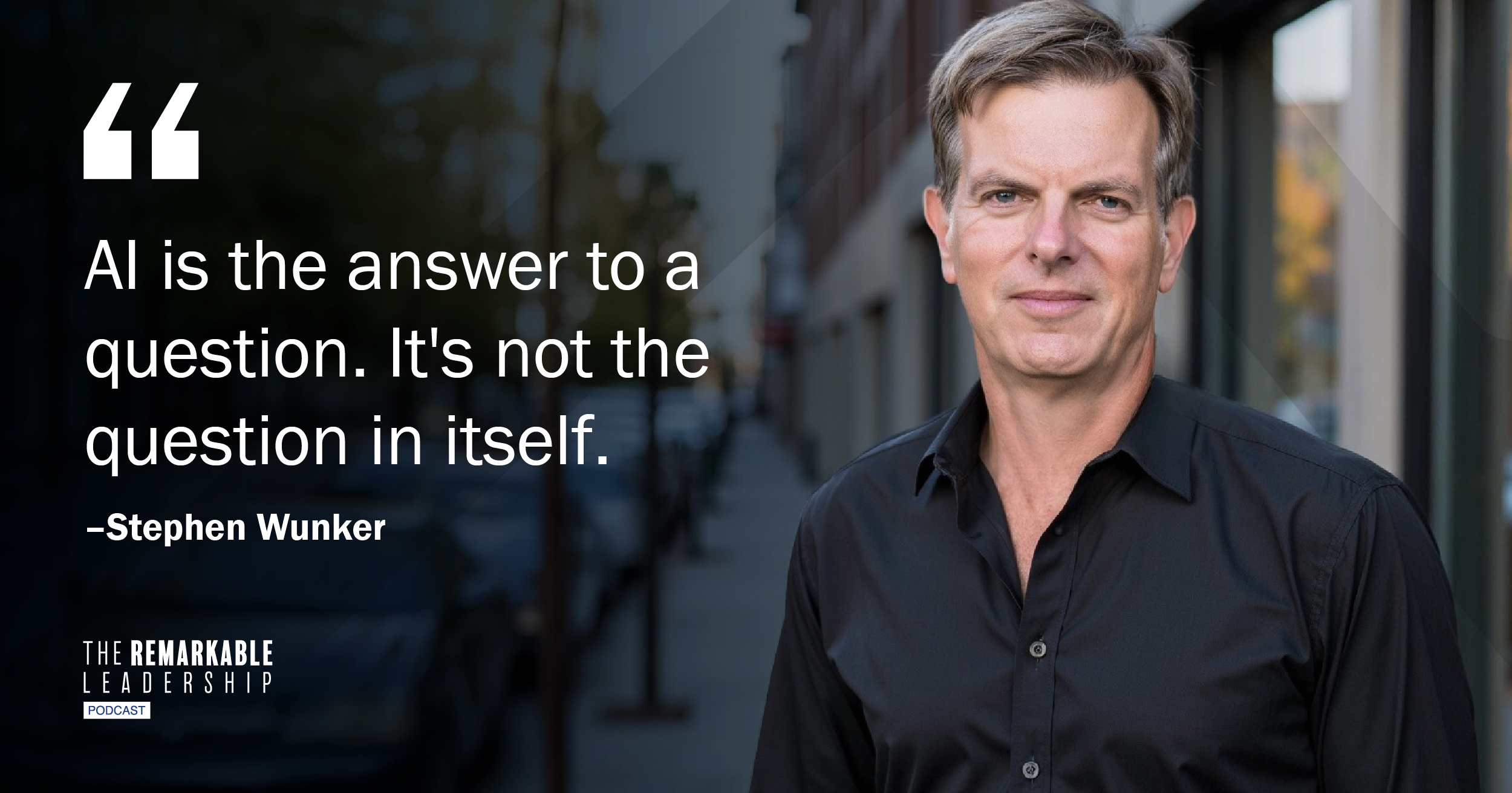
So actually, Kevin, I think we start not even thinking about AI, but thinking about the core business priorities that you have. AI is the answer to a question. That's not the answer in itself or it sorry, it's not the question itself. Right. So first, business priorities. Second, how do you achieve those priorities with work that today humans shouldn't do, won't do or can't do?
00:12:45:16 - 00:13:09:19
Steve Wunker
Humans, doctors in consultations with patients, should be spending half their time looking at a screen and typing in a keyboard. We will take notes after every meeting that we have and distribute them to all the participants. We can't, I did this last week, have a workshop with 120 participants where people break out into groups of four.
00:13:09:19 - 00:13:36:10
Steve Wunker
We have 30 different tables and all of them, take notes via a voice recorder rather than off and flip chart in or summarize fashion. A voice recorder, that we can then get transcriptions of and summarize detailed conversations from 30 different tables and the commitments that people undertake. You just could do that before I so should won't can't.
00:13:36:12 - 00:13:44:00
Steve Wunker
If you think about that, then you start really unleashing what the organization might do with AI.
00:13:44:02 - 00:14:13:16
Kevin Eikenberry
Yeah, that was one of the things that I highlighted. And I love that, that that those three pieces, you know, you've already answered this question in a way. But I think it's but I want to ask it directly. Right. Like what? What do you see? Organizations getting wrong as they're implementing AI? Like, again, you've you've already tossed a bunch of crumbs here, but, very specific.
00:14:13:16 - 00:14:18:07
Kevin Eikenberry
Like, what are the big mistakes you see people make, organizations make.
00:14:18:09 - 00:14:46:07
Steve Wunker
You know, the biggest one, Kevin, is that they think of AI as some sort of grease in the machine or, you know, some sort of dust that they put on top of all their existing strategies and ways of working that is going to magically transform things. And it won't. You might get some minor efficiency improvements along the way, with some hidden costs, but working out that way doesn't really change your competitive position.
00:14:46:08 - 00:15:10:16
Steve Wunker
It doesn't change your cost structure, your speed of action doesn't fundamentally alter the basis of who you are. You need to back up and think about it, as I said from the first principles. So yeah, by all means do some little experiments, do the productivity enhancements. That's great. But if you're not really backing up and thinking about it hard, you're missing a trick.
00:15:10:18 - 00:15:34:04
Steve Wunker
We talked about it in another publication, Kevin, in terms of ABC, a is I fi depressed? So by all means, if you want to put in a natural language interface on some like internal intranet. Yeah, sure. By all means, go ahead do that. B is become great at experimentation. The bigger the enterprise, typically the worse they are at experimentation.
00:15:34:06 - 00:15:52:00
Steve Wunker
But given that we're in this world where the technology is advancing so quickly and what people are doing with it is changing so fast, you need to be really good at experimentation. So you need to know what are your hypotheses, what are you trying to learn, and what are your pre and post measurements? How are you going to capture those learnings?
00:15:52:00 - 00:16:01:10
Steve Wunker
How are you going to disseminate them? How are you going to kill experiments? So often people don't do that. C is create the future, which we've been talking about.
00:16:01:11 - 00:16:18:11
Kevin Eikenberry
You know, I wrote just last week. So for those who in the podcast, it will be a couple months ago. But I just wrote last week about how so often, when we're facing uncertainty, what we do is we fight flight or freeze. And I'm suggesting what we need to do is test, try and learn.
00:16:18:11 - 00:16:37:06
Kevin Eikenberry
Which is exactly Steve, what you're suggesting, because in a, in a work in a world context that is more uncertain than ever, we need to think about how we can use the these things to help us deal with that, rather than try to bolted on to something that reminds us of what we used to do. I think it's a really important piece.
00:16:37:08 - 00:17:05:01
Kevin Eikenberry
One of the things that's happening a lot in our world right now is that organizations continue to get flatter. And we we can we continue to question the role of middle managers. I think one of the most important things you do in this book, and one of the things I think that organizations really need to think about, is, hey, the role of middle manager isn't going to go away, it's going to change a lot or needs to change a lot.
00:17:05:02 - 00:17:14:06
Kevin Eikenberry
Talk about that change at this may be the most important thing for everyone. Listening is maybe the most important thing. You hear.
00:17:14:08 - 00:17:37:09
Steve Wunker
You know, Kevin, I actually agree. I think it is probably one of the most important things, even though it's back in chapter two. I agree with you. There are so many wrongheaded assumptions out there in the popular press about AI, and this is a huge one. People say AI is the death of middle managers. No, no no no no, AI is a revolution in middle management.
00:17:37:09 - 00:18:04:14
Steve Wunker
No longer do middle managers have to spend time looking at Excel reports summarizing what people did, attending meetings to hear what else everybody else is doing, socializing concepts, all things that are not really a good use of the skills that middle managers have. So they shouldn't be processing information. AI does that very well. They need to be close to customers.
00:18:04:14 - 00:18:14:18
Steve Wunker
They need to be closer with their direct reports. Not spending, one time, one on one every week maybe. But really.
00:18:14:20 - 00:18:17:01
Kevin Eikenberry
Yeah, maybe that's a, maybe.
00:18:17:06 - 00:18:41:03
Steve Wunker
Right. Joining you then maybe do joining with them, coaching them, understanding what's happening at the coalface of the organization, focusing on the strategic issues. And critically, every change manager or sorry, every middle manager needs to become a change manager, something that a CTO relayed to me recently. She's been thinking about her, which is a very large organization, over a thousand people.
00:18:41:05 - 00:18:57:21
Steve Wunker
And she said, I've got so many people here who I've hired for their technical capabilities, but I've realized anybody who has direct reports in this organization needs now to become the change manager. It's so true. It's no longer the high priesthood of change management in the C-suite.
00:18:57:23 - 00:19:09:20
Kevin Eikenberry
I would actually argue that she should be saying change leader or change champion. But the point is, the point is absolutely accurate, right? The point is absolutely accurate.
00:19:09:22 - 00:19:38:19
Kevin Eikenberry
There are a ton of books that talk about culture. We've had a number of the best ones on this show. The word culture is not on the title of this book. The culture chapter is perhaps the shortest chapter in this book, and yet it's in some ways, everything we've talked about is culture. The thing that you bring to the table that I want you to talk about is your you're not writing a book, and in this book you're not talking about culture change writ large.
00:19:39:00 - 00:19:58:16
Kevin Eikenberry
You're talking about something very specific, how we as a culture deal with technology. So our technology culture. So can you talk about what you mean by that and what we should be thinking about? That's like taking culture down to that one thing, right? Like what? What does that look like to you?
00:19:58:18 - 00:20:23:09
Steve Wunker
So, two things about culture. First of all, culture often lags. It doesn't treat. You need to address the hard variables of change first, how, people are assessed, how they're hired, how they're incentivized, how they're promoted, how you allocate resources. If you don't change that, you're very unlikely to change the culture. But the culture is really important.
00:20:23:10 - 00:20:50:11
Steve Wunker
It guides all those invisible decisions and behaviors that senior management is never going to be able to dictate, nor should it dictate. So one critical element of tech oriented culture change is having an acceptance of perhaps not failure, but of learning and even then, anticipation that people are going to learn, and sometimes that it's going to be through mistakes.
00:20:50:13 - 00:21:01:18
Steve Wunker
But it should always be in the service of learning, work, moving at a very uncertain time. If we're not there already, there's a tremendous unclear I.
00:21:01:18 - 00:21:04:05
Kevin Eikenberry
Think we're already there. I think we can officially say we're already there.
00:21:04:06 - 00:21:23:20
Steve Wunker
Steve are trying to say it's safe ground here. I can, but yes, I agree. So, look, none of us have this figured out. If I look, I, Jonathan, my coauthors, one of the world's leading futurists, he will tell you it is a total folly to go predict what the world is going to be like in ten years.
00:21:23:21 - 00:21:50:15
Steve Wunker
But we can talk about the patterns of change, and we can talk about the skills that you're going to need to adapt given those patterns. So a huge one is that ability to experiment, to learn, to disseminate those learnings and have a degree of psychological safety so that, you can act in, in, a way that's a little more free than you might have anticipated.
00:21:50:17 - 00:22:09:13
Steve Wunker
We quote a study in the book by some landscape architects who look to how kids play on playgrounds, and the first playground they had was a very traditional playground with, you know, big swings out and slide in the middle and things scattered around the edge, no fence. And the kids clustered around the big equipment at the center of the playground.
00:22:09:15 - 00:22:30:14
Steve Wunker
And that, okay, kids, go away. Only thing they changed was they built a fence around the playground, and then they brought a different group of kids, and they saw how these kids play in the playground. And the kids were playing all over the playground, right up to the border of the fence. And the lesson of that is that we always have invisible fences in our minds.
00:22:30:16 - 00:22:49:14
Steve Wunker
If we don't lay out where that fence is, we tend to constrict ourselves to the center of the playground, actually, by laying out the fence, by setting the boundaries in the governance guardrails, you actually create freedom. So we need to create the freedom to experiment within the fence.
00:22:49:16 - 00:23:15:07
Kevin Eikenberry
That, that, that that is a powerful piece of the book and a powerful study. And it it it ties to empowerment. It ties to accountability. It ties to psychological safety. It ties to setting clear expectations, it ties to so many of the things that that everything on that list I just described are some of the things that leaders ask me about, talk about every single day.
00:23:15:08 - 00:23:30:08
Kevin Eikenberry
And so I love that, we have a limited amount of time. You have some place that you need to be. So I have a couple of questions I want to ask as we shift gears before we finish. One is I want to know, Steve, what you're reading these days.
00:23:30:10 - 00:23:57:16
Steve Wunker
So, I actually read an article just this morning by Sandy Paul Chowdhury, who set up Cal Berkeley. It's a new piece in our business review. And it's titled, Why New Technologies Don't Transform Incumbents. Saying it as a book called reshuffle, which it came out ten times, did. It's very consistent and yet very complimentary. We do not say the same things, but they are very much agreeing with the common, thrust.
00:23:57:18 - 00:24:21:11
Steve Wunker
So he looks at how companies like Adobe and fashion houses just layered on new technologies onto existing work practices, didn't fundamentally change them. And then you have companies like Figma and Sheehan really rethink that way things were done and disrupt what actually, we're pretty forward thinking incumbents, but not flexible enough.
00:24:21:13 - 00:24:41:08
Kevin Eikenberry
Oh, there's that word flexible, everybody. That's the title of my last book, Flexible Leadership. Which I have been not saying anything about, but it's also connected to this, although again, I barely even use the word, the phrase I in that book, but, absolutely. That on before we go, where do you want to point people?
00:24:41:08 - 00:24:48:03
Kevin Eikenberry
They want to learn more, Steve, about the work, about the company, where you want to point people before we say goodbye.
00:24:48:05 - 00:25:11:07
Steve Wunker
So, the book An Octopus Organization is on Amazon. The. You can check out the website AI and octopus.com. Please connect with me on LinkedIn. Steve, one group, I do respond to email. So, do get in touch. And I'd love to hear how you're approaching these sorts of issues.
00:25:11:09 - 00:25:27:15
Kevin Eikenberry
Listen, I have a question for all of you. It's a question I ask you every week before I say goodbye to Steve and say goodbye to you. And the question is, now what? What are you going to do? Like what's the there's no point to this. I mean, Steve and I are fun, relatively good looking, but what matters here is what you're going to do.
00:25:27:15 - 00:25:50:00
Kevin Eikenberry
I said relatively, Steve, what we're going what you're going to do as a result if you don't take some action here, what's the point? There is no like we are in an age of uncertainty. We we have new opportunities and tools all around us, but we have to step back before we can step forward. And we have to think not about bolting things on, but re creating what we've got.
00:25:50:00 - 00:26:03:04
Kevin Eikenberry
And and so all of that is a some of the kinds of things we talked about today. But the real challenge is what are you going to do. That's the challenge for you. I hope you will take that challenge. Your other challenge is to make sure you subscribe so you don't miss any future episodes. You can come back again next week.
00:26:03:06 - 00:26:06:03
Kevin Eikenberry
Steve, thanks so much for being here, is a pleasure to have you.
00:26:06:05 - 00:26:07:17
Steve Wunker
I enjoyed it.
00:26:07:19 - 00:26:13:00
Kevin Eikenberry
We'll be back next week everybody with another episode of the Remarkable Leadership Podcast. We'll see you then.
Meet Stephen

Stephen's Story: Stephen Wunker is the co-author with Jonathan Brill of AI and the Octopus Organization: Building the Superintelligent Firm. He is the Managing Director of New Markets Advisors, a global consulting firm that helps ambitious innovators—including 29 of the Fortune 500—find their next wave of growth. He’s founded four pioneering companies, developed one of the world’s first smartphones, and worked with AI initiatives for over a dozen years. A longtime collaborator of Harvard Business School legend Clayton Christensen, Wunker has advised hundreds of organizations and is considered one of the world’s leading authorities on innovation. He’s written over 100 articles for Harvard Business Review, Forbes, and others, and authored four other bestselling books. Steve holds an MBA with Honors from Harvard Business School, a Master’s of Public Administration from Columbia University, and a BA cum laude from Princeton University.
Follow The Remarkable Leadership Podcast


Looking to Develop Stronger Leaders?
Want help developing the leaders in your organization? Reach out to explore how the Kevin Eikenberry Group can support your team.
Book Recommendations
Like this?
Join Our Community
If you want to view our live podcast episodes, hear about new releases, or chat with others who enjoy this podcast join one of our communities below.
Leave a Review
If you liked this conversation, we'd be thrilled if you'd let others know by leaving a review on Apple Podcasts. Here's a quick guide for posting a review.
