What does it take to create an ownership culture when most employees don't literally own the business? In this episode, Kevin talks with Greg Hawks about the mindset shifts leaders need to make to help people act like owners by bringing more of their heart, head, and hands to work. Greg explains how his framework of owners, renters, and vandals influences behavior and why leaders must pay close attention to the environments they create. He shares how organizations unintentionally produce renters by limiting contribution, tolerating toxic behaviors, and failing to help people see the bigger picture. They also discuss why the desire for responsibility is often driven by more than money, how leaders can broaden the circle, so people think beyond their own “room” in the house, and why shaping a culture of trust, contribution, and shared perspective is one of the most important responsibilities any leader has.
Listen For
00:00 Why Ownership Mindset Matters (Beyond Financial Ownership)
00:38 Creating an Ownership Culture
02:54 The Big Idea: Why Acting Like an Owner Changes Everything
03:42 What “Ownership” Really Means at Work and in Life
05:20 The 3 Workplace Mindsets: Owners, Renters, Vandals
06:20 How Each Mindset Shows Up (Heart, Head, and Hands)
07:21 The Real Problem: Why Vandals Drive Disengagement
08:23 The Tipping Point Strategy: Reduce Vandals, Grow Owners
09:01 Should You Fix or Remove Toxic Employees?
10:11 Why Organizations Tolerate “Vandals”
12:08 Leadership Responsibility vs. Labeling People
14:05 How Leaders Accidentally Create “Renters”
14:35 The Power of Contribution in Building Ownership
16:32 “Reach for Responsibility” – The Key to Ownership
23:05 Breaking Silos: Widening Perspective Across Teams
28:03 Final Leadership Insight: Culture Shapes Everything
00:00:09:04 - 00:00:38:00
Kevin Eikenberry
Owner. We look and we look at things and act differently when we are an owner. And yet most people who go to work every day, probably including you, don't have any real or significant ownership in the company. From an accounting standpoint. But we are not an accounting podcast with respect to our accounting friends. This is a leadership podcast, and creating ownership away from the finances is something we definitely want to create.
00:00:38:06 - 00:01:02:16
Kevin Eikenberry
Today we are talking about that ownership and how we can create an ownership based culture. Welcome to another episode of the Remarkable Leadership Podcast, where we are helping leaders like you and organizations like yours grow so that you can lead more effectively. Make a bigger, positive difference for your teams, your entire organization, and the world. If you are listening to this podcast, you can join us in the future.
00:01:02:16 - 00:01:33:08
Kevin Eikenberry
Live on your favorite social platform, or at least perhaps one of your favorite social platforms. You can find out when those are happening, how to get in the loop, and how to get involved. And find out how to get this information sooner. Information like this sooner by going to our Facebook or LinkedIn groups. Two of the platforms where these take place just go to remarkable podcast.com/facebook or remarkable podcast.com/linked in to get all the scoop to get all the dates and to join us.
00:01:33:09 - 00:01:52:03
Kevin Eikenberry
And if you like what you're hearing today and you want help in developing the leaders in your organization, let's talk. You can reach out to Kevin. Excuse me info at Kevin I can very.com you know, get to me and we can schedule a time to learn more about your needs in your organization and see how we might be able to help with that.
00:01:52:04 - 00:02:27:07
Kevin Eikenberry
Let me bring in my guest. His name is Greg Hawkes and he is a keynote speaker and author. More about that in a second. And in culture. Excuse me, corporate culture specialist. For more than 25 years, he has partnered with organizations across the country to reshape culture, deepen trust and activate ownership mindsets. He works with companies of every size, from esops and credit unions to fortune 500 corporations and national associations, and is the author of a new book, Act Like an Owner five unlock Creating Culture People love and Results Leaders Need.
00:02:27:10 - 00:02:34:10
Kevin Eikenberry
That's a good combination. And so today, Greg is our guest. I'm happy that he's here. Greg Hawkes, welcome.
00:02:34:12 - 00:02:43:16
Greg Hawks
Kevin, what a pleasure and privilege to be here. I love seeing all those little tabs in the book. You probably have more tabs than I had when I was editing it. So I.
00:02:43:16 - 00:02:54:19
Kevin Eikenberry
Love it. Well, here's the one thing. I have read it since you have. I'm confident of that. I say that to people all the time. I'm not going to. This isn't going to be a book report, though. It really won't. But I do want to start with the book.
00:02:54:21 - 00:02:55:19
Greg Hawks
That sounds great.
00:02:55:21 - 00:03:02:10
Kevin Eikenberry
And that is why. Why the book? What's the. Let's start here. What's the big idea of the book, Greg?
00:03:02:12 - 00:03:21:07
Greg Hawks
The big idea of the book is that having an ownership mindset is the best way to live life. Like that's the big idea of life. Whether it work in your personal life, in your relationships, and your aspiration in your parenting. Being an owner is by far the best way to approach life.
00:03:21:09 - 00:03:36:15
Kevin Eikenberry
But wait a minute. I don't have ownership of everything. So we probably, you know, I, I went through this little thing in the opening about ownership and accounting and finance was trying to be semi clever, but it was also trying to be clear about that. But we in order to get really clear, I need to have you tell us about that.
00:03:36:15 - 00:03:42:18
Kevin Eikenberry
When you say ownership or to think like an owner or act like an owner, what do you mean?
00:03:42:20 - 00:04:14:15
Greg Hawks
Well, there are the five unlocks are really the idea in it. So I won't do a book report either. But the premise is that, you know, financial return or investment is only one small aspect of what it means for us to own our life in the decisions we make in the way we respond to the situation, the circumstances around us, the way we reach for responsibility, how we think about our role in in concept with the overall business were a part of and the relationships that we have.
00:04:14:15 - 00:04:31:06
Greg Hawks
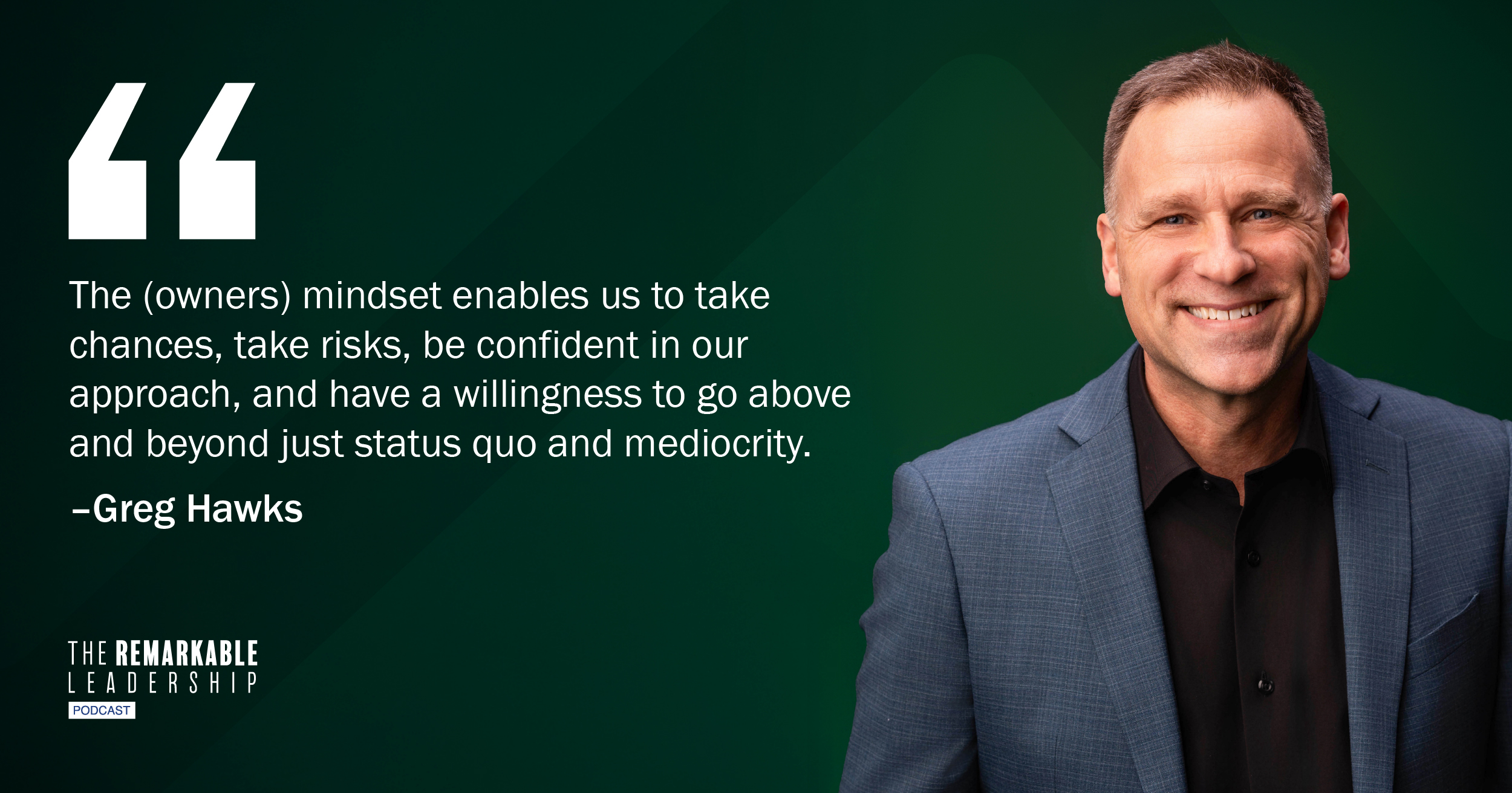
And so the mindset enables us to take chances, take risks, be confident in our approach, and have a willingness to go above and beyond just status quo and mediocrity.
00:04:31:08 - 00:04:51:15
Kevin Eikenberry
So the I often will say on the show that there's usually at least one thing in every book that I read. It's certainly every book I read in preparation for the show that it will be the thing that I won't forget, that I won't, you know that I won't. And yeah, there's a couple things here, and one of them is comes right up beginning.
00:04:51:17 - 00:04:59:22
Kevin Eikenberry
You talked about an owner. You have a a background of owning, investment. How houses originally.
00:05:00:00 - 00:05:00:16
Greg Hawks
Home.
00:05:00:18 - 00:05:20:06
Kevin Eikenberry
Yeah. And you can't even talk about. You talk about that in here. And so from that comes the metaphor, if you will. You say that there are really three kinds of people. You're the mindset that you rent but also in life. So yes you are there and, and in my life I've often talked about two of the three but not the third.
00:05:20:08 - 00:05:47:12
Kevin Eikenberry
And really, really I mean, not not in this way, like you are. So let's talk about those three, because I think that as in fact, before you say those three, for those of you that are listening, I just want you to listen to Greg's description of these three mindsets, behavior sets of people, and think of the people that you work with that maybe you say, hey, I already see, people in these spots.
00:05:47:12 - 00:05:56:14
Kevin Eikenberry
I don't want us to label people at the same time. I think it'll be helpful for you. So, Greg, with that long introduction, what are the three types of behaviors that I love?
00:05:56:14 - 00:06:20:10
Greg Hawks
That phrase behavior says instead of mindsets. I guess it's that combination. Well, there are owners and there are renters and there are vandals, Kevin. That's what they are in the workplace. And you are correct, people, when I start using that, they immediately start mentally associating the terminology with people in their organizations. Of course, my shorthand description of it is that owners bring their heart, head and hands.
00:06:20:11 - 00:06:36:14
Greg Hawks
There are people who show up with the skills and gifts and talents they have, but they also have curiosity, imagination. They bring passion and care, and people who show up with a renter's mindset, which statistically is every other person in the workforce. They show up with their skills, they do a good job. They show up to work on time.
00:06:36:19 - 00:07:02:04
Greg Hawks
They get what's done, what's needed. But they have they have decided it's not worth caring. It's not worth investing their imagination. They're not using creativity to go outside of the realms of solving. They're just like, I'm just doing my thing. And then, of course, vandals, they bring destruction. They bring divisiveness, they bring strife, they bring the toxicity that people like to talk about in a workplace because of a variety of reasons.
00:07:02:04 - 00:07:21:04
Greg Hawks
But they are they are there and an undercurrent of what's diminishing. And really, the what I will say is the reason why more people are renters and not, bring an owners mindset is has more to do with the vandals, freedom than any other thing.
00:07:21:05 - 00:07:26:16
Kevin Eikenberry
Okay, so so say say more about that. What you just said. I think that is worth us diving into it.
00:07:26:16 - 00:07:57:05
Greg Hawks
Totally. And it's I mean, you're a reader, so I suspect you've already had you've done Malcolm's the 25 year that the revenge, the tipping point. Right. The Gladwell philosophy on those little things and and what people get really excited about in work is like, how do we get these disengaged people engaged? So they focus on this big part, whereas Gallup also has this actively disengaged, which correlates with my owners, renters, vandals, and they put all this energy on, like, what do we need to do for the get the disengaged engaged in like Gladwell talks about?
00:07:57:05 - 00:08:23:22
Greg Hawks
The reality is when you mess with the percentages at another place, it tips over to create a whole landslide in an area corollary, you know, corollary or peripheral to it. And so my philosophy is target the activities to the vandals, reduce that number. And you can see it in Gallup's 25 year study when they did when vandals are reduced, owners go up and the renters stay the same.
00:08:23:22 - 00:08:40:01
Greg Hawks
That's what's shocking about it, because what happens is you reduce those that are actively disengaged and those that are disengaged, go, hey, look, they're not putting up with that. They're not tolerating that. We're not letting those kind of toxic people. So I'm going to give myself and invest back in. And so it has that kind of impact in an organization.
00:08:40:01 - 00:08:46:17
Greg Hawks
And so that's the that's the shift in the twist I think most people miss on getting the disengaged engaged.
00:08:46:19 - 00:09:01:07
Kevin Eikenberry
So vandals can do one of two things. And then expanding on what you've just said a little bit, I think, they can either be, if we think about them sort of in a higher in a hierarchy. We got that. We got the owners at the top and the renters in the middle and the vandals at the bottom, if you will.
00:09:01:09 - 00:09:26:19
Kevin Eikenberry
If we first of all, we can remove vandals. And if we remove vandals, well, that's that's good all the way around. But let's just talk about people that we help we help make a shift. Right. So if we help a vandal, sometimes if we get people to to no longer be actively disengaged, sometimes they become the passionate ones, like they jump to the top right and and sometimes they not, not often, but when they do.
00:09:26:21 - 00:09:49:23
Kevin Eikenberry
Here's the thing I want to say about this. Here's the example I want to use. Almost all of us have an experience of having a bad customer service experience that turned around correctly, made us a passionate fan of the company. And so there are opportunities there. I don't think that's what we should be shooting for. I think we should just try to shoot in to move them up so they're no longer a negative weight in the organization.
00:09:49:23 - 00:09:51:17
Kevin Eikenberry
But yeah, we have to recognize that can't happen.
00:09:51:19 - 00:10:11:20
Greg Hawks
My philosophy is and again, my experience in owning property and in the workplace, once a person gets to this vandal level, I'm like, let's arrest and evict those suckers. Let's just get them out the house because they're going to cause more damage. And they've broken trust to a point where it's just like, it's not it's not worth it.
00:10:11:22 - 00:10:29:16
Greg Hawks
And, you know, as you read in the book there, there really are four I found it's not deep research, but I've found for reasons vandals live in a home at work because literally we're owning visible properties. You're like, why would I let a vandal live in my house at all? Why would you put up with that? And you know, my my quick for.
00:10:29:16 - 00:10:49:12
Greg Hawks
Are there revenue generators? They've been there a long time. There's a nepotism element and either or they're the owner or leader of the company. Right. That's the very brief version of it. They find more, but because they are producers, that's the reason people tolerate that kind of behavior. If they weren't generating something for the organization, they'd be like, we'll get you out of here.
00:10:49:12 - 00:11:06:02
Greg Hawks
You're just you're, you know, negative on all around. But they produce in a way that then makes it difficult because leadership, that's what I love about talking about leadership. There is a lot of friction and tension on hey, these we keep hearing you complain about this person and they they're toxic individual and they're not a team player and they don't care.
00:11:06:08 - 00:11:26:19
Greg Hawks
But also they're producing high levels. They've got clients that they've nurtured over the course of time, and they're big providers for organization, or they've been here for decades and they have a heritage and a legacy. And so it's really awkward to do something about it. And so there's a lot of tension. So it's not easy I say arrest evict vandals.
00:11:27:00 - 00:11:41:08
Greg Hawks
That's not easy at all because they're usually providing something significant that then creates that difficult. If they were just a pain in the, you know, then I'll leave or just be like, you're gone. But that's not the that's not the reality at all. For vandals.
00:11:41:10 - 00:12:08:08
Kevin Eikenberry
Yeah. The, the one thing that I would say and you know, you can respond to this, as you wish. Is that the only challenge that I have when we label people as owners, rentals and renters and vandals is that once we've decided that we we're part of the problem, right? So, so that's why I'm like, man, I there is a point where we have to we have to cut bait on the vandals.
00:12:08:13 - 00:12:30:23
Kevin Eikenberry
Yeah. As hard as it is as you just described, which I completely agree with 100%. And there's absolutely a time when you do that. And I think as leaders, we have to and as organizations like I've seen organizations that they they get rid of people as vandals before they even really know that they really are. Yeah. And so and there are many leaders that wait way too long, which is really the crux of your.
00:12:31:01 - 00:12:34:22
Greg Hawks
That loss aversion. We we're afraid of like, should I.
00:12:35:00 - 00:12:56:18
Kevin Eikenberry
Well, but it's also like, you know, do we believe in people's ability to change behavior. Right. And so we so there's a tension there. I just want to acknowledge that, that as I read, although I agree with everything you said, that tension is there because I'm a very I'm very careful about the difference between behavior and people. Yeah.
00:12:56:18 - 00:13:03:00
Kevin Eikenberry
And what we label them as people. And if once we've done that, it's over.
00:13:03:02 - 00:13:28:22
Greg Hawks
The challenge I find, Kevin, is that most leaders aren't collect self-aware enough organizationally, not individually, that the harm or the or that the environment the organization has created, that in the people. It's not that the people came in bad spirited with a with a desire to be toxic person. Nobody comes into that. So they come into this environment and then they go, oh, there's a competition internally that's been set up.
00:13:28:22 - 00:13:45:14
Greg Hawks
Or oh, the way they evaluate and measure things here requires me to be very self centered and very focused on just my numbers and my results, what I'm doing. And so what leaders, when they look at people, they think that, you know, with when I talk about renters, I'm like, listen, they come in day one as an owner.
00:13:45:19 - 00:14:05:14
Greg Hawks
But then the perversity of an organization, they learn to be renters because of the culture of the place, not the person. So I fully agree, don't label people, but recognize these mindsets and take responsibility as leadership on this are environment produce renters. And that happens way more than not.
00:14:05:19 - 00:14:16:02
Kevin Eikenberry
So so let's talk about that for a second. How are we unwittingly, certainly unintentionally, creating renters.
00:14:16:03 - 00:14:35:20
Greg Hawks
So some of the ways, you know, one of the ways one of you'll one of the biggest ways is, the first place I should say is, diminishing contribution. The people love to contribute. Where they contribute, they buy in. Right. We use that language, Kevin, all time. We need you to buy in. We need you to own your all.
00:14:35:23 - 00:14:55:00
Greg Hawks
We need you to own this vision in this goal. And yet then ownership comes also from contribution. If I get to have a say in it or I can have a voice in it, I get to be listened to, then I have an obligation internally to go. I was a part of this strategy, this idea, this approach, this product, this service.
00:14:55:04 - 00:15:13:18
Greg Hawks
I'm certainly going to be all in. And and the reality is most, most contribution. I'll say when I'm speaking, you know, we mostly have bad ideas. We think they're good because they're ours, but we mostly have bad ideas. And to have a good or great idea, it takes a lot of other voices, perspectives, people to contribute to it.
00:15:13:20 - 00:15:47:19
Greg Hawks
And so having smart leadership and this is so I love your podcast about leadership because smart leadership learns the balance of how do I invite people to contribute thoughts and ideas and also balance it with most of the answers? No. Most time the answers. We don't have the manpower, the resources, the money for it. But how do I create this environment where there's people that like I, I love the opportunity to contribute and know that if I land on something or spark something, it will grab some legs and will run with it, and otherwise we'll just put it on the shelf, put it in the idea box.
00:15:48:00 - 00:15:52:23
Greg Hawks
But at least it's a space that says we value your thoughts and opinions.
00:15:53:01 - 00:16:11:22
Kevin Eikenberry
So there's a as you hinted earlier, and if you had already read the book, you said all five of them sort of very quickly. They're five keys. It's a subtitle book that unlocks to create a culture that people love and results leaders need, meaning the ownership culture, if you will. And we don't have time to go into all five.
00:16:12:01 - 00:16:32:14
Kevin Eikenberry
But we need to talk about I think we need to talk about the third one, which is reach pro responsibility. Because if people don't have that figured out, yeah, you can't you can't get from to there. You can't get to ownership. And people aren't don't see that world that way personally. So let's talk about what you mean by reach for responsibility.
00:16:32:17 - 00:16:50:07
Greg Hawks
So interesting. That's the one you center. Because I believe that's when most people associate with like this is what it looks like to own it. And you know, when I'm, when I'm speaking, just to step back a second, I'll just put up pictures of two different families. In front of a house, and I'll have the audience guests speculate.
00:16:50:08 - 00:17:06:23
Greg Hawks
It's like, which one? He thinks the owner, which he thinks renter. And without fail, one will say because of what the yard looks like on that one, they're the they're the renter. And what someone will say what the yard looks like on that one. They're the renter, you know, it's limited. They'll take the exact same information and have exactly the opposite.
00:17:07:01 - 00:17:07:11
Kevin Eikenberry
Yes.
00:17:07:13 - 00:17:28:07
Greg Hawks
I guess of what it is, in the sense we will use the same data. And so in work we do that also like when people say this is what it looks like to buy in or we need you to own it, then how a person interprets that to be entirely different. So this idea of reaching for responsibility, you know, is central to not being in some of our corporate speak, it's I'm not limited to my job description.
00:17:28:09 - 00:17:47:23
Greg Hawks
The and I'm not I'm not just a 9 to 5 or I'm willing to go above and beyond, but again, I put the onus on leadership because I believe people do want to give their best on a day to day basis because it's most fulfilling for them. And yet, what leadership has failed to do is recognize what the return is on the investment.
00:17:47:23 - 00:18:05:13
Greg Hawks
So some of the language also used is like, are you investing your life at work? Or you spending your life at work? Because as investors we go, oh, what is my return? What am I getting back from this? And every single one of us want to return, even if we're at the top levels of leadership, we're doing it for a reason.
00:18:05:18 - 00:18:26:18
Greg Hawks
And you have a little acronym E frog that is that is my editor was like, are you sure you want to use that? Like, you know, it's easy for me to remember. So that's the that's the most important. And it's the emotional, financial, relational opportunities and growth. And so a lot of us as humans, we're way more motivated by things than just money.
00:18:26:20 - 00:18:45:16
Greg Hawks
Some people. So this idea of reaching for responsibility, as you know, Kevin, and being in leadership for years, there are people who have a sense of themselves. It's like I'm a go to person. If there's if something goes wrong, I want to be the person you call because I like seeing myself that way. I like being someone who is if it's not even in my department.
00:18:45:16 - 00:19:07:10
Greg Hawks
But there's an issue and you're like, this guy always gets it done. This, this lady, she always figures a way out when there's an emotional hit with people. Some people that are like, I like being seen that way. I like living in that. And I like what that produces in me as a person. And so I get a I get a big return on being because most people are like, who wants to do more than their job?
00:19:07:12 - 00:19:29:11
Greg Hawks
A lot of people there are a lot of people who are looking for opportunities. You know, you've got Gen Zers. Some of them are like, I just want I'll do more just for the opportunity to be in the room with somebody. I wouldn't normally be in the room with, be on a project I wouldn't normally be in a project with, and so I want to reach for that with no financial benefit at all, but with the idea like, hey, there's a future in that.
00:19:29:11 - 00:19:47:14
Greg Hawks
And some of us, Kevin, that have been around a while, we also just like growing. We're like, I'm a I'm a lifelong learner. I want to be exposed to things that are hard and difficult because I will grow. I know I have to have external things that stretch me, and so put me in a position or put me in a place that I'm that's tasking that of me because I don't want to get lazy.
00:19:47:14 - 00:20:08:20
Greg Hawks
I don't want to drift into mediocrity. I want to keep being stretched beyond what I am. And growth is a high value proposition for me, even though others are like, why do you why do you, why do you do more than you're being asked? Well, it's very easy. I'm reaching for that responsibility because that's what I believe keeps me fulfilled and keeps me filled up and keeps me motivated as a human.
00:20:08:20 - 00:20:25:17
Greg Hawks
And so as leaders. Knowing that about the people you lead then enables you to ask them to make sacrifices. Because we live in a world where it's like, well, who wants to do that? A lot of people want to go above and beyond when it when they get the return that they that really satisfies them.
00:20:25:19 - 00:21:04:02
Kevin Eikenberry
I would even say, and I don't have I have observational data, not research data to back up what I'm about to say that in a world of in a post-Covid world, if you want to call it that, where people are working more apart, they actually want that more that need that we have that, that to, to, to make a difference, to be a part of something bigger than ourselves to, to, to add value in meaningful ways, to feel like I'm doing something that makes a difference is an even.
00:21:04:03 - 00:21:13:12
Kevin Eikenberry
It's not a bigger, it's not a bigger need than it was before. But other situations that we used to be in, in the workplace made it easier to see that than we can see it now.
00:21:13:12 - 00:21:37:03
Greg Hawks
Yeah yeah yeah. And just was met. It was met that way. And it's an interesting dynamic because I've got kids that are Gen Z and just young young in their careers. And my son specifically moved to Chicago. So was a new city for him. And he was working in a 100% remote place. And he was like, and the idea that that point was like, oh, Gen Z loves being remote.
00:21:37:03 - 00:21:58:06
Greg Hawks
They got the freedom they do. But he was like, I need to be around people that can help me, that I can watch, maybe even like mentor from afar, you know, and have connections with people. So he literally left a job that was remote. So he went to a job that was three days in the office, because he just want to be around people that would help him learn, grow in his in his career.
00:21:58:06 - 00:22:15:04
Greg Hawks
And as a young person, you know, you're like, that's a you know, I'm like, that's a good move. That's great to get around and do that. And so having a ownership culture that recognizes the things that come from that we get the young leaders get from that, it's really, really important.
00:22:15:06 - 00:22:32:08
Kevin Eikenberry
I have I read that story in the book. And the reality is that my daughter is in exactly the same spot. She lives in Chicago as well. But she starts a new job in a week from today, as it turns out. Yeah, a week from today. Two weeks. Two weeks from today, maybe. And but.
00:22:32:08 - 00:22:46:14
Kevin Eikenberry
And one of the things is now she's going to have to be in the office four days a week before she really wasn't at all. And I had told her in the past that at some point you need a job, you need to have the experience of doing that from a career perspective. Not that you can't advance.
00:22:46:16 - 00:22:48:08
Greg Hawks
Right from oh no. Yeah, she.
00:22:48:08 - 00:23:05:17
Kevin Eikenberry
Is now super excited for all the reasons, Greg, that you just described. Yeah. There are five keys. We talked a little bit about one. We don't have time to talk about all of that, but one other one that I want to talk about. And it's because so many people talk so much about silos at work.
00:23:05:21 - 00:23:06:07
Greg Hawks
00:23:06:12 - 00:23:26:06
Kevin Eikenberry
And, you spend a little time talking about this. And one of the here's the interesting thing about silos to me is that a lot of times I always say to people, if if people are wearing the the accounting t shirt or the marketing t shirt or the Kansas City t shirt rather than the company t shirt, they're working in a silo now.
00:23:26:11 - 00:23:52:03
Kevin Eikenberry
They happen to be excited about and even feel a sense of ownership, but only for Kansas City marketing or accounting, not for the company. So let's talk about that one and how, and you call that, you call that widening the circle, and it's even connected a little bit to your other one called Think Wheelhouse. Yeah. And so let's talk about how we help people as leaders.
00:23:52:05 - 00:23:58:03
Kevin Eikenberry
Right. Move beyond what's actually looks pretty good until you step back and look at the broader picture.
00:23:58:08 - 00:24:24:01
Greg Hawks
Yeah. And and that Kevin is really we talk about one falling on leadership that it's always going to come back to smart leadership, relational leadership. People that have relational equity and have built that in there and they're growing into the position that they're in. But that idea, you know, silos, it's an interesting dynamic because a marketing person, we don't want working in accounting, you know, that is not what we want.
00:24:24:07 - 00:24:47:12
Greg Hawks
We do not want them in that room. So there's like, well, there's a reason they're in the room they're in because they're skilled, they're gifted their experience through education. And so the challenge with the silo is not the renter element, the hands. Right? Not the thing. It's like, this is what we hired you for is your education. It's the heart and head issues that say what keeps people separated when it comes to our business.
00:24:47:12 - 00:25:05:23
Greg Hawks
And that idea of, I'm in I'm we're in the accounting t shirt because, you know, it's accounting. You're like, that's what you hired me to do. Like, that's what I'm able to do. That's what I that's how I provide value to us. Why are you giving me grief about loving my room? You know, it's like, this is it.
00:25:05:23 - 00:25:26:03
Greg Hawks
And so, you know, oftentimes the challenge with the silo is then the contribution that's made. I've got a friend that calls them the gaps that the money's in, the gaps that in between the marketing, the accounting, that gap. If there's not a crossover of communication, understanding, appreciation and validation of what both bring to it and and.
00:25:26:03 - 00:25:27:15
Kevin Eikenberry
Heart more than just hands.
00:25:27:15 - 00:25:44:13
Greg Hawks
Right? Totally. Totally. And that's and that's a leadership I mean, leadership is head and heart. I mean that leadership is the place that says, how do we access these and how do we resource head and heart? And so that idea of how do we strategically connect people in a way that says, we want you killing it in accounting?
00:25:44:13 - 00:26:03:17
Greg Hawks
We we really do want you doing your job well. We want you to understand it in the context so that the value you're bringing is for the whole and not just in this little window you look through every single day, whether it's at home or in the office. And you're you're total scope of our business. Is your.
00:26:03:17 - 00:26:21:19
Kevin Eikenberry
Room. So so for leaders, I want to make two comments. It's really easy to think about this for the for others, but I want to talk to leaders for a second for yourselves. Number one, make sure you're not doing the same thing. Yeah. Make sure you're not living inside of of whichever silo it is that that you were hired.
00:26:21:21 - 00:26:43:13
Kevin Eikenberry
And what's the first word on your job title? Make sure you're not doing that. Number one. And number two, don't assume the assumption is the assumption we make is I see the whole thing. So everyone else must see it. I promise you they don't. They can't. We have to help elevate their line of sight, elevate their perspective. Once they see it, they can't unsee it.
00:26:43:15 - 00:26:48:21
Kevin Eikenberry
But until they can see it, they've got no chance. We can't assume they see what you see.
00:26:48:23 - 00:27:12:16
Greg Hawks
It's so interesting you say that, Kevin, because, you know, sometimes leaders are like, I see the whole thing. So they don't need to. They just need to focus on their little room and they just need to trust me and I'll see it all. And so instead of them, the people that they're leading in a partnership ship of ideas, of understanding the whole, they're just they're being micromanaged, if you will, and tasks because it's like the leaders, like, I got the big picture.
00:27:12:16 - 00:27:21:11
Greg Hawks
You guys just trust me. Just do what I ask you to do. Just stay in your room. Where is their ability to contribute significantly is to have a greater perspective.
00:27:21:13 - 00:27:46:23
Kevin Eikenberry
And there's and the core underlying mindset of that is actually often not always meant to be helpful, but the unintended ripples are so unhelpful as to be a problem. Right. So I want to grant everyone who's listening some grace there. If you're hearing this, but we have to help get past it, because if we can't, we can't ultimately be successful.
00:27:47:01 - 00:28:03:13
Kevin Eikenberry
Is there any other one thing, Greg, that you would say thinking about this organizationally, is there is there a specific organizational point that you'd like to make based on what we said or maybe based on something I haven't said before we start to wrap up?
00:28:03:15 - 00:28:26:02
Greg Hawks
I think it is the the leaders best task is creating the environment, shaping the space, because we can talk about all the hand elements and all the details. But if you just create an overall environment that produces people who are empowered and thrilled to buy in you, the details of a lot of it just are taken care of.
00:28:26:02 - 00:28:43:13
Greg Hawks
It is culture shaping that creates an environment for people to thrive in. And so, you know, that's what you know. My hope is with the book that it is it's empowering with the ideas of how to create the entire space. Yes. I love that you have all those notes. I haven't seen that before. I appreciate.
00:28:43:13 - 00:28:49:14
Kevin Eikenberry
It. So, tell me, I mean, we've been talking about your book, but tell me what you're reading these days.
00:28:49:16 - 00:29:14:17
Greg Hawks
I'm reading this book The Right Kind of Wrong. I heard about a couple of years ago. Amy Edmondson and I. You know, it's a failure book about. And she's, so smart. And the idea. And honestly, I'm just at the beginning of it, it was. But it she's referencing a story about when they just were starting to learn how to do open heart surgeries and the, the machinery that they had and the kids that they were in the failure.
00:29:14:17 - 00:29:29:19
Greg Hawks
And like, kids are people are dying like it's literal life and death and it feels like startling to read, you know? And the point is, you know, here we are decades later and like, you know, open heart surgery on all the tools that can let the heart keep doing in the lungs. Like we don't even think about it.
00:29:30:01 - 00:29:56:04
Greg Hawks
But literally people lost their lives in the experiments. It was life or death anyhow. But you go, okay, so I think about my level of failure. It doesn't have that kind of consequence. And what am I learning from the little failures that I have? So I'm just in the front three chapters of it. But I, you know, because the conversation around failure always really interesting because people love talking about it, but they don't love doing it.
00:29:56:06 - 00:30:01:05
Kevin Eikenberry
Oh, yeah. How do you learn? But learn? We learn from failure. But I don't want to fail. Like, don't talk any about that.
00:30:01:09 - 00:30:14:10
Greg Hawks
And nobody is. And nobody genuinely is like, man, I really appreciate you wasting our time and our money and that we lost that business with the client. Thank you so much for failing like that within our company. Thank you. That's not a response people get.
00:30:14:12 - 00:30:22:15
Kevin Eikenberry
We'll have a link to Amy's book in The Good you know. We'll have a link to Greg's book in the show. It's a great work. And what do you want to point people if they want to connect with you? Learn more.
00:30:22:15 - 00:30:41:00
Greg Hawks
LinkedIn. Where do you wanna point them? This LinkedIn is the place Greg Hawk's dot com. The book is on there. Act like an owner Bbc.com they're all point to the kind of the same area. Yeah. And so I think, that's that's it. And I love LinkedIn. So I'm glad we're here on this LinkedIn live because, as the podcast is being recorded.
00:30:41:04 - 00:30:54:17
Kevin Eikenberry
Yeah, absolutely. So that's a reminder. If you came in late, I said at the beginning, if you want to get information like this sooner, in this case, like two and a half months, you're listening to the podcast, if you're listening, if you're watching us.
00:30:54:19 - 00:30:55:13
Greg Hawks
It's happening that you're.
00:30:55:13 - 00:31:14:19
Kevin Eikenberry
All good. If you're listening to us, if you connect with me. Remarkable podcast.com. Excuse me Kevin I can yes. Remarkable podcast.com/linkedin or just make sure you're following me. Make sure you connect with Greg and I both. And you can get this kind of information sooner. Greg, before we go, I have a question for everyone other than you.
00:31:15:01 - 00:31:37:22
Kevin Eikenberry
Okay. If the question I ask people every single week, I guess kind of in absentia, and that is. Now what? What are you going to do as a result of being here? Because you've been here for 30 ish minutes and you may have found us mildly entertaining, which I think I probably both hope, but ultimately that's not why we were here.
00:31:38:00 - 00:31:54:03
Kevin Eikenberry
Right? You can find you can find a podcast is probably more entertaining, but what you may not find is an app. Is it a podcast? It can give you more practical advice if you take it. Because you may have I hey, I thought of this. I thought this was are all good things, but none of it matters if you don't take action.
00:31:54:03 - 00:32:07:05
Kevin Eikenberry
So it's our hope that you will act on something that you got here, because that's an ownership mentality that says, hey, there's something I can do, so I'm going to go do it. And so I hope that you will do exactly that. Greg, thanks for being here.
00:32:07:07 - 00:32:09:04
Greg Hawks
Totally. My pleasure. Thank you so much.
00:32:09:06 - 00:32:28:22
Kevin Eikenberry
And so, everybody, that also means one more thing. That means if you were here today and you found it valuable, you got to come back and it's very easy to come back. You can connect with me on LinkedIn because I'm here on a regular basis. But you can also make sure you subscribe wherever you're watching or listening so you don't miss any future episodes of the Remarkable Leadership Podcast.
00:32:28:23 - 00:32:29:13
Kevin Eikenberry
Thanks, everybody.
Meet Greg

Greg's Story: Greg Hawks is the author of Act Like an Owner: Five Unlocks for Creating Culture People Love and Results Leaders Need. He is a keynote speaker and corporate culture specialist who challenges leaders and teams to Act Like an Owner. For more than 25 years, he has partnered with organizations across the country to reshape culture, deepen trust, and activate ownership mindsets. Earlier in his career, Greg spent a decade as Executive Director of a nonprofit, leading teams through complex challenges and building environments where people contributed their best. That experience became the foundation for his work with companies of every size, from ESOPs and credit unions to Fortune 500 corporations and national associations. Known for his energetic presence, distinctive language, and practical strategies, Greg equips executives and employees alike to re-engage, increase accountability, and spark growth.
Follow The Remarkable Leadership Podcast


Looking to Develop Stronger Leaders?
Want help developing the leaders in your organization? Reach out to explore how the Kevin Eikenberry Group can support your team.
Book Recommendations
Like this?
Join Our Community
If you want to view our live podcast episodes, hear about new releases, or chat with others who enjoy this podcast join one of our communities below.
Leave a Review
If you liked this conversation, we'd be thrilled if you'd let others know by leaving a review on Apple Podcasts. Here's a quick guide for posting a review.
