How can leaders use data to make better decisions and drive real change? In this episode, Kevin talks with Sebastian Wernicke about why so many organizations invest heavily in data and AI yet still struggle to achieve breakthrough results. Sebastian explains the difference between being data-driven, data-frustrated, and data-inspired. He believes that data should not only confirm and optimize what organizations already do but also challenge assumptions, reveal unexpected possibilities, and inspire new directions. They explore common myths about data, including the belief that it is always objective, that deeper analysis will automatically reveal the right answer, and that complex decisions can be reduced to a simple yes or no. Sebastian also shares why leaders must balance depth with decisiveness and become more comfortable with uncertainty and probability. They also discuss the opportunities and risks of AI, particularly its tendency to fill in gaps and generate appealing answers based on hidden assumptions
Listen For
0:00 Introduction — why "data driven" isn't the whole story
1:55 Meet Sebastian Wernicke & his book, Data Inspired
3:13 Why Sebastian wrote the book
6:02 Data driven vs. data frustrated vs. data inspired
10:33 The 3 myths about data — setting the stage
11:48 Myth #1: Data isn't objective truth
13:18 Myth #2: The three TV shows example
17:15 Myth #3: Data won't give you a clean yes-or-no
18:37 Embracing complexity (and getting comfortable with discomfort)
20:04 Why this is really a culture problem, not a tech problem
23:08 Balancing depth and decisiveness in decision-making
26:09 Machine learning vs. today's AI — what's actually different
30:29 Resisting the "AI will make it easy" temptation
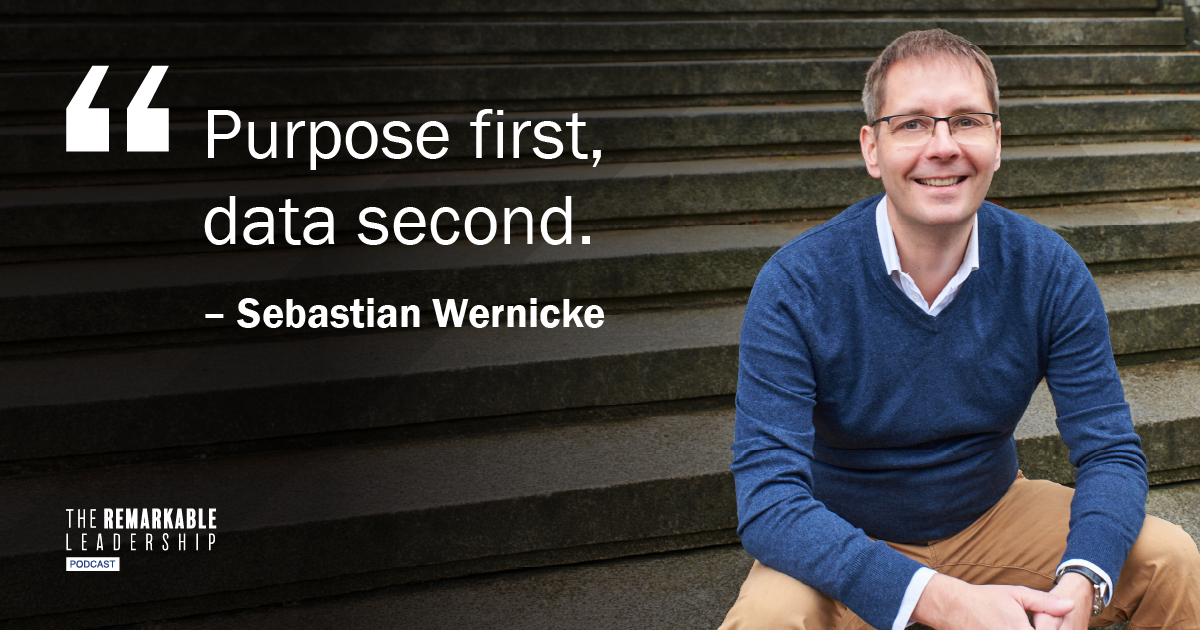
32:09 Purpose first, data second
34:14 What Sebastian's reading & where to find him
36:19 Closing: what are you going to do about it?
00:00:08:12 - 00:00:40:17
Kevin Eikenberry
We are awash in data and everyone seems to want to make data driven decisions, but that's harder than we think. Now, this isn't a conversation for data scientists, although I'm talking to one of those in a minute. It is a conversation for us as leaders, and it has implications for our entire organizations. Today, we are talking about data, but also, and perhaps more importantly, how to create a culture of inquiry that allows us to use data far more effectively regardless of where we sit in the organization.
00:00:40:23 - 00:01:05:21
Kevin Eikenberry
Welcome to another episode of the Remarkable Leadership Podcast, where we are helping organizations and their leaders grow and lead more effectively and make a bigger, positive difference across their teams, communities, and the world. If you are listening to this podcast, you could join us in the future for live episodes on your favorite social channel to find out when those are happening, so you can join us and get this information sooner.
00:01:05:23 - 00:01:32:22
Kevin Eikenberry
You can go to either our Facebook or LinkedIn groups, two of the places where these are simulcast and just go to remarkable podcast.com/facebook or remarkable podcast.com/linkedin. Do that and you'll be in the know. And speaking of being in the know, one more thing before I introduce my guest. If you want to get more from this episode and any other podcast you listen to, just go and download my short Practical Action guide.
00:01:33:04 - 00:01:55:20
Kevin Eikenberry
Just go to Kevin eikenberry.com/get more so you can get more from podcasts. And heck, if you're listening to this, you can pause and go get that before we start. But we're going to start and I'm going to bring on my guest and introduce him to you. His name is Sebastian Vinicky. And how did I do? Sebastian do. Okay.
00:01:55:22 - 00:02:19:20
Kevin Eikenberry
Tastic. He is a partner in the Axiata Consulting, one of Europe's oldest, economics and finance consultancies, where he leads the data science and I practice. He's a leading expert in data and AI strategy and a former chief data scientist. I told you all that. For two decades, he has guided organizations around the world to achieve breakthrough transformation through the power of data.
00:02:20:01 - 00:02:40:07
Kevin Eikenberry
His ability to make complex topics around data accessible, engaging, and actionable has made him a sought after speaker and workshop facilitator. He has three Ted talks that have reached over 5 million viewers. Sebastian, I don't think we'll get to 5 million on the podcast, but if we do, we'll both be happy.
00:02:40:09 - 00:02:42:02
Sebastian Wernicke
Aim high. Yeah, exactly.
00:02:42:04 - 00:02:48:08
Kevin Eikenberry
Hi. Absolutely. Thanks. Thanks so much for being here. And am I right? Today we are on different continents.
00:02:48:10 - 00:02:55:07
Sebastian Wernicke
Actually, I'm in Cambridge, but not the UK one. The US one, so we're not. We we made it on the same continent. Yeah.
00:02:55:07 - 00:03:13:17
Kevin Eikenberry
All right. We're on the same kind of. I'm super glad you're here. We're going to talk about your book Data Inspired, which I just noticed didn't make the intro. Normally, if it's not there, I add it. But we're going to talk about Sebastian's book data Inspired building an Organizational Culture of Inquiry for Lasting Transformation. And so let's just start right there.
00:03:13:22 - 00:03:17:13
Kevin Eikenberry
And why don't you tell me why the book.
00:03:17:15 - 00:03:28:00
Sebastian Wernicke
Yeah, that's always a great question because, I mean, writing a book is hard. And even in these days there's of the question, why would you even do that? An especially physical book. What's that all about?
00:03:28:02 - 00:03:29:21
Kevin Eikenberry
And I love the books.
00:03:29:23 - 00:03:59:22
Sebastian Wernicke
I know, I know, I'm the same, but but still, you get that question. Right? And so, I mean, the book came came to life because over 20 years, as you just mentioned, Iceland working in data and what I notice is that most data initiatives that my clients were working on, they weren't outright failing, but they were doing something in a way even worse to the organizations because they were entrenching the way that the organization works.
00:03:59:22 - 00:04:19:21
Sebastian Wernicke
So they made everybody very good at staying the same. And then a year or two years after they implemented their data projects, the pilots, they looked back and they said, Yeah, it's kind of good. You know, we we produce something, but we were hoping for breaks.
00:04:19:23 - 00:04:35:09
Kevin Eikenberry
Oh, and Sebastian has frozen. Hopefully he's going to get back here, in just a second. They were hoping for breakthroughs. I'm sure. I'm hoping that we'll get him back. Let me see if there's anything I can do on my end to do that. I think you're back.
00:04:35:11 - 00:04:37:19
Sebastian Wernicke
I'm back. Yeah.
00:04:37:21 - 00:04:58:10
Kevin Eikenberry
We will trim that out. For those of you watching live, we will trim that out of the, of the, of the podcast. Go ahead. So, so so to set where we were, you're working with organizations on data project. They're not failing. That's good, because you're working with them, but they're not getting the results they really wanted, and they say at the end, like we thought we were going to get transformation.
00:04:58:10 - 00:04:59:09
Kevin Eikenberry
Breakthrough.
00:04:59:11 - 00:05:30:20
Sebastian Wernicke
Yeah, exactly. We're going to we're going to transform the company. And what we got was a little optimization. And then over time what happens these things accumulate. So you build the dashboards, you built a little process optimization. And over time it just becomes harder and harder even to change. Because what you do with all of these measurements and these these smaller incremental improvements is you have so much entrenched what you're doing right now that it even becomes harder to reach transformational change.
00:05:30:22 - 00:05:52:17
Sebastian Wernicke
And so I was always wondering about what's that all about, because that is not a new topic. This thing I like to call data frustration has been around ever since I've been working in data. You have these big promises. You have these huge hopes for what data can do, and then you're not getting any of that. And that was, in the end, the reason where I said, okay, I need to write a book about what I'm seeing out there.
00:05:52:17 - 00:06:02:01
Sebastian Wernicke
I need to explain what data can and cannot do to an audience and hopefully inspire more transformational progress.
00:06:02:03 - 00:06:18:22
Kevin Eikenberry
So you talk about three things. I just put it up on the screen, the people that are watching. And you said this idea of people being data frustrated, I use the phrase I think I used in the opening, the phrase data driven. And so I want you to sort of talk about these three ideas because they're hooked together, data driven, data frustrated.
00:06:19:00 - 00:06:22:17
Kevin Eikenberry
And then the new idea, data inspired.
00:06:22:19 - 00:06:46:09
Sebastian Wernicke
Yeah, absolutely. So data driven, I think when we're saying that what we're hoping for is that data will have better answers for us. So I think whenever a client of mine says we want to become more data driven, what they really mean is we have a feeling that we're making too many decisions without evidence that we're very gut based in our decision making, and we want to add data to that.
00:06:46:09 - 00:07:08:18
Sebastian Wernicke
And the only reason why you would do that, of course, is if you're hoping for improvement. So in this case, it's better decision making. It's faster decision making. It's more accurate decision making. And that is the data driven mindset that essentially you say ultimately, what I wish for is that data would be helping us make all the decisions around here.
00:07:08:18 - 00:07:14:15
Sebastian Wernicke
Or if you go to an extreme, that data makes all of these decisions on its own. That's that's purely data driven.
00:07:14:17 - 00:07:17:14
Kevin Eikenberry
We may have another conversation about that. We may get there lower.
00:07:17:14 - 00:07:34:20
Sebastian Wernicke
Yeah. Oh yeah. Yeah. Well, and it's also it has its limitations. And I think that notion in many ways also isn't quite correct, because you assume, for instance, that data has all the answers and you assume that, you know, if you just add data to your decision making, it becomes better. So there's a lot of things to unpack there.
00:07:34:20 - 00:07:56:07
Sebastian Wernicke
But that, in a nutshell, is what it would mean to be data driven. Now what happens is because data is quite valuable and there are studies on that. So if you manage to use data, your decision making effectively, you improve on all business metrics. So you become more likely to reach your revenue targets, your profitability targets, your customer satisfaction goes up.
00:07:56:09 - 00:08:23:15
Sebastian Wernicke
All of these things. So it's no wonder that if you ask around 99% of companies, literally 99% of them say, oh yeah, we see data de AI now as a top priority for us. And they've been saying that for years again. But at the same time, while the the topic is super important to them and they're putting behind millions, hundreds of millions or billions, even in investment, they're then not achieving the breakthrough results.
00:08:23:15 - 00:08:48:19
Sebastian Wernicke
And that is what leads to the second word, the data frustration. So you realize it's valuable. I mean, nobody needs to tell you that data is valuable. The whole data is the new zero is the oil. That's the tired metaphor. I mean, everybody knows that. But at the same time, despite everybody knowing it and despite everybody putting these huge investments behind it, they're not getting the results.
00:08:48:19 - 00:09:12:19
Sebastian Wernicke
And so they're frustrated. And then sometimes I also like to say, you know, they're not just data frustrated. They become data cynical over time and be like, oh, we tried it with that data thing didn't work. So, you know, we're just gotta, gotta do it the old way. And now comes in data inspired. And I think the data inspired mindset is about achieving a couple of things.
00:09:12:19 - 00:09:34:12
Sebastian Wernicke
So first of all, it's about saying the purpose of data is not just to optimize what we do today, but actually to look for transformative change. So we want to use data to tell us not just where we are right, or how we can do things a little bit better. We want data also actively to tell us where we are wrong, what are the things that we need to change?
00:09:34:12 - 00:10:09:23
Sebastian Wernicke
How do we create the resilience? How do we make our company futureproof? And if you do that, then of course that means that you use data not just to measure and to ask, you know, how much, how many, but to also paint these scenarios of the future and to use data to say, what if you know, what if we did it this way, where is the customer using our product in a way that's completely unintuitive, and you take these outliers, you take these anomalies and you say, well, that's actually a possibility for us that could paint a picture of where we need to go.
00:10:10:01 - 00:10:31:05
Sebastian Wernicke
And the data inspired is not about getting rid of the data driven, but I think it's a more nuanced understanding of data to say, how do we want to use this? Are we in optimization mode? Are we in transformation mode? And to realize that data can do all of these things, that it can be a tool of optimization, but also of discovery?
00:10:31:05 - 00:10:33:16
Sebastian Wernicke
What's possible?
00:10:33:18 - 00:10:57:13
Kevin Eikenberry
I love that now, I think you've already given us more than enough to chew on. But we're just getting started, and and I want to go back. I told you before we went live that we can have our whole conversation about the first about three chapters of the book, and we're not going to do that. But we could, because to me, the opening part of the book does two things.
00:10:57:15 - 00:11:26:03
Kevin Eikenberry
It sets a foundation. And I'm going to ask you to share a little bit more of that foundation in a second with a couple of questions. But the other thing it does that you've hinted at without saying exactly is, that, at the end of the day, there's still humans in this. And when we think about how we want the humans in this and it's, it's, it's, it's using the data inspired by the data, but not, not blindly relying on the data.
00:11:26:03 - 00:11:48:08
Sebastian Wernicke
Yeah, absolutely. And and I think that's also very important to realize. And that's also what I spend some time in the first chapters on, is to realize that there's a couple of myths, I think, going around when it comes to data, which is, you know, that data would be this ultimate objective truth, that as long as we just look at the data, it will guide us in the right direction.
00:11:48:08 - 00:12:12:16
Sebastian Wernicke
And I think you need to have a much more nuanced understanding of data itself and where the power is, but also where the limitations of data are if you want to get that value out. So the naive assumption data has all the answers that that is clearly wrong. And and we need to move beyond that. Even though it I think it's a very tempting, assumption to make.
00:12:12:19 - 00:12:14:09
Kevin Eikenberry
It's, it's seductive for sure.
00:12:14:14 - 00:12:34:08
Sebastian Wernicke
Right. Yeah. And it's, it's comforting, you know, I mean, if I'm a leader today, I have to dealing with so much complexity, velocity out there, it's uncomfortable. I have to make these difficult decisions every day. And when I say every day, I probably mean, you know, every half hour because you have these 30 minutes plus in your calendar.
00:12:34:12 - 00:12:56:01
Sebastian Wernicke
So it's just very natural to say, isn't there something that can help me with all of that hard decision making? Because decision making is hard. It takes energy, and data is so seductive because it promises to be that solution oftentimes, and to say, okay, you won't have to make these difficult decisions anymore. You'll just have to look at the data out pops the answer, and we're good to go.
00:12:56:01 - 00:13:04:00
Sebastian Wernicke
And by the way, if we're wrong, we can always point at the data and say, well, but but it was there. And so I get the seduction 100%.
00:13:04:02 - 00:13:18:12
Kevin Eikenberry
That's one of the myths. You talk about two other myths about data that I think we need to understand as well. The first one is a huge one. But what are the other things floating out there that people take as trade, which aren't?
00:13:18:14 - 00:13:40:01
Sebastian Wernicke
So once we've unpacked that data, might not be this objective truth that you're looking for, that there's a lot of decision making going into creating data in the first place. Then there's that that second aspect where you say, okay, let's assume we understand that, but then surely when we have the data all laid out, when we have the complete analysis in front of us, then we'll know what to do.
00:13:40:01 - 00:13:54:21
Sebastian Wernicke
Yeah. So so all we need to do is to dive into the data deeply enough. And I constructed this example for the book, which is not an unrealistic example, where I have three TV shows for you and you have the ratings for them. So I125 stars rating.
00:13:54:23 - 00:13:57:13
Kevin Eikenberry
I love this example. I almost brought it up myself.
00:13:57:13 - 00:14:26:23
Sebastian Wernicke
So going and you choice is your task is to choose the best show and everybody that looks at that will choose one show where they say that is obviously the best. Yeah. So they go for the one with the sci fi Alia the the action one, the the fantasy one. The thing is so that people will go to different shows and give me different reasons for why they think that data is telling us that this is the best show.
00:14:26:23 - 00:14:47:00
Sebastian Wernicke
And so in fact, you can make a perfectly valid argument for each one of these. So one of them has the best average rating the but it only has very few reviews. And so people might say I you know, I'm not I don't want to rely on that. Right. So I'll outlier take that away then another show has almost as good a rating.
00:14:47:01 - 00:15:05:09
Sebastian Wernicke
And then when you dive a bit deeper into the data. It turns out, though, that the third show has the most four and five star ratings as a percentage. So if you're all about I don't go by averages, I don't want to disappoint my audience. I want to give them something that they actually will love or has the highest likelihood of being loved.
00:15:05:09 - 00:15:26:01
Sebastian Wernicke
Maybe if you want to put it that way, and it's the third show. And so it's not really just about looking at the data and the data will immediately tell you what's the best show. It's about having a discussion and realizing maybe if you are a streaming service, even from a strategic perspective, what does best even mean for us?
00:15:26:03 - 00:15:46:13
Sebastian Wernicke
Does best mean the best average? Does best mean we don't disappoint the viewers? What? What is that for us? And without adding that discussion into the mix for which there is no data, that's going to be a subjective, strategic discussion. Data won't help you once you've done it, you you have very useful evidence to go on. And so that be fantastic.
00:15:46:18 - 00:16:03:11
Sebastian Wernicke
But you need to do the first part as well. And you need to define your notion of, of what it means, you know, to, to to to be the best or and you can transfer that to other examples of course, as well. Right. When you say, for example, we're a customer centric company, well what does that actually mean?
00:16:03:11 - 00:16:17:18
Sebastian Wernicke
You know, are you fast? Are you reactive? Are you cheap? And unless unless you have these discussions, data won't help you. And I think that's the second myth to unpack. Data isn't helpful on its own. And then there's a third one, which is.
00:16:17:23 - 00:16:34:11
Kevin Eikenberry
The third myth. I just want to comment on that last week. Yeah, literally within the last hour, had a conversation with a member of my team about best. And because she was talking about something she did in AI. Right. And she said, give me the best here. And I said, well, tell me what you meant by best.
00:16:34:11 - 00:17:01:04
Kevin Eikenberry
And she was giving me shorthand. She did look at well, here's what I mean by message. You told the machine all of that. But if but if she hadn't and just said best, then assumptions are made and and the output is not as valuable. Right. So she did that. That was just she used best in our conversation just as a as a shortcut in the conversation.
00:17:01:06 - 00:17:15:07
Kevin Eikenberry
And I stopped us to go back. And she had done that. She'd done all of I think she had framed it the right way for this sort of small thing that she was looking at. But it's a useful example of that. So third myth. What's the third?
00:17:15:08 - 00:17:38:14
Sebastian Wernicke
Third myth is. Okay, then once once we do look at the data that the data will give us a clear yes or no answer. So let's say we've agreed, you know, that how the data came to be, we've agreed on what best means for us. So then okay, then we get the answer right? Well, and with any complex question, most of the time you're not going to get a simple yes or no answer out of the data.
00:17:38:20 - 00:18:04:18
Sebastian Wernicke
Data fundamentally will lead you to statistics, and statistics will lead you to probabilities. And so if you're hoping that data will tell you, well, this is 100% the right decision to make, you're going to be disappointed right out. And rather, you have to learn to live with probabilities. And you have to learn with answers such as there's a 70% chance of success, which of course for a decision maker is hugely frustrating, right?
00:18:04:18 - 00:18:06:19
Sebastian Wernicke
I mean, 70%, what does that mean?
00:18:07:01 - 00:18:08:09
Kevin Eikenberry
But that's the real world.
00:18:08:09 - 00:18:27:15
Sebastian Wernicke
That's the way I do it or not. Yeah, but the decision maker is looking for comfort, right. And so they're like, should I do it or should I not do it like the 70%? Of course it's helpful if you're in a relaxed mind of state, right. And and and it's helpful if you've already decided that this is the way you're going to look at data.
00:18:27:15 - 00:18:37:14
Sebastian Wernicke
But if you approach data by just saying, I want the answers, then you're going to be disappointed and frustrated by that answer I 70% it's a gamble.
00:18:37:16 - 00:19:05:00
Kevin Eikenberry
Which is what life is. So you you have a whole chapter, you have a whole chapter about embracing complexity. And and this is this is interesting to me for lots of reasons, because we are, as you said earlier, in a complex world, and it relates to a, to my last book, Flexible Leadership, which, which talks about how much of the time we are actually leading in situations that are complex, not just complicated and not and certainly not clear.
00:19:05:02 - 00:19:17:03
Kevin Eikenberry
Like all of this stuff about your myths, if the world is clear and it's 40 years ago and best practices reign supreme, then those myths, while still true, were less important than they are today.
00:19:17:05 - 00:19:32:16
Sebastian Wernicke
If the world were a petri dish, right, and we could do all of our experiments, of course, here. But we only get to make that decision in the complex situation once there is no precedent, there is no experimental data to go on, and we have to live with that, just like you say. Yeah.
00:19:32:18 - 00:20:04:15
Kevin Eikenberry
So so talk more about because ultimately, as I said in the open, we're talking about data and the book is about data, but ultimately this book is about organizational culture, and it's about how we how we organizationally think about and use data. But in interwoven with that is how we use and think about complexity. And you're saying when you do embrace complexity, which sort of goes opposite of your whole comfort, right.
00:20:04:16 - 00:20:05:02
Kevin Eikenberry
Well, you.
00:20:05:02 - 00:20:27:03
Sebastian Wernicke
Have to learn to be comfortable with the discomfort there. Yes, absolutely. I mean, the and the surprising thing is, of course, and you just mentioned the word right culture. So why data and culture? Where does this fuzzy topic come in. And the thing is this. So the way I like to unpack that is that I say, well, what's ultimately the purpose of data?
00:20:27:05 - 00:20:54:15
Sebastian Wernicke
The purpose of data is to change and to do things differently, to make different decisions. Because if we make the same decisions with data and without data, it's just a very expensive hobby, right? You're not data driven. Your data decorated essentially. And so what we oftentimes operate on is this assumption that I would call the data deficit theory, you know, which is oh, we just need to add data to our decision making.
00:20:54:15 - 00:21:18:15
Sebastian Wernicke
And then things will become better automatically. And there's decades of psychological research that shows us that it's not the case. Our default state of mind is certainly not when we believe strongly in something and we see contradicting data to say, okay, the data shows. Otherwise I'll change my mind immediately. On the contrary. Right it again, it entrenches us.
00:21:18:15 - 00:21:47:17
Sebastian Wernicke
Yeah. And we dig down and we say, well, I don't believe that data. Somebody must run the numbers again. What's the source? That seems kind of sketchy, right? So we immediately attack the data. And this is where the culture topic comes in. Because if we want data to change minds, if we want data to transform companies, if we want data to transform our decision making, it's not enough to just focus on the technology side and invest in generating more data that we deliver to everybody.
00:21:47:17 - 00:22:15:03
Sebastian Wernicke
You know, there's these slogans like, just get the right data to the right people at the right time, and magic will happen. It doesn't. And so we need to very consciously engineer and design the culture around dealing with data. And what that ultimately means is that we need to think about our decision making culture within an organization. How are we making decisions today and how does that interplay with data?
00:22:15:03 - 00:22:41:06
Sebastian Wernicke
Do we have a culture that when data comes in and tells us we are wrong, that that culture will actually be accepting of that data, you know, is it, for example, possible that the most junior analysts in the room can challenge the senior leader if they have good evidence and be successful with that? Does that happen? And unless we engineer that very deliberately into the culture, it doesn't happen.
00:22:41:06 - 00:22:47:21
Sebastian Wernicke
We fall back into our brain defaults, which are not very friendly when it comes to data.
00:22:47:23 - 00:23:08:10
Kevin Eikenberry
100%. So it goes back to, you know, creating a culture of inquiry, which is how I framed the title of the of the of the episode. In fact, I didn't put the word data in there. And that's what we've been talking about. But you now you've taken us to the word, to the idea of decision making, which is ultimately where all of this is leading.
00:23:08:10 - 00:23:30:21
Kevin Eikenberry
And I want to read something that you wrote, and then have you respond to it. So you said and I thought this was really, really critical. It ties to what you just talking about. The key to using data effectively for decision making lies in finding the right balance between depth and decisiveness. Striving to understand everything in full depth can make it hard to accomplish anything.
00:23:31:01 - 00:23:47:13
Kevin Eikenberry
Conversely, neglecting to understand critical details means you are likely making mistakes. So, depth, and decisiveness. Can you talk about that a little bit more, especially in the context of what you see happening in organizations?
00:23:47:14 - 00:24:14:12
Sebastian Wernicke
Yeah. So the the main point here, I think, is to be very deliberate about that balance. So there's two kinds of decision making that I often see where this goes wrong. So the one is the where there's just too much depth right. So you're trying to add data to everything and you end up in this. Well either you get paralyzed by all the analyzing that you do or also something, you know, the data isn't really the point anymore.
00:24:14:12 - 00:24:38:04
Sebastian Wernicke
You're not you're not looking at the data content anymore. You're just trying to add more data because you somehow hope it will be helpful. So you're drowning in data and the decisions don't become any better. And that of course, then, you know, leads again to data frustration. Now that's that's one extreme. The other extreme is that people will say, well, I have this really fine tuned intuition.
00:24:38:06 - 00:24:56:18
Sebastian Wernicke
My intuition is really great. I'm not sure I really need all that data. You know, I'm supposed to lead here, so that's why you go to your, let's go. And, and and that, of course, also is not the right way to do it. I mean, you need evidence. And also, I mean, it's a bias. I think that's that's quite well known.
00:24:56:20 - 00:25:14:17
Sebastian Wernicke
We all like to think our intuition is great, but unless we're a total expert in something that's just not true, it's just our brains telling us, oh, you're such a good decision maker. It's not true. And so what we need to find out is what is the balance there. So we want to add data to to the decision making for sure.
00:25:14:17 - 00:25:34:22
Sebastian Wernicke
And we want to add as much evidence and as much useful bits and pieces as we can. But at the same time we have to decide, and we have to realize also that we will not be able like I just said, with the data myths, to find the answer in the data. At the end it is the leader, the decision maker that has to say, okay, I've seen the evidence, it's not complete.
00:25:35:00 - 00:25:55:04
Sebastian Wernicke
There are still some gaps. There might be some pointers here and there, but given all the evidence, I would recommend we do A and not B, and that is then still the personal decision. And we need to, I believe, design that balance very deliberately of saying okay this is where this is how far data is going to go.
00:25:55:06 - 00:26:09:03
Sebastian Wernicke
And this is our expectation of leadership in the age of data. And then I think that that balances out quite nicely. You know, you are using the evidence that you have, but you're also moving forward.
00:26:09:05 - 00:26:28:04
Kevin Eikenberry
So we're having this conversation in July of 2026 and marking that for someone who might be listening to this on the podcast sometime in the future, we've gone 27 minutes, and, and we haven't really talked about I, I other than a couple of examples.
00:26:28:06 - 00:26:32:10
Sebastian Wernicke
As soon as you mentioned the data, I thought, oh, this is going to go to.
00:26:32:12 - 00:26:56:17
Kevin Eikenberry
And so people are saying, well, wait a minute, isn't there, aren't they going to talk about AI? I think we have all this data. Isn't that supposed to help us deal with all of this, amount of it and help us sort it and use it? I mean, just give me a minute or two on. How this conversation can be different now than it could have been three years ago.
00:26:56:19 - 00:26:58:05
Sebastian Wernicke
Yeah. Oh.
00:26:58:07 - 00:27:02:04
Kevin Eikenberry
It or it, it. I'll, I'll leave that to you.
00:27:02:06 - 00:27:22:12
Sebastian Wernicke
So so I'm very deliberate in the book about differentiating between two things. One I call machine learning. The other one I call I like we have today. And I think that is a very important distinction. So machine learning is essentially the pinnacle of a data driven approach, because you say I am going to let data make the decisions.
00:27:22:12 - 00:27:48:13
Sebastian Wernicke
So what happens in machine learning is you take a large data set, you try to formulate a very clear goal, and then you point a computer at it and you tell it given the data, I want you to figure out my goals. So for example, I have 50,000 images of, you know, skin some of which has, something that might develop into cancer, some of which is non problematic.
00:27:48:15 - 00:28:07:08
Sebastian Wernicke
I want you to learn based on the data how to distinguish between the two so that when I, you know, you go to the doctor and you put your camera added, it can tell you is it problematic or not. And much better than a doctor because no doctor will ever be able to see 50,000 different images. And that is classic machine learning.
00:28:07:08 - 00:28:29:06
Sebastian Wernicke
We have data, we have a very clear goal, and you're essentially operating in the space of statistics. So you can also do things like assess how correct is that, what is the error rate. And it's all very well defined. Now along comes AI. So what we used to call gen AI right. So so that but it's not just generative of course.
00:28:29:06 - 00:28:51:13
Sebastian Wernicke
It also helps us process images and text and all of this other data here. We don't have that. The way that AI is trained is not with a clear goal in mind, which also is what makes it so powerful. Right? It's a general purpose tool. Essentially the way that AI is trained is by judging. Do users like the answers that it produces?
00:28:51:13 - 00:29:16:01
Sebastian Wernicke
Yes or no? That's called reinforcement learning, and that's all they do. There is no specific goal in mind. It's just do people like the answer is do people find it useful? And you already, I think, mentioned a very important aspect earlier in the conversation, which is that AI is really great at filling the gaps. So anything that we don't tell AI, it'll just make it up.
00:29:16:01 - 00:29:27:23
Sebastian Wernicke
And by the way, it'll make it up without telling us. Yeah. And that's what makes it all it. Exactly. Unless you're very explicit and you put in this long list that. By the way, here's what I mean. Here's what I don't mean. This is what I want you to do. This is what I don't want you to do.
00:29:28:03 - 00:29:47:02
Sebastian Wernicke
And we've all been there, right? So we need to craft these huge prompts. You can never be quite sure it follows them. But, you know, once you craft them, at least there's high hopes. And that is both a power and the danger of AI when it comes to decision making. It's very powerful because of all the gap filling.
00:29:47:04 - 00:30:06:04
Sebastian Wernicke
It basically means that we don't need to do a lot of things that are very complicated with machine learning, right? So we don't need the huge data set. We don't need the precise goal definition. We will always get an answer out of it. Of course, that's also exactly what makes it so dangerous, because there's all these hidden assumptions.
00:30:06:04 - 00:30:28:22
Sebastian Wernicke
And since AI is trained on always providing an answer that you will like, it will produce it no matter what. It will produce it, whether it has good data to go on or whether it doesn't. And unless it understands you very well, it will also have a tendency to provide an answer that the average person it's the way to find useful, right?
00:30:29:01 - 00:30:50:15
Sebastian Wernicke
Yeah. Now, if we if we think about what makes a great leader, right. And a great decision maker, it's certainly not that they always go with the average. So again we need to resist that temptation just like we needed to resist the data temptation. We now need to resist the AI temptation to think it's a very powerful tool, but don't believe that it's going to make everything easy.
00:30:50:15 - 00:30:58:15
Sebastian Wernicke
That you find difficult about your job. Because what's difficult about your job is exactly why you have it, and why we trust you as a leader.
00:30:58:17 - 00:31:19:01
Kevin Eikenberry
Right? It's interesting because I think that one of the, the things that's true, in your book, about using the word transformation, and you said it at the beginning, if we just use data and we don't and aren't really clear about what we're trying to do, we just get more of the same, and the same with AI.
00:31:19:01 - 00:31:44:09
Kevin Eikenberry
If we're not really clear about how we work with it, it's going to give us the average. And we don't want the average. We want something significantly better. And in both cases, it's it's pointing us to transformation. If we use AI to, to plug in to stuff we're already doing in our work, it's just going to do more of that as opposed to helping us transform the way we lead.
00:31:44:09 - 00:32:09:00
Kevin Eikenberry
Yeah, our business do our work. And and so in that regard, even though, it's a different topic, that's the connective tissue I see between our conversation today and the stuff related, I it's that transformation piece. And I'm going to close before we sort of move out by by sharing something you say throughout the book and you say it really strongly at the end, which is purpose first, data second.
00:32:09:01 - 00:32:18:19
Kevin Eikenberry
Yeah. So you want to before we close, do you want to say anything more about that? You're nodding with me for those. I was listening like he's I must have hit the right nerve there.
00:32:18:19 - 00:32:50:07
Sebastian Wernicke
So I was just about to bring up that phrase, you know, because it it rang so loud in my mind. Why we're already saying that. Yes, that is exactly the thing. You know, the today there's such a big temptation to say our strategy is we do more with AI. And that is not a strategy. A strategy should all be all about your business and the challenges that you face.
00:32:50:09 - 00:33:05:00
Kevin Eikenberry
And we lost him again. Hopefully we'll get him back like we did the last time. For those of you that are with us, live, it's just a second. I'm sure he'll be back.
00:33:05:02 - 00:33:06:19
Sebastian Wernicke
Did that come through or.
00:33:06:21 - 00:33:08:20
Kevin Eikenberry
No, we lost you a little bit again. Okay.
00:33:08:20 - 00:33:31:13
Sebastian Wernicke
I'm going. I'm going to just do it again. Maybe, because I think, you know that that is. That is just such an important part. So what? The purpose first data. Second means or purpose first AI second. You could also say is that there's currently a lot of fear of missing out, right? So everybody thinks that their strategy should be let's do more with AI and that on its own is just not a strategy.
00:33:31:13 - 00:33:51:04
Sebastian Wernicke
AI is a means to an end, just like data used to be, or data still is. I should say. Right. And so what's what's really important is that you need to think about what are the challenges that are facing your business. You know what what what is this complex world making hard for you? What do you want to do about it?
00:33:51:04 - 00:34:06:00
Sebastian Wernicke
What does that mean for how you run the business? What does it mean for your business model? What does it mean for what you do for the client and how you serve your client? And once you figure that out, you could put a little footnote into your strategy that says, we're going to use data and AI to do it.
00:34:06:02 - 00:34:14:20
Sebastian Wernicke
But that is the right way to approach it. Data and AI on its own. That's not a strategy. And that's also not a purpose, right? It's a technology.
00:34:14:22 - 00:34:27:18
Kevin Eikenberry
100%. So before we go, Sebastian, I have two more questions for you. One of which you knew, I'm going to ask you what you're reading these days.
00:34:27:20 - 00:34:57:12
Sebastian Wernicke
Yeah, I've really gotten into the Infinity Machine by Sebastian Mallaby, another Sebastian, great author. And it's a history of AI, told through the perspective of Demis Hassabis. Who's the CEO at Google DeepMind. And it's just so fascinating because I think it weaves in that technology that we're all talking about with a highly fascinating person who actually used to be a video game programmer.
00:34:57:12 - 00:35:15:07
Sebastian Wernicke
I played lots of his games as a kid, so I feel like I've known the guy for a while. Right? And so, really, really fascinating. Very well told, deeply researched. It's it's human and AI woven together and and just such a good writer, too. I love the book.
00:35:15:08 - 00:35:32:06
Kevin Eikenberry
The Infinite Machine. We'll have that in the show notes. We'll also have, data inspired, Sebastian's new book in the show notes. But beyond that, where do you want to point people? Sebastian I'll hold the book up. Where do you want to point people? To learn more about you, to get connected with you, about the book, any of those things?
00:35:32:08 - 00:35:51:03
Sebastian Wernicke
Yeah. So two places LinkedIn is where I'm very active. Always looking forward to new connections. You know, if you want to follow, do follow, but also feel free to connect. I always love to have interesting conversations and, data inspire talk is the website. If you want to learn more about the book, there's also a newsletter attached to that.
00:35:51:03 - 00:35:59:01
Sebastian Wernicke
So if you want to get like a weekly dose of of perspectives on data, a little bit of data inspiration, that's where you can find all that.
00:35:59:03 - 00:36:19:13
Kevin Eikenberry
Data inspired.org. You can get the book anywhere books are sold, of course. And you're going to want to get a copy for sure. So, thank you, Sebastian, for being here. It was a pleasure to have you. I enjoyed our conversation vastly. I learned a lot, took a lot of notes for myself. But it leads to a question that I have for all of you who are listening.
00:36:19:15 - 00:36:38:08
Kevin Eikenberry
And that is, it doesn't matter what notes I took, and it doesn't even matter what notes you took. It only really matters. This your answer to this question. Now, what? What are you going to do as a result of this? Like if you don't take any action here and Sebastian wants you to buy a book, and that may be one of the actions, but that's not really what I'm talking about.
00:36:38:11 - 00:37:08:18
Kevin Eikenberry
What I'm really talking about is, what did you hear today? What insight did you get that you need to act on? Because unless you act on it, nothing's going to change. And so I hope that you will ask that question. I hope you will go and download our free tool. At Kevin, I can pre-comp get more, which points to in part that question, but gives you a way to help make your consumption of any podcast more effective.
00:37:08:20 - 00:37:20:19
Kevin Eikenberry
I hope you'll ask that question. I hope you'll, get connected to us. Sebastian. Sebastian, thanks again for being here and everybody. I hope you will be back next week for another episode of the Remarkable Leadership Podcast.
Meet Sebastian

Sebastian's Story: Sebastian Wernicke, Ph.D., is the author of Data Inspired: Building an Organizational Culture of Inquiry for Lasting Transformation. He is a partner at Oxera Consulting, one of Europe’s oldest economics and finance consultancies, where he leads the data science and AI practice. Sebastian is a leading expert in data and AI strategy and a former Chief Data Scientist. For two decades, he has guided organizations around the world to achieve breakthrough transformation through the power of data. His ability to make complex topics around data accessible, engaging, and actionable has made Sebastian a sought-after speaker and workshop facilitator. His three acclaimed TED Talks have reached over 5 million viewers. For more information, follow Sebastian Wernicke on LinkedIn or visit www.datainspired.org.
Follow The Remarkable Leadership Podcast


Looking to Develop Stronger Leaders?
Want help developing the leaders in your organization? Reach out to explore how the Kevin Eikenberry Group can support your team.
Book Recommendations
Like this?
Join Our Community
If you want to view our live podcast episodes, hear about new releases, or chat with others who enjoy this podcast join one of our communities below.
Leave a Review
If you liked this conversation, we'd be thrilled if you'd let others know by leaving a review on Apple Podcasts. Here's a quick guide for posting a review.