Are you leading with all of who you are, or have you limited yourself to your job title? Kevin welcomes Tony Martignetti to discuss why so many leaders become one-dimensional and how reconnecting with overlooked parts of ourselves can unlock greater creativity, fulfillment, and impact. Tony introduces his four-step framework: Discover, Distill, Design, and Deliver. He explains how leaders can identify talents and experiences they've set aside and bring them into their work. Kevin and Tony also discuss how AI is reshaping the value of human contributions, why our identity needs to extend beyond our professional roles, and how leaders can create cultures where people feel encouraged to bring their whole selves to work. Tony offers a simple question to begin uncovering your hidden brilliance: When was the last time you felt most alive?
Listen For
0:00 Are you leading in three dimensions?
1:58 Why Tony wrote Illuminating Hidden Brilliance
3:26 The big idea: you’re not broken
4:23 What makes a leader one-dimensional
6:26 The myth of specialization
7:12 When your title becomes your identity
7:54 Where to start: when did you last feel alive?
10:03 What if your answer isn’t at work?
12:31 The Illumination Framework: discover, distill, design, deliver
15:33 Leading like a lighthouse
16:07 How AI is changing the math for leaders
19:08 When AI can do your core work
20:23 “The people here are amazing”
21:58 Helping your team find their hidden brilliance
23:41 Why the book comes with a playlist
26:18 Rich Sheridan’s furniture story
28:36 What Tony is reading
29:45 Where to find Tony
30:22 Now what?
00:00:08:15 - 00:00:37:09
Kevin Eikenberry
Welcome to another episode of the Remarkable Leadership Podcast, where we are helping organizations and their leaders grow and lead more effectively to make a bigger difference across their teams, organizations, and the world. Are you leading in three dimensions or as a shallow and flat version of yourself? That's the question we'll explore today and will help you see the power of leading in a multi-dimensional way.
00:00:37:11 - 00:00:57:16
Kevin Eikenberry
If you're listening to the podcast today, you could join us in the future live on your favorite social platform. You can get all the information about how to join us, live on your favorite platform, so you can interact with us and get the information soon, or get a competitive advantage for doing that. The best way to do that is to join either our Facebook or LinkedIn groups.
00:00:57:18 - 00:01:31:20
Kevin Eikenberry
Just go to remarkable podcast.com/facebook or remarkable podcast.com/linked in. If you want to get more from this episode and every other podcast you listen to. Just download my short practical action guide. Go to Kevin eikenberry.com/get more. And with that, let me introduce my guest today Tony Martin Eddie. He is a leadership advisor, bestselling author, and global keynote speaker who helps leaders integrate all of who they are into how they lead.
00:01:31:22 - 00:01:56:00
Kevin Eikenberry
As the Chief Illumination Officer of Inspired Purpose Partners. Tony brings over 30 years of experience spanning hi tech and life sciences into his work and helping visionary leaders navigate complexity, reclaim their brilliance and design cultures where others can do the same. He joins us today to talk about his new book, Illuminating Hidden Brilliance The Power of Multidimensional Leadership in a One Dimensional World.
00:01:56:01 - 00:01:58:12
Kevin Eikenberry
Tony, welcome to the show, sir.
00:01:58:14 - 00:02:06:03
Tony Martignetti
Thank you so much. I'm looking forward to the conversation, and I love seeing the book all tabbed out like that. It's just great.
00:02:06:05 - 00:02:14:21
Kevin Eikenberry
There you go, everybody. So. So let's start here, Tony. Why did you write the book?
00:02:14:23 - 00:02:35:10
Tony Martignetti
Yeah. First and foremost, because I felt like I was, going through this journey of trying to find out what was missing in my life and how I was kind of being one dimensional along, my path, and then also realizing that there were so many people who I was talking to who felt like there was something missing in their world.
00:02:35:12 - 00:02:57:14
Tony Martignetti
And I, let's just put that out there. Yeah, right. Just put it out. There I is. So I promise. Yes. I think a lot of people are questioning themselves right now and saying, like, what do I think in the world of work when I is in the equation? And I often say that, the pandemic had us questioning a lot.
00:02:57:15 - 00:03:20:22
Tony Martignetti
And then I came and became like the the next big influx point for all of us. So what do we do now? So, you know, pandemic opened up and said, oh, who am I? And what do I do with my self at this point, this moment? What is the meaning I want to make with my life? And now this bigger moment is, ooh, I is here.
00:03:20:22 - 00:03:26:04
Tony Martignetti
And now what do I do with my wonderful life that I have?
00:03:26:06 - 00:03:37:04
Kevin Eikenberry
We're gonna dive into some of those things today and give you some tools to help you do that. What's the big idea, Tony, of the book. If you. If I gave you a couple of sentences. What's the big idea of the book?
00:03:37:06 - 00:04:00:00
Tony Martignetti
Yeah, I'm going to I'm going to take something a little bit off the left. Out of left field, which is that you're not broken. That we're not broken. That, you know, we're just misunderstood. And oftentimes it's because of the fact that we've left a lot of things on the sidelines. And if we allow ourselves to go back and explore what we left behind, brilliance is hidden there.
00:04:00:02 - 00:04:23:07
Tony Martignetti
A lot of organizations, they, not maliciously, but they, focus on what the titles are, what are what are the things that people are hired for. And instead they leave all this wonderful things that people have on the sidelines. And if we can bring that back in, beautiful things happen.
00:04:23:09 - 00:04:46:11
Kevin Eikenberry
And you talk about, you know, I mean, I don't think that very often people think about being multi-dimensional. Or, or even, you know, framework. But you talk about, let's just start there. What do you before we talk about multidimensional, you're saying and I said it in the open, that a lot of us are really almost one dimensional.
00:04:46:11 - 00:04:53:05
Kevin Eikenberry
What do you mean by being a one dimensional leader and why is that a liability?
00:04:53:07 - 00:05:20:03
Tony Martignetti
Yeah. And really, what happens is, as we get started in our careers, you know, we're in what's called achievement mode. We we move so fast towards, you know, collecting the titles, doing the things that earn us respect and, and, and money, let's be honest. And so we, we move, very fast and very, maniacally towards the, the title grabbers.
00:05:20:03 - 00:05:39:21
Tony Martignetti
And so if you think about a career in finance, because that happens to be one of the things that I did is that you think, okay, if I'm, if I double down on being analytical, if I double down on what is getting the, respect and honor in that space, then I'm going to do everything I can to focus in that.
00:05:39:23 - 00:06:23:05
Tony Martignetti
But at some point, you realize that that's not the only thing that matters. At some point, you need to think beyond achievement mode. And how do I integrate experiences and the things that go beyond that one thing and expand and see how, I can get more impact and more value and actually more aliveness for me personally by expanding beyond that one lane, that one dimension that I have focused on, and that is really the crux of all this, is that how do you think about what am I leaving behind that could actually not only allow me to achieve what I'm looking for, but also make me feel more fulfilled and potentially not burn
00:06:23:05 - 00:06:25:22
Tony Martignetti
me out in the process.
00:06:26:00 - 00:06:46:18
Kevin Eikenberry
You you cite, David Epstein's book range. So I'm a big fan of that book and that. Yeah. And so you talk about the idea of the myth of specialized ation, which you've just been sort of getting into. I want to make an observation about what you're saying, and that is that not only are we narrowing and one dimensional izing ourselves.
00:06:46:20 - 00:07:12:00
Kevin Eikenberry
Yeah. To get to get those promotions and such. But the but the additional problem that that's caused there is because we're so good at being the accountant. Let's just use that since that's that once we become the accounting manager, I don't want to let go of all that stuff. Yeah, I really have to do if I'm going to lead, because if I if I'm only framing myself as one dimensional and I let go of that, what's left?
00:07:12:02 - 00:07:35:19
Tony Martignetti
Yes. Yeah. Which comes back to this, this thing that we, we haven't really talked about yet, which is identity. We we tie our identity into this title and the role that we play in. As soon as that goes away, what are we left with? It's almost feels like you're. You know, you're pulled away from the very thing that defines you.
00:07:35:21 - 00:07:54:12
Tony Martignetti
And so we need to start defining ourselves based on the title and the role and instead see how our identity can be expanded beyond that one dimension. And, and see that we have many things we can bring to the table. So I'm not sure if that's answering your question, but I'll, you know, I'll just riff on that.
00:07:54:13 - 00:08:23:08
Kevin Eikenberry
Yeah, it certainly is connected. And I wanted to get to this idea of identity connected, because I think in some ways the book is about illuminating our hidden brilliance, which means we have, as you say in the book, we have to first discover it before we can that, like, how do we help? How can we as individual leaders discover or perhaps rediscover our hidden brilliance, our three dimensionality, if you will?
00:08:23:10 - 00:08:26:10
Kevin Eikenberry
Yeah. Where should we start?
00:08:26:12 - 00:08:45:16
Tony Martignetti
Yeah. I mean, the starting point is, first of all, this is this happens at many layers. And and what I mean by that is that it's as the leader but also as, as the team. So to come together. So it's a collective move and it's also an individual move. And one of the starting points is really think about what have you.
00:08:45:16 - 00:09:07:13
Tony Martignetti
When was the last time you felt alive? You know, if you think about a person doing numbers, well, maybe they're going to say, okay, well, last time I felt alive was doing, you know, putting the business model that delivered this wonderful insight that the company was able to take forward and, and do something with it. I came from the world of biotech.
00:09:07:13 - 00:09:31:04
Tony Martignetti
And so, you know, we were making an impact on patients lives. And often times whenever I was able to do something that made an impact and was able to make a decision, that changed how we looked at the business. That's invigorating, right? It's it's wonderful to know when you can connect something that you did to a real world impact.
00:09:31:06 - 00:09:54:02
Tony Martignetti
But that question that I just said, and I did it very quickly, when did you feel when was the last time you felt the most alive? Is a clue that should have you thinking deeply about one? Was the last time you felt most alive? I've had people answer that in many different ways. Oftentimes it's not at work.
00:09:54:04 - 00:10:02:17
Kevin Eikenberry
So what if this was that was actually what I was going to ask next. So people may be listening saying, my answer is not at work.
00:10:02:19 - 00:10:03:10
Tony Martignetti
Yeah.
00:10:03:12 - 00:10:20:03
Kevin Eikenberry
How do I mean, we as leaders are humans first, and we're better leaders when we're better humans and all those sorts of things. But like how what's what's your advice if that's people's response? Like, I can answer that question, Tony.
00:10:20:05 - 00:10:52:10
Tony Martignetti
But it's and that's okay. And in fact, that's welcome. Because what now we need to do is we need to bridge that. We need to figure out how do we connect the, the dots from that aliveness to what you do. And so just to kind of give you some examples. So for myself, you know, way back in the resource recesses of my mind and in my in my experiences, I was an artist and, I was, you know, on the track to become an architect.
00:10:52:12 - 00:11:25:03
Tony Martignetti
And when I was about to make decisions to go to college, I made this split decision to go pre-med. So I was a pre-med major who, you know, put away all his, his paint brushes and his, pencils and crayons to to pursue medicine. It, you know, came from this place, which I know a lot of people navigate, which is you got to make sure you can make a living and not just say that bad about being an architect, but, you know, there's a sense of like, oh, that doesn't fit in the professional life.
00:11:25:05 - 00:11:53:02
Tony Martignetti
And now, you know, I have to make a bridge from okay, how do you bring the artist back into the room, or how do you bring the ex back into the room? And that really is about understanding what it is that that other identity has, or that other thing that made you alive. How can you integrate the neural pathways that that gave you and the lessons it gives you to bring it and apply that into your day to day life?
00:11:53:04 - 00:12:16:17
Tony Martignetti
So it's really about integration. And it doesn't happen overnight, but it starts with that discovery piece, which is to say, why did that make me come alive? Why does it make me feel good to do that? And what is it about that that might bring the brilliance back into the table? You can tell when people have that sparkle in their eye when they talk about it.
00:12:16:19 - 00:12:30:22
Tony Martignetti
You know, I talk to people about surfing and they're like, oh my God, when I'm surfing, I do this, you know, this is so cool. And I learned this about surfing and and I'm like, well, how can you take what you've learned about surfing and apply it to leadership?
00:12:31:00 - 00:12:57:02
Kevin Eikenberry
So the metaphorical piece of that, of course, is important. But you're you're talking about something more specific, like how do I actually do that? Do you have in asking ourselves those questions are really helpful. Do you have specific, exercises, specific things you would recommend if people are are following you? Said, Tony, I'm with you. You're asking me these questions like, what do I do next?
00:12:57:04 - 00:13:22:02
Tony Martignetti
Yeah. And that's where the book is, like packed with so many tools and exercises that, you know, really put this into action. One of the things that I was cautious about, because I read a lot, and I didn't want to just write a book full of a bunch of, like, stories. I wanted to make sure that people could take the steps that will allow them to unearth for themselves, but also put it into action, the, the sidelined parts of who they are.
00:13:22:04 - 00:13:46:10
Tony Martignetti
And so the if I were to cover the overall arc of the book real quick is that there's illumination framework is the is the key and it's really discover distill design and deliver. And if you think about the first step, this cover is really, you know, putting together the inventory of going back and saying, okay, what is it that I've left behind?
00:13:46:10 - 00:14:09:19
Tony Martignetti
What are some things that I've done? And maybe they don't fit the parts to fit, spend some time in that discovery, go back. And even if you need somebody else to be on that journey with you to say, you know, where have you seen me? At my best. Where have you seen me? You know, light up, and allow that discover face to sit for a bit.
00:14:09:21 - 00:14:37:22
Tony Martignetti
And then the distill phase is, is really an important thing too, because oftentimes we say like, oh, that's nice. I discovered some things about myself. But application is where distill really becomes valuable. You start to say, okay, how does this apply to where I'm at right now? My current challenges, the current roles that I'm playing in the workplace and how I bring that, what I've learned into this place I'm at, how can I apply those?
00:14:37:22 - 00:15:11:05
Tony Martignetti
Yes. And, that distill phase is important. Design is where, you know, now that you've done those first two stages, you start to bring in the supporting environment. How do I make sure that I have the right players around, the right people, the right environment that's fosters this, but also the, you know, just in generally, I'm designing the practices and habits to support this unearthing of who I am, the integration of of these different parts.
00:15:11:07 - 00:15:33:10
Tony Martignetti
And then the deliver part, which is kind of the sustaining practice, which is how do I ensure that I'm not just doing this? It's great. But then I also then just kind of fall off the horse and I'm back to where I was. Deliver is allowing yourself to make sure that you have sustaining practices and habits that keep you going.
00:15:33:12 - 00:15:57:11
Tony Martignetti
And it ends with this, this whole concept of being a lighthouse, a lighthouse is an interesting metaphor because being a lighthouse, it doesn't shine just to be bright. It actually, guides people in, and it's not static. It's a discerning light. Right. And so you have to maintain that light, but it also has to be intentional.
00:15:57:13 - 00:16:07:07
Tony Martignetti
So bring people in. But also sustain your own light. I know that sounds really hippie dippy when I talk about light and everything, but it's really, it's important. We all have that.
00:16:07:10 - 00:16:30:13
Kevin Eikenberry
Everybody is illuminating, you know, illuminating hidden brilliance. And so I want to go back to something you hinted at early, and I and I interrupted you and said we'd go back to this, and that is, you know, you sort of framed this, okay, we had Covid, and now we have AI. And you say that AI is changing the math for leaders.
00:16:30:15 - 00:16:49:21
Kevin Eikenberry
Yeah, I think you're right. So and it's it's tied to some stuff we've already said. But I think it really is important that we pull it out and talk about it because, it for AI is it isn't just the next technological change, it is the next the next time to change. But it's potentially much more than that.
00:16:50:00 - 00:17:10:12
Kevin Eikenberry
And, and I think that much like we missed the lessons early in Covid because we were in them. Yeah, we're missing now or we run the risk of them and you can help illuminate them for us. Or we can have this conversation. So, let's talk about how is AI changing the math for leaders.
00:17:10:14 - 00:17:29:15
Tony Martignetti
Yeah. First and foremost, people think that okay, well now we have this tool. We can just use the tool as opposed to using the, you know, kind of tapping into the people. And I think the key thing is that we can't we can't just say, oh, replace people with the bots. The bots should in amplify the people.
00:17:29:17 - 00:18:04:12
Tony Martignetti
But we need to continue to find out how do we get that originality, that, that sense making that that ability to, to see things across the spectrum of what's possible. That's what humans do. We are mean making machines as as I always say. And I think that is what we need to make sure we're tapping into. And for the people who are using AI, we have to be careful, because if we constantly give our agency our identity over to a tool, that's what it is.
00:18:04:14 - 00:18:35:17
Tony Martignetti
Then what happens is giving up the ability to unearth what really is inside. I come back to this and I know this is a bit of a tangent, but I always think about this idea from Todd Henry's book, Die Empty, which I just left out. But, he is. What I mean is really about, you know, how we often have our best ideas inside of us, and many of them go to the grave because we just don't give ourselves the space to bring them to the surface.
00:18:35:19 - 00:19:01:22
Tony Martignetti
And so the best thing we can do is hope to die empty with all of our ideas out in the field, with everything express. And I think that's really my mantra here, is I want people to realize that don't let those ideas die, and don't let AI become the the, the blocker of it. Right? Because oftentimes it can be seen as, oh, I'll just abdicate my creativity to this tool.
00:19:02:00 - 00:19:08:19
Tony Martignetti
No, you can help me to amplify, but don't let it stunt your creativity.
00:19:08:21 - 00:19:28:04
Kevin Eikenberry
I think the other thing, it goes back to what we were saying earlier, and that is that like if my identity is I'm a good analyst, I'm a good accountant, I'm a good finance guy. Like all the stuff that I was good at, many of those things, the, the core deliverable stuff, the tool can do faster than you.
00:19:28:04 - 00:19:30:05
Tony Martignetti
Could 100%, but.
00:19:30:05 - 00:19:37:13
Kevin Eikenberry
That's not the whole thing that you bring. But if that's all you see that you bring, we've got a real identity crisis.
00:19:37:15 - 00:20:06:03
Tony Martignetti
Yes. Yeah. So question yourself and say, hey, what if, what have I not been allowing myself to see? And that's why I like the idea of doing this collectively and allowing yourself to be able to be in community and do this work so that others can say like, look, I see this beyond what you're sharing. You know, you're not appreciating the the ideas you dropped into the room when, you know, when we're talking about this and, you know, you may think you're just analytical, but you're a connector.
00:20:06:03 - 00:20:23:13
Tony Martignetti
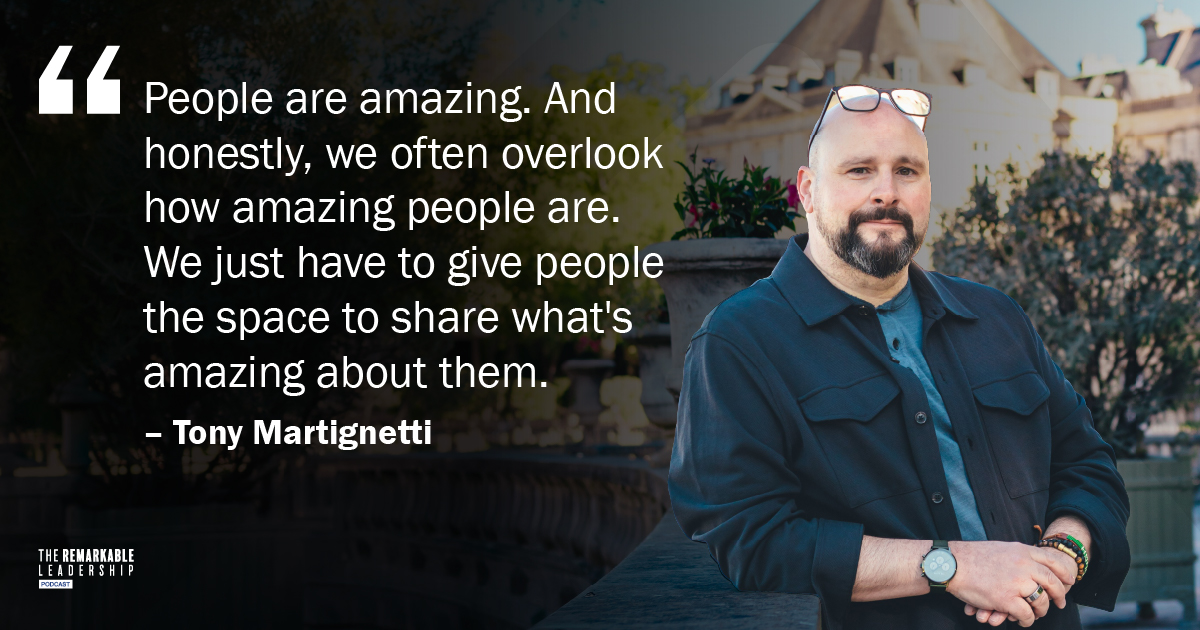
You know, you're someone who sees things that I don't see. And whatever, I mean, whatever it might be, every one of us has something to share. And I'll just share this because I think this is such a beautiful sentiment. I, I was recently at in that and, someone said, oh, you know, the people here are amazing.
00:20:23:13 - 00:20:51:23
Tony Martignetti
And I was like, wow, you're right. People are amazing. And honestly, we often overlook how amazing people are. We just have to give people the the space to share what's amazing about them. And I think that is what we often don't do. And that's what I think. The invitation is here. How can we find what's amazing about each individual and not just closed down and say, well, this person's a great analyst?
00:20:52:01 - 00:20:59:22
Tony Martignetti
Well, maybe there's a lot more to that person than just being a great analyst. And I guess we're really dialing down an analyst. But hey, they're great.
00:21:00:00 - 00:21:03:04
Kevin Eikenberry
We're not we're not picking on anybody. Right.
00:21:03:06 - 00:21:04:02
Tony Martignetti
Yeah.
00:21:04:03 - 00:21:28:04
Kevin Eikenberry
So Tony, I really love what you what you're just saying because I immediately thought of five. I've been where people have made that statement, man, that people here are amazing. And so the two things one is, number one, people are amazing, which is exactly what you said. Yeah, but the other thing is, I'm think I'm immediately thinking of some of these places where I've heard or said that same thing.
00:21:28:06 - 00:21:58:09
Kevin Eikenberry
And the other piece that's with that is that, that, that place, allowed us all to see that because of the culture that was created, even if it was just at a conference. Right. There's a there's a culture at that conference, even if it's for two days or whatever. And so there's really a deep lesson there for us as leaders in terms of the culture we're creating, the dimensional izing our teams and helping each other to see all of that.
00:21:58:14 - 00:22:06:13
Kevin Eikenberry
I mean, you hinted early, that this isn't just about doing this for ourselves, but helping our teams. So anything more you want to say about that?
00:22:06:14 - 00:22:24:14
Tony Martignetti
Yeah. I mean, you know, one of the things that is, really the crux of all this is that when you have, when you explore your own identity, when you do the work for yourself, what happens is it's an invitation to others to really bring, and it gives them permission to do more for themselves. And I think that's the key thing.
00:22:24:14 - 00:22:57:21
Tony Martignetti
And when you have identity that opens up, expands connection is the is the next part of this. And what happens when people feel well connected and trusting to each other and trusting each other? Innovation, business results. Those are the things that business is looking for, right? So I mean, what better way to get there than to to find this, to do this work as a team and unlock that what I call the dormant, brilliance that's lying inside your organization.
00:22:57:23 - 00:23:24:20
Tony Martignetti
Find ways to do this exploration, to find ways to connect more deeply and the result is a bigger impact without the burnout. I mean, I think that's the other thing is people always think like, oh, is this going to be a, you know, add more to my plate or do I have to do more? And like, no, honestly, the capacities there, it's that sense of doing it with your whole self as opposed to doing it with a fraction yourself.
00:23:24:22 - 00:23:38:09
Tony Martignetti
It's like going uphill with a, without, you know, with one leg. And, you know, again, it's like it's hard, but if you have two legs, then it's a whole lot easier.
00:23:38:11 - 00:23:40:08
Kevin Eikenberry
It's not as hard, right? It's easier. Yeah.
00:23:40:08 - 00:23:41:04
Tony Martignetti
00:23:41:06 - 00:24:03:21
Kevin Eikenberry
So there's so much more we could talk about at, but, I want to ask you something that maybe no one else has asked you. So one of the things that's different about this book, every everybody than than the thousands of books that I've read, I remember any book I've ever read that starts out with a playlist of music, and you and you come back to music 2 or 3 times throughout the book.
00:24:03:23 - 00:24:18:10
Kevin Eikenberry
I don't want to talk about the playlist itself. I want to talk about why a playlist and what's the what's the meaning and how is it connected to the idea, of illuminating hidden brilliance?
00:24:18:12 - 00:24:47:02
Tony Martignetti
Yeah. I mean, music is has been played a big role in my life, for, for many reasons. But I also think that it's, it gets people out of the mode of and just reading the book and just, you know, reading along, I want them to take those ideas with them as they navigate their lives. And that and that song might remind them of, hey, this is reminding me of that, of this moment, of this idea, and it sticks with them.
00:24:47:04 - 00:25:13:03
Tony Martignetti
So it's kind of like ingraining into their lives. Okay, I know I've had a tough, tough time figuring out who I am, and now I'm navigating the story of my life and that just putting that song on will remind them and give them that reinforcement to keep going. Kind of like it has for me. And I always think about how storytellers, I mean, how music has been there.
00:25:13:03 - 00:25:41:09
Tony Martignetti
It's always in the background of people's lives. We don't think much about how important the songwriter is. It it's it's critical. And and actually coming back to something that, has been so stuck with me, I always ask people, what's your favorite class you took in college? My favorite class in college was music therapy. And I didn't know that that would be something that continue to stay with me.
00:25:41:09 - 00:26:07:16
Tony Martignetti
But the reason why I loved it is because I saw the impact it had on, Alzheimer's patients on, you know, people with dementia and autistic children and how just listening to a song for a moment can give you this sense of connection to the emotional connection. So, so yeah, long winded answer, but I'll just say this is why I think music is such a fundamental part of the human experience.
00:26:07:18 - 00:26:35:20
Kevin Eikenberry
So when you get your copy of Illuminating Hidden Brilliance, you'll also get at list 20 companion tracks. You know where the code to go. Find it right there on Spotify. You're rocking and rolling, literally, as you go. So so, Tony, is there is there anything I didn't ask? I mean, there's so much ground we could cover, of course, and we couldn't cover it all, but is there something that that maybe as as this, as this, the journey of this conversation has gone?
00:26:35:20 - 00:26:39:22
Kevin Eikenberry
Is there something that you didn't we didn't talk about that you wish we would have?
00:26:40:00 - 00:27:12:04
Tony Martignetti
Well, you know, I don't get a chance to talk about this, but I want to talk about this. Do you know Rich Shepherd? Rich Sheridan? I'm sure he's probably got a guest on your show. Rich Sheridan from Memo Innovations. I had this the the honor of having him on my podcast. And we had a conversation about one of the stories from his early life, actually, in his book, and in the book, I mentioned his the story of him assembling this piece of furniture way back in the day.
00:27:12:06 - 00:27:17:17
Tony Martignetti
And, I love sharing this because I haven't had a chance to share this. Anybody?
00:27:17:19 - 00:27:19:06
Kevin Eikenberry
Besides the the book. Everybody.
00:27:19:12 - 00:27:46:06
Tony Martignetti
Yes, it's in the book. But what I love about it is that, it's an early example of what I call outliers trying to find their way in the world. When you're someone who, you know, finds the sense of like, okay, I know I'm somebody who understands and loves doing, you know, tech or, you know, doing software development, but then finding a connection between that love of the tech.
00:27:46:08 - 00:28:10:01
Tony Martignetti
But how does it connect back to something else? His love of making people feel good, the joy he became. He was able to find this moment of joy in his mother's eyes when he sampled this piece of furniture, and when she came home and he realized that this is how I can add value through doing the things I do and giving people joy.
00:28:10:03 - 00:28:36:13
Tony Martignetti
There's an integration between those two things, and I think that's also the crux of what we're trying to do here, is how can you bring something that you're really good at and find that connection point to something that is meaningful to others? And that's what Rich was, a great story, that I love sharing because it's funny, but also very meaningful in the grand scheme of things.
00:28:36:14 - 00:28:48:13
Kevin Eikenberry
I did ask you or I did tell you I was going to ask you this question. So as we start to wrap up, and I said, so I said, Tony, I'm going to ask you what you're reading these days. So what are you reading these days? Tony?
00:28:48:15 - 00:29:13:22
Tony Martignetti
Well, it's one of those books where I just I wish I had I wish I had the honor of of writing it. I just read Daniel Pink's new book called A Whole Brain. A whole mind. And it is just brilliant. You know, his argument now is just this, you know, everyone has been we've been overindex on the idea that left brain thinking is, is what gets done is how we lead the world.
00:29:14:00 - 00:29:33:11
Tony Martignetti
But in reality, the right brains are starting to take, a seat at the table. And I think that's what we need more of. We need a whole brain, holistic view of the world. I'm not going to do justice to Dan's argument, but I will just say, if you are a fan of Daniel Pink, his new book is, you know, Gray Day.
00:29:33:11 - 00:29:45:23
Tony Martignetti
It's probably my favorite book by his, by him by far. And so go grab it. It's, it's a book for this time, and definitely one that really taps into how we're leading the future.
00:29:45:23 - 00:30:05:18
Kevin Eikenberry
So we will have a link to that in the show notes. We also have a link to the brilliance, Martin Martini. And yeah, you can tell me, where else people can find you, where you want to connect them to. I'll hold the book up. If people are watching while you watch. Where do you want to point people?
00:30:05:20 - 00:30:22:07
Tony Martignetti
Well, thank you so much, Kevin. And I will say the best place to find me is Tony McPeak, Starcom. Or on social media. You can find me at LinkedIn. I am pretty active. I always share insights and thoughts around the way and try to be of service as much as possible. So there you have it.
00:30:22:07 - 00:30:45:06
Kevin Eikenberry
Tony M speak Sky and that will also be on the show notes, of course. So before we go and I let Tony go, I'm going to ask you all the question I ask you every single episode is simply this. Now what what action will you take as a result of being here? There's something that you heard from Tony that illuminated a part of your brain.
00:30:45:08 - 00:31:02:15
Kevin Eikenberry
And it is that thing, that action that you need to take, and you need to listen to it, because otherwise, all you did was. Whoa. That was interesting. That was good. Maybe that action is to go by Tony's book. Tony, want you to do that. I want you to do that. But that's not really what I'm talking about.
00:31:02:15 - 00:31:22:22
Kevin Eikenberry
I'm talking about what did you hear here? That I need to act on? What action am I going to take as a result of hearing it? Because that is will will transfer, transform this into something you listened to or watched and into something that made a difference in your life. That's what we both hope that you do. I want to thank you for being here, and I thank Tony for being here.
00:31:23:00 - 00:31:37:08
Kevin Eikenberry
And we'll be back next week, which means if you're not subscribed, what are you waiting on? And if you are subscribed, tell somebody else so they can join us. We'll be back next week with another episode of the Remarkable Leadership Podcast. Thanks everybody.
Meet Tony

Tony's Story: Tony Martignetti is the author of Illuminating Hidden Brilliance: The Power of Multidimensional Leadership in a One-Dimensional World. He is a leadership advisor and global keynote speaker who helps leaders integrate all of who they are into how they lead. As chief illumination officer of Inspired Purpose Partners, Tony brings over thirty years of experience spanning high-tech and life sciences into his work helping visionary leaders navigate complexity, reclaim their brilliance, and design cultures where others can do the same.
Follow The Remarkable Leadership Podcast


Looking to Develop Stronger Leaders?
Want help developing the leaders in your organization? Reach out to explore how the Kevin Eikenberry Group can support your team.
Book Recommendations
Like this?
Join Our Community
If you want to view our live podcast episodes, hear about new releases, or chat with others who enjoy this podcast join one of our communities below.
Leave a Review
If you liked this conversation, we'd be thrilled if you'd let others know by leaving a review on Apple Podcasts. Here's a quick guide for posting a review.