How can you make work work for your team? Kevin sits down with Natalia Emanuel and Emma Harrington to discuss what research reveals about in-person, remote, and hybrid work and why the best answer is rarely one-size-fits-all. They talk about the “proximity effect” and how face-to-face interaction can strengthen creativity, collaboration, and well-being, while also acknowledging the flexibility and accessibility benefits of remote work. Natalia and Emma explain why simply requiring people to come into an office isn’t enough; leaders need to coordinate when teams are together and intentionally use that time for brainstorming, mentorship, and other activities that benefit from human connection. They also share practical ways to improve virtual collaboration, including creating permission to look away from the screen and move
Listen For
0:00 Where should people work?
1:48 Meet Natalia Emanuel and Emma Harrington
3:41 Why they wrote In Person
5:22 The big idea: digital tools shrink our networks
6:57 The proximity effect
8:36 Where organizations get the remote work debate wrong
11:09 Walking, creativity, and looking away from the screen
15:58 The trouble with hybrid meetings
16:57 The case for in-person: how Shark Week was born
19:56 Remote work and mental health
22:11 It takes 160 hours to make a friend
22:48 The under-discussed case for remote work
24:54 How to make in-person days actually different
28:29 One piece of advice for frontline leaders
32:19 What they're reading
34:14 Where to learn more (and the in-office days calculator)
34:50 Now what?
00:00:09:06 - 00:00:35:23
Kevin Eikenberry
Where should people work? Since the pandemic, this has been perhaps the biggest question. Organizations have considered debated, and even thought about. Our guests today bring data, not just anecdotes or statistics selected based on a personal viewpoint. This conversation is overdue and hugely needed. Stay with us for the next 30 minutes and I promise you will learn something about this important question.
00:00:35:23 - 00:00:59:01
Kevin Eikenberry
Where should our people work? Welcome to another episode of the Remarkable Leadership Podcast, where we are helping organizations and their leaders grow and lead more effectively to make a bigger, positive difference across their teams, communities, and the world. If you are listening to this podcast, you could be live in the future on episodes on your favorite social media platforms.
00:00:59:06 - 00:01:25:08
Kevin Eikenberry
Well, I guess assuming the ones we're on are your favorite. You can find out when they're happening, how they're happening, and how you can connect with us by going to two of the places where these live streams happen. You can go to remarkable podcast.com/facebook or remarkable podcast.com/linkedin to get connected and stay on top of everything we're up to, including joining us live.
00:01:25:10 - 00:01:48:16
Kevin Eikenberry
If you want to get more from this episode and any podcast you listen to, download it. Download my short practical guide. It's, available at Kevin eikenberry.com/get more where you can get more from your podcasts. All right. With that, let me bring in my guests. There are two of them today, and they have now joined me on screen for those of you watching.
00:01:48:16 - 00:02:15:19
Kevin Eikenberry
They are Natalia and Matt Emmanuel, which I mistyped on my screen. That's why I'm like, wait a minute, that's not right. It's Natalia Emmanuel and Emma Harrington and Natalia, received their PhD in economics at Harvard and both completed postdocs at Princeton. Short answer. They're smart. Natalia is a research economist at the New York Federal Reserve Bank, and Emma is a professor of economics at the University of Virginia.
00:02:15:20 - 00:02:38:08
Kevin Eikenberry
Their work has been published in top journals including science, the Quarterly Journal of Economics, and American Economic Journals. Their research has been featured in the BBC and the New York Times and The Wall Street Journal in The Economist. You get the idea here on the The Atlantic's Good on Paper podcast and NPR's Planet Money and After Today, the Remarkable Leadership podcast.
00:02:38:14 - 00:02:59:18
Kevin Eikenberry
Natalia lives in New York with her husband and four children and six chickens. She has a black belt in taekwondo. So is quilts in her free time and illustrated the cartoons in their new book, which we're going to be talking about today. Emma lives in Charlottesville, which is appropriate since she teaches at UVA. With her husband and her rambunctious Portuguese water dog named Ali.
00:02:59:20 - 00:03:20:05
Kevin Eikenberry
She enjoys running and hiking, and as one friend put it, we'll probably still be analyzing data up in heaven. The book I just mentioned that Natalia illustrated is their brand new book titled In Person How Working Together Fuels Creativity, Productivity, and Growth. I welcome you guys to the show. So glad that you're here.
00:03:20:07 - 00:03:22:03
Emma Harrington
Thanks so much for having us.
00:03:22:04 - 00:03:41:01
Kevin Eikenberry
So I told them, before we started, that it's not very often that we have to guess. It happens sometimes, and I'm glad to have you both here. And so I'm flipping a coin as to who to ask a question first, too. So, Emma, since you're second in the list, on the book, I'm going to ask you the first question.
00:03:41:02 - 00:03:46:16
Kevin Eikenberry
So. So why did you write the book?
00:03:46:18 - 00:04:13:23
Emma Harrington
I think on a, personal level, we benefited a lot from in-person time together, which is our main theme of the book. So we were lucky enough in grad school to be assigned to the same dingy basement office and Harvard, sort of the bowels of the building, and we just got to know each other at a personal level, where Natalia is ever the fan of the catnap underneath her desk.
00:04:14:01 - 00:04:15:01
Emma Harrington
I would go for like.
00:04:15:03 - 00:04:16:11
Kevin Eikenberry
Literally underneath the.
00:04:16:11 - 00:04:47:07
Emma Harrington
Desk. Yeah, she can just wiggle right under there and go to sleep really quickly. Was impressive talent and along with those sort of like personal experiences, we also became really comfortable talking about research and debating different ideas and came to see that we had a lot of overlapping interests. We were very interested in this question of how can we really make work, work for people and understand what leads to a productive and meaningful career?
00:04:47:12 - 00:05:15:23
Emma Harrington
And then on sort of a more macro level, we saw that quickly. The debate about remote work was getting just incredibly polarized. It was always sort of yes, remote. No. Remote. Not this question of, well, why have we been in person in the first place? And so we really wanted to bring that into the foreground and make that conversation more one of like, how do we have those meaningful moments in person that help us have those meaningful careers?
00:05:16:01 - 00:05:22:16
Emma Harrington
And how can we do that in a way that retains some of the flexibility that we had when we were remote?
00:05:22:17 - 00:05:33:16
Kevin Eikenberry
So I tell you, I think that Emma kind of answered this in part, but I want your take on. So what would you say is the big idea of the book?
00:05:33:18 - 00:05:56:06
Natalia Emanuel
One of the things that surprised us when we were doing this research, or it really resonated with us, was that it seems as though when everybody is just a digital shoulder tap away, you should be able to connect with absolutely anybody. But what we find is actually that people contact who they actually end up connecting with ends up shrinking.
00:05:56:11 - 00:06:16:08
Natalia Emanuel
It ends up getting a little bit more siloed. You're only talking to your team. You're only talking to people that you knew in person. And you can see this in organization after organization. And so the big idea that we wanted to underscore is that there's really something magical about being in person. And that's distinct from being in the office.
00:06:16:10 - 00:06:35:17
Kevin Eikenberry
So one of the things that you share in the book is about a tool that you guys aren't even old enough to really remember, and that's a fax machine. And the idea of the fax machine is that you could literally talk to anyone in the world who also had a fax machine, but the research that you guys cite and I won't get these numbers exactly right, but their directionally right.
00:06:35:17 - 00:06:57:04
Kevin Eikenberry
Is that the distance that people actually sent faxes was like incredibly small. It's exactly your point to tell you and I, I had never heard that, research. But it ties to so much of the other things you guys talk about in the book. So, I'll tell you, I'll stay with you. You guys opened with the concept that that I don't know everyone's familiar with, and they need to be.
00:06:57:04 - 00:07:09:02
Kevin Eikenberry
And you've both sort of already hinted at it, and it's the idea of the proximity effect. So would you talk about what that is, but more importantly, what that means to us all practically?
00:07:09:04 - 00:07:29:01
Natalia Emanuel
Well, I think this is capitalizing on exactly what you were saying, that there is something really special about being in person and that when we are in person, our brains are literally more synchronized with one another. So one of our favorite studies that we stumbled upon has, put little electrode caps on people who are having a conversation.
00:07:29:01 - 00:07:57:06
Natalia Emanuel
And when they were having, this conversation in person, their brains were sort of having a complete symphony that their brains were lighting up at the same time. And then when you have this conversation, over zoom, you get 90% of that synchrony is lost. And that shows up in so many other important parts of work. It means you have 16% fewer ideas when people are brainstorming, and those ideas that they have are less creative, you have less mentorship.
00:07:57:08 - 00:08:06:22
Natalia Emanuel
And so there is something about being in person that really allows people to have something powerful, that really fuels work.
00:08:07:00 - 00:08:36:05
Kevin Eikenberry
We're talking with Natalia Emanuel and Emma Harrington about their book in person, and I just had to tell you all that, all of those things Natalia just said, we're not just like statements of her imagination. Every one of those things that she just tipped off is research that they talk about in this book, which is one of the reasons why I think the book is so fascinating, and it takes us back to what I said at the open, which is, maybe we now have some real data that, that we can all use to make better decisions.
00:08:36:07 - 00:08:58:07
Kevin Eikenberry
So I want to ask this question. I might I'll ask you this because, you know, we talked about the the polarity that's come, you know, in the post-pandemic era, if you want to call it that, about how people feel about work and all of the not only what has been said in the press, but what people say at a dinner party.
00:08:58:09 - 00:09:21:09
Kevin Eikenberry
Right, as well, and everything in between and the polarity around that. And so, I guess, Emma, I'll ask you this. What what is the thing that you think organizations in large part because this is an over generalized statement, I realize. But, in general, how are we getting this, this whole question, this whole conversation? How are we getting it wrong?
00:09:21:11 - 00:09:47:17
Emma Harrington
I think probably the number one way that we're getting it wrong is thinking that there is a one size fits all solution for all organizations and all teams. Then everyone can either thrive fully remote, or if you're talking to a different person, everyone needs to be in the office. Five days a week. And we find that for a lot of organizations, the right answer is sort of the middle ground.
00:09:47:23 - 00:10:22:21
Emma Harrington
Then it's really important to leverage those moments of in-person connection for the proximity effect. To take advantage of that, get some of those sort of effervescent, not super quantifiable aspects of work to actually grasp those face to face with your colleagues. But yeah, there's also these advantages of remote work that we probably don't want to just, like, shunt to the sidelines unless we're in an in particular organization where in-person work is just absolutely vital to what the company does.
00:10:22:22 - 00:10:44:15
Kevin Eikenberry
Yeah, I love that find the middle ground. And that's, I think, really going to set the tone for the rest of our conversation is that, that that we are living in a both and world related to this and that there are there are real, tensions between the two poles if we want to go back to the polarity point.
00:10:44:17 - 00:11:09:14
Kevin Eikenberry
And, and I think that this conversation is meant to help everyone think about that tension differently and start to think about it more, I think more productively. One of the things you guys talk about, and I tell you, I'll ask you about this, one of the things that you guys talk about and let me back up, all of us know that one of the best ways to get ideas is when we're doing something unrelated to the work itself, whether it's taking a shower.
00:11:09:16 - 00:11:35:11
Kevin Eikenberry
On a side note, I once wanted to put a whiteboard in my in my shower. My wife turned me down. She just turned me down. I just don't understand that. But in the shower, taking a walk in the book, you talk about taking the walk. And the thing that I found really practical and fascinating is that while we might do that and you talk about examples in the book, and many of us are probably going for a walk with someone at work or not.
00:11:35:11 - 00:11:56:06
Kevin Eikenberry
And like, that's a very productive way to actually ideate and and to think things through and all that stuff. And we talk about being on zoom and we can't really do that. You guys talk about how we can sort of simulate or make it okay to not be locked in on the screen. All the time while we're on a zoom.
00:11:56:07 - 00:12:07:20
Kevin Eikenberry
Natalia, would you talk about that? What I'm going to call the the walk around your take a walk advice at work like nothing. I mean, when we're virtual, right?
00:12:07:22 - 00:12:33:23
Natalia Emanuel
Absolutely. So one of the things that, one study was doing is it was trying to have people who are worked in an organization come up with creative ideas that their company could implement that would serve their clients. And they had some of them doing this in person and some of them doing it on zoom. And the people who are doing it on zoom thought that they were productive, but they were less productive than the ones who were doing this in person.
00:12:34:01 - 00:12:58:03
Natalia Emanuel
And what this was unique about their study is they actually were tracking the eyes of the workers. And, what they were finding is that the people who were having this conversation on zoom, their eyes were really limited to the four screens of their computer or the four walls of their computer, as it were, whereas the people who were in person would let their eyes wander, and that allowed them to let their minds wander.
00:12:58:03 - 00:13:20:00
Natalia Emanuel
And so they had a lot more of these creative ideas. And, you know, there is this social construct that we are supposed to be looking at the screen because otherwise you wonder, you know, are they checking the broccoli in the oven? Are they checking their phone? Exactly. And so that there is that social construct. So sometimes turning off the screen if you really can trust people that way.
00:13:20:01 - 00:13:27:06
Natalia Emanuel
To know that they are engaged in the meeting. And then also, if you can take it as a walking meeting, how that would be amazing.
00:13:27:08 - 00:13:47:00
Emma Harrington
Yeah. There's also cool research that in some of it is about the physiology as well. Then they have put people on treadmills and then had them trying to come up with creative ideas on the treadmill. I guess treadmill thoughts probably is a little less catchy than our thoughts, but maybe it should really catch on where when you. I don't have.
00:13:47:00 - 00:13:52:09
Kevin Eikenberry
Good handwriting to start with. How am I supposed to do that? Well, I guess I have to talk into my phone, right?
00:13:52:09 - 00:14:20:01
Emma Harrington
Right. Here are your notes. Or maybe walk really slowly on the treadmill. Slow treadmill dogs, I guess, would be the great catch phrase. And they found that that was meaningful and like moving the needle of how creative people were. And it actually persisted even after people sat down. They were still more creative after having taken a walk. So, I mean, another hack you could try is go for a walk to brainstorm, come back, have your zoom meeting.
00:14:20:01 - 00:14:24:19
Emma Harrington
But you've gotten sort of the creative juices flowing somewhat literally.
00:14:24:21 - 00:14:36:12
Natalia Emanuel
And one of the things that's a little bit concerning about remote work is there was a recent study that suggested that people actually have less physical mobility on days when they're working remotely, or that it's it's a.
00:14:36:15 - 00:14:38:18
Kevin Eikenberry
Junior study for that. That's pretty quick.
00:14:38:20 - 00:14:58:19
Natalia Emanuel
Right? That's true. But the quantity was shocking to me. At least it was 2500 fewer steps, which is like half of what the average American walks and a quarter of what's recommended for us. It was just a really dramatic drop off. And so if it is this physiological thing, if you need to get your blood moving, to get your brain moving, that's kind of a bummer.
00:14:58:21 - 00:15:19:00
Kevin Eikenberry
That the one thing that I took from the very specifically, about the, you know, I mean, I think all the exercise, the walking, all that stuff is awesome. But the idea that I took from the making it okay to look away from the screen, like on our team, we will I'll say things like, like I will have notes.
00:15:19:00 - 00:15:38:10
Kevin Eikenberry
Like if I'm doing a one on one, my one on one notes for my team member over here, like what I want to make sure and so I just always let them know, hey, I'm looking here. That's what I'm looking at. Or hey, here's what I'm doing. And the extension to that is that we should we should have we should be clearly describing to each other that and to make it okay for people like I simulated.
00:15:38:12 - 00:15:53:06
Kevin Eikenberry
And of course, all of you listening are not going to know this. But like they tell you, you were talking about looking around the room, which we would do in a meeting, and I was looking around my office while you were talking. And if we we could even be explicit in our team culture about, hey, this is what I'm doing.
00:15:53:08 - 00:15:58:02
Kevin Eikenberry
And I think that's a very tangible thing we could do to make a difference.
00:15:58:04 - 00:16:26:19
Emma Harrington
Yeah, that's something we also see is that when you just have some people who are remote, you get a lot of the impacts of kind of everyone being remote. And I think some of that may be that if you've ever been to a hybrid meeting and ends up being that everyone is sitting around looking at their computers, the person who's remote looking at their notes, and you're not getting that sort of eye glazing around the room that you would if everyone were in person.
00:16:26:21 - 00:16:57:10
Kevin Eikenberry
Yeah. And, you know, we can have a whole conversation about the, the hybrid meeting and, and whether they even work like I have been known to have, in fact, when we have a team meeting here where almost everyone is remote, we just are all remote because we make sure that we're really even. I mean, even though there are downsides, we're evening the playing field for the for in most cases the two people that might be in the office on that day, if there's two or there's only just Kevin, and, you know, I think those are all intelligent things to think about.
00:16:57:10 - 00:17:16:12
Kevin Eikenberry
Well, we got other useful stuff to talk about beyond the meeting itself. So I want to take a minute and do this. Here's where we're headed for the rest of our time. We're going to talk about the case for in-person, the case for remote, and then making the most of the time when we are together, because most many of us are somewhere in between those two poles.
00:17:16:18 - 00:17:25:02
Kevin Eikenberry
So, which of you wants to take the case for in-person, since that's the big key of the book, and I'll let you I'll let you fight over that one.
00:17:25:04 - 00:17:27:12
Natalia Emanuel
I have added.
00:17:27:14 - 00:18:05:15
Emma Harrington
Okay, take it. So I think it's helpful to actually start with a sort of specific example. So one thing that I just learned this is actually doesn't happen in the office, but it definitely happens in person, is we tell this story of these people at the Discovery Channel pretty high up in the organization who meet over drinks and they start just chatting, but then they shift over into talking about one of the main questions for the company of how can we improve our summer ratings?
00:18:05:15 - 00:18:35:04
Emma Harrington
They were just abysmal. And so people just started brainstorming what they would be excited about watching. And someone yelled at sharks, someone else scribbled it on, napkin. And that was how Shark Week was born. And it doubled the ratings in that first summer in 1988, and it's been on the air ever since then. And so that moment was probably, as you talked about before, I facilitated the creativity of that moment was facilitated by being in person.
00:18:35:06 - 00:18:44:16
Kevin Eikenberry
Or the alcohol. Now, I noticed that the person who doesn't have four children is the one talking about we should go to the bar. That is an interesting observation. And it's.
00:18:44:18 - 00:19:06:10
Emma Harrington
Yeah, yeah, I guess and full disclosure, I am currently pregnant, so I'm also not drinking. Okay, okay. Maybe maybe a toddler is someone who needs a drink with her for a job, but being the alcohol, being the person interaction they were, they had this creative moment. And it doesn't sort of check off any item on their to do list.
00:19:06:15 - 00:19:45:11
Emma Harrington
But when you think about those people's careers and what they're going to think back on as the moments that define their careers, I think everyone in that room will say that was a defining moment. That made my career feel meaningful to me. And so we think that that's really what you want to be shooting for when you're thinking about these doses of in person, is that it just creates emphasis on teens, these moments that are really hard to plan in advance but can generate a lot of ultimate meaning creativity, productivity, mentorship, then we think are really the hallmark strengths.
00:19:45:13 - 00:19:56:11
Emma Harrington
The office, let me see that plan again and again in the data. But sometimes these stories, I think, are helpful in thinking about, well, what is it that we may be missing when we're not in-person?
00:19:56:13 - 00:20:21:05
Kevin Eikenberry
Well, in the book you talk a lot about and, Natalia, I'll let you talk to this for a second. You talk a lot about you mentioned and you just mentioned mentorship, and we could probably do a whole show on that. But you also, talk a lot about mental health, and I think probably all of us at some level, in some way know that working remotely has impact on our mental fitness, if you will.
00:20:21:07 - 00:20:29:19
Kevin Eikenberry
And I just like maybe Natalia, can you underscore that a bit for us? Yeah.
00:20:29:21 - 00:20:49:17
Natalia Emanuel
This was one that we went into with a lot of, you know, curiosity without sort of a strong sense because a lot of people say that they enjoy their time at home. And so you could imagine that this might go either way, right? That perhaps being removing your commute and no one seems to love their commute, would actually be good for people's mental health.
00:20:49:17 - 00:21:18:12
Natalia Emanuel
But what we actually found was that the people who were in remote occupations had, a decline in their mental well-being. This was about a 9% increase in mental distress. And one of the reasons why we think that happened is that you are seeing a 20% increase in the time that people are spending alone, for people who are in remote occupations, who are also not living with a partner or kids, 1 or 10 of them.
00:21:18:12 - 00:21:41:05
Natalia Emanuel
Yeah. Well, 1 in 10 of them are actually completely, like not seeing anyone in a given day. I mean, and we know that social isolation is not good for anyone. But, you know, it's been likened to smoking 15 cigarets a day. Just really quite bad. And so we see this both in self-reports of people's mental health in terms of their, you know, taking prescription medications.
00:21:41:09 - 00:22:11:08
Natalia Emanuel
And so there is something incredibly valuable that the you know, human connection that happens. And I think one of the things that's telling is that people say that workplace is the number one place where Americans make friends, as adults, and for good reason. We spend a huge amount of time there. So even though it would be great if people could supplement by, you know, hanging out with their neighbors, hanging out with their bodies, with their soccer friends, there is something incredibly nourishing about the human contact at work.
00:22:11:10 - 00:22:23:21
Emma Harrington
Yeah. One stat that I also find particularly telling is that these researchers tried to quantify how many hours does it actually take to form a friendship? And they estimated that it takes 160 860.
00:22:23:21 - 00:22:24:19
Kevin Eikenberry
I remember reading that.
00:22:25:00 - 00:22:48:14
Emma Harrington
And so that is just a lot of hours to accumulate in any context and work, for better or worse. We spend a lot of time there. And so those hours are easier to rack up in that context than in your soccer league, with your neighbors, with other contacts where you could try to form connections. It's going to be a slower burn to actually get that accumulated hours.
00:22:48:16 - 00:23:06:09
Kevin Eikenberry
Yeah. So the the yes, and here is there is also a case for the for remote work. And we've talked about some of those things already. I don't know that we need to spend a ton of time there because I think most, most people, especially those that love their remote work or continue to advocate for more of it.
00:23:06:13 - 00:23:16:14
Kevin Eikenberry
Right? Perhaps. So I think maybe people know that. What maybe what's a case for remote work that you think is maybe under discussed MI what do you think?
00:23:16:15 - 00:23:38:14
Emma Harrington
I mean, I think a huge one that really pops out in the data is that for people with physical disabilities, remote work has just been a game changer. And if you just kind of plot raw data, you kind of see that remote work has maybe helped women a little bit, be more active in the labor market, especially in those with children.
00:23:38:14 - 00:24:04:14
Emma Harrington
But you kind of have to squint to see that one for people with physical disabilities. Yeah, I'm just going at all. It's really obvious that there's been kind of a sea change in their ability to work. And so that, I think is a huge population of people where we're able to use remote work to sort of tap into that labor, that sort of talent, that expertise that otherwise wouldn't be that heavily utilized.
00:24:04:19 - 00:24:33:19
Emma Harrington
I think another population that you see is in other countries with more traditional gender norms, women kind of fall into more of the same camp where there's really low labor force participation rate of women, even with a lot of education in places like India or other countries similar to that. And studies there show that offering remote work can dramatically change women's willingness to work.
00:24:33:21 - 00:24:54:03
Natalia Emanuel
One other group that's worth mentioning is people who have really unpleasant workplaces. People would go to large lengths to be able to not be around unpleasant colleagues, and remote work is a way to sort of buffers them from the, you know, nasty interactions that they might unfortunately have to experience at work.
00:24:54:05 - 00:25:20:02
Kevin Eikenberry
Where the Sunday scaries are a real thing. Right. So, so, let's, let's talk about. The middle ground, if you will. Right. Like lots of people who are listening, watching, are on some sort of hybrid schedule. They're in the office some of the time. They're not in the office some other times. And you guys make the same point that I've been making for a number of years.
00:25:20:02 - 00:25:45:19
Kevin Eikenberry
Is that if we're going to be together, those work are to look different than the days, because there are real productivity advantages when we're when we have more uninterrupted time. So why would we go to the office and have them look exactly the same? Like I've heard hundreds of people literally tell me, well, Kevin, why should I go if I do exactly the same thing I put in my headset like Emma is right now and I'm working like, well, I said, then you shouldn't go because it's got to be different.
00:25:45:19 - 00:25:58:14
Kevin Eikenberry
It's not different. What's the point? And they're exactly right. So how do we make it different? How do we make the most of the in-person time? I tell you, I think.
00:25:58:14 - 00:26:19:00
Natalia Emanuel
The first thing is we need to have coordination, right? We need to have everybody in the office at the same time. So the worst thing, as you said, is I braved my 26 minute commute. If you're a typical American, that's how long it is to get in. And then I sat on zoom because all of my teammates are RDFa.
00:26:19:00 - 00:26:38:22
Natalia Emanuel
Right. So it means that you have to be in the same office as them, and everybody needs to be coming in. So that automatically means we shouldn't be having these policies like two days a month, two days a week that are unspecified as to which they are true. Like right now, that's the worst, right? We had one person who sort of said, oh, I'm picking Friday specifically because no one's there.
00:26:39:01 - 00:27:09:13
Natalia Emanuel
You're like, well, that's unhelpful, right? And so the first piece is that there has to be the coordination, right, that everybody needs to be coming to the same place at the same time. And then from there sort of focusing on making sure that those are the times when you are really connecting with people, that all the creativity and the shoulder tapping and the aligning on whatever are plans, that's the crucial piece, so that when you are working remotely, you can do the execution.
00:27:09:15 - 00:27:32:17
Emma Harrington
Yeah, sort of. I think a sort of specific story that maybe illustrates that point is I love talking to this co-founder of a startup that was created many years before the pandemic, where instead of a 26 minute commute each way, they were more like 2 or 3 hours from one another, and they were spread all throughout New England.
00:27:32:17 - 00:27:54:08
Emma Harrington
And so going in every day was just not going to be a reality for them. But what they did was they decided, okay, we're going to be intentional about having one day where we all come together every week, and on that day the whiteboard is going to be out. We're going to be brainstorming ideas. We're going to be planning what we do the rest of the week.
00:27:54:08 - 00:28:23:07
Emma Harrington
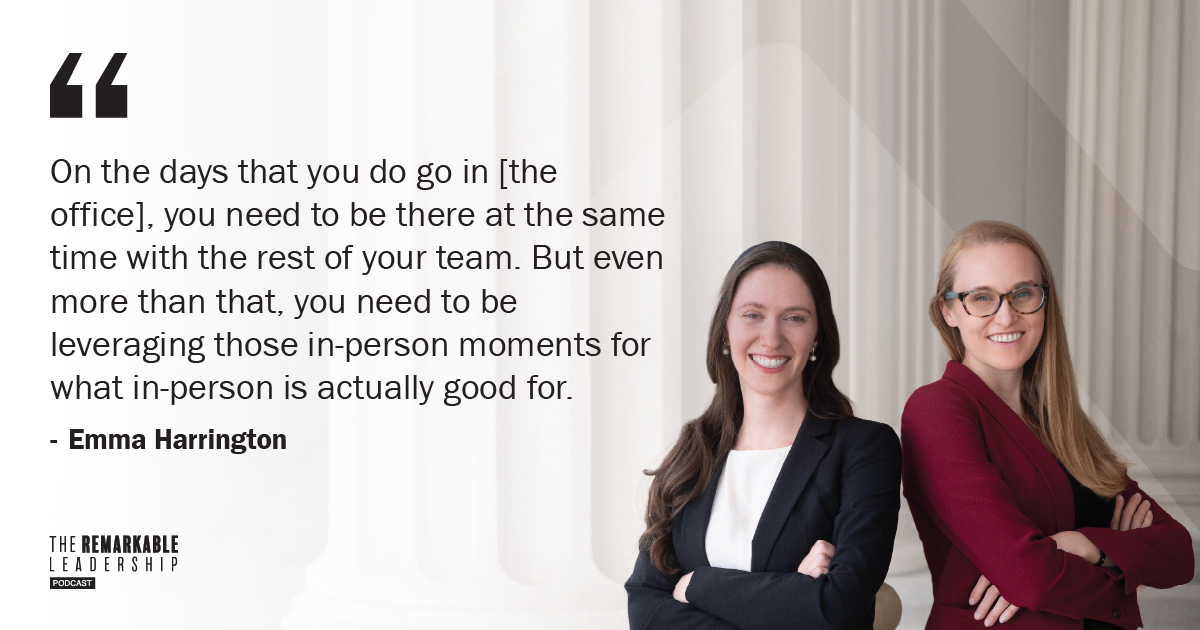
When we're remote, we're going to be interacting with one another and we're also going to spend quite a bit of time just schmoozing and talking about what's happening in our lives outside of work, to sort of replenish those human connections. And all of that. Really leverage is what the office is best for. And so in that sort of is an extreme case, but it generalizes broadly that on the days that you do go in, you need to be there at the same time with the with the rest of your team.
00:28:23:13 - 00:28:29:14
Emma Harrington
But even more than that, you need to be leveraging those in-person moments for what in-person is actually good for.
00:28:29:16 - 00:28:56:07
Kevin Eikenberry
100%. I couldn't have said it. I, I couldn't have said it better than that. I think it's exactly right. There are people here who will lead organizations here, meaning watching and listening, who lead organizations and their next steps could be pretty straightforward. But a lot of people who are here are I me a frontline leader, a leader of leaders, perhaps, but not in the C-suite, not in the position to make policy.
00:28:56:08 - 00:29:23:18
Kevin Eikenberry
And so if you could give and I ask each of you this question, to tell you, you first, if you could give that person one piece of advice and of course, you don't know whether they're all remote or not right now, but let's presume that they're probably some mixture. Right? What would be the one piece of advice you would give them based on what everything you've done in the book, you've you've learned what's one thing you tell them to do?
00:29:23:20 - 00:29:42:14
Natalia Emanuel
Well, if you're aiming to have people in the office, I would say then the leader needs to be showing up. There's an excellent study that shows that, your line workers are 26% more likely to show up when they know that their manager is going to be showing up as well, that you are a magnet for your workers.
00:29:42:14 - 00:29:49:07
Natalia Emanuel
And so if you want them in the office, if you want to connect face to face, and you need to be there as well.
00:29:49:09 - 00:29:51:04
Kevin Eikenberry
Emma. Well, what do you got?
00:29:51:05 - 00:30:31:10
Emma Harrington
I would say to play matchmaker a little bit. Not romantic matchmaker, sort of a platonic matchmaker, and be intentional about creating mentorship, relationships and directing people to meet regularly. Maybe have a scheduled lunch with one other person from the team. Repeated that same person every week. Maybe give them some questions to think through together, because the research really shows that that sort of an intentional matchmaking can pay pretty big dividends in terms of making people learn more and end up being more productive.
00:30:31:11 - 00:30:48:19
Emma Harrington
And that's going to be even more important when you're not in the office every day where you it's harder to rely on serendipity to generate those sorts of mentorship relationships, and can be helpful for the manager to kind of give people a nudge to have those conversations.
00:30:48:21 - 00:31:07:13
Kevin Eikenberry
So I'm just going to add one comment to each of those pieces of advice. So to Natalia's, point, I think that, not only does the manager or the leader need to be there, they need to be modeling all the stuff we've been talking about, like they can't be there. Then close the damn door. Sorry. You know, they've got to be modeling.
00:31:07:13 - 00:31:29:06
Kevin Eikenberry
They got to be out front on all the things that you guys have suggested. And, Emma, to your point, I think, we need to make sure that when we do what you've described, that we help the mentor or not, that mentee mentee is going to get it, that the mentor sees that that's an an expectation and sell them on the value that they will get from this because they'll get it.
00:31:29:08 - 00:31:42:01
Kevin Eikenberry
But if they feel an internal tension of, yeah, but I should still be writing more code, or, you know, or doing more invoices or whatever. Then that's going to that's a tension that could get in the way. I love both of those pieces of advice.
00:31:42:01 - 00:32:01:04
Emma Harrington
Yeah. And just one note on that. I mean, I think one thing that we see in the data is that a lot of companies respond to remote work by increase in performance incentives, because you can't see as well what people are doing day to day. So it's natural to start rewarding the outputs. And there's a lot of merit to that.
00:32:01:10 - 00:32:19:19
Emma Harrington
But I think one side effect is it can sort of double down on some of the costs of remote work, that you're even less like being a mentor. Other people, when they're not in person. So they're not sort of top of mind. But also your bottom line is that you've got to be churning out all these code and invoices and everything else.
00:32:19:21 - 00:32:28:20
Kevin Eikenberry
100%. So I told you both ahead of time I was going to ask you a specific question and how I'm going to do it. So, Emma, your first, what are you reading these days?
00:32:28:22 - 00:33:01:22
Emma Harrington
So I'm reading a book by Emily Oster on Crib sheet to try to prepare for my upcoming child. This will be my first child as opposed to, not only for but, Yeah, I think I think it's actually a book that we drew, or at least I drew some inspiration from, obviously a super different context. But parenting, like remote work can be incredibly polarizing, and there's now more and more data about what is actually effect death.
00:33:02:04 - 00:33:15:22
Emma Harrington
And I think Emily Oster does a beautiful job of actually just laying out what we know and letting people make their own decisions, and that what we're kind of trying to do in the book is saying, here's the evidence. Now you make of it what you will.
00:33:16:00 - 00:33:18:09
Kevin Eikenberry
And how you what are you reading?
00:33:18:11 - 00:33:42:12
Natalia Emanuel
It's an autobiography of a Civil War soldier named Sarah Emma Edmondson, who went undercover as a man. Frank Thompson and, later told her story after she had been dishonorably discharged because she had to get medical attention for malaria but didn't really want to go to the Army's doctor, given that she was not actually a male soldier.
00:33:42:14 - 00:34:09:18
Kevin Eikenberry
Awesome. We will have links to both of those books in the show notes, but we'll also have a link importantly to, Natalia and Emma's new book in person How Working Together Fuels Creativity, Productivity, and Growth. You'll get a copy when it comes out. And, of course, for the podcast. I don't know when you're listening to this, but if you're listening when it first comes out because you're subscribed, which you should be, then it's not coming up for a week, but you can always preorder it.
00:34:09:20 - 00:34:14:17
Kevin Eikenberry
One of you tell us where we can learn more about your work. What do you want to tell us? What do you want to point us.
00:34:14:19 - 00:34:31:10
Natalia Emanuel
Etc. in person? Booking.com has both, a link to buying the book, and then it also has our calculator for how you can determine how many days a week you should have your teeth. And if that's something that you get to have a say in.
00:34:31:12 - 00:34:50:21
Kevin Eikenberry
There's a calculator, everybody. There's about 30% of you that think that will be the most valuable thing that you could get is a calculator to help you figure that out. Listen, thanks, both of you, for being here before I say goodbye to the two of you. And before you say goodbye to everyone. Question that. I always ask you my listening audience.
00:34:50:21 - 00:35:33:05
Kevin Eikenberry
Is this. Now what? What action are you going to take as a result of this conversation? You got a tremendous amount of information and insight today. The question is not. That was interesting. The question is, what action will I take based on what I just learned? And it's my hope, and I think all three of our hopes that that's what you will do, that you won't just take this as, on face value and find it interesting, intellectually stimulating, and maybe even a little bit fun, but rather that you'll go take action because until you do, nothing will really change for you, for your team, for your work, for your mental fitness
00:35:33:07 - 00:35:45:21
Kevin Eikenberry
and everything else, for your productivity, creativity and growth. So, Natalia and Emma, thank you so much for being here. It was absolute pleasure to have you. I enjoyed I hope you enjoyed it as much as I did.
00:35:45:23 - 00:35:47:09
Emma Harrington
That's great. Thanks so much.
00:35:47:11 - 00:35:49:09
Natalia Emanuel
Thanks so much for having us. Was lovely.
00:35:49:11 - 00:36:01:07
Kevin Eikenberry
All right everybody, we'll be back next. If this if you thought this was lovely, keep on coming back. Make sure you subscribe so you don't miss any future episodes, because we'll be back next week with another episode of the Remarkable Leadership Podcast.
Meet Natalia & Emma
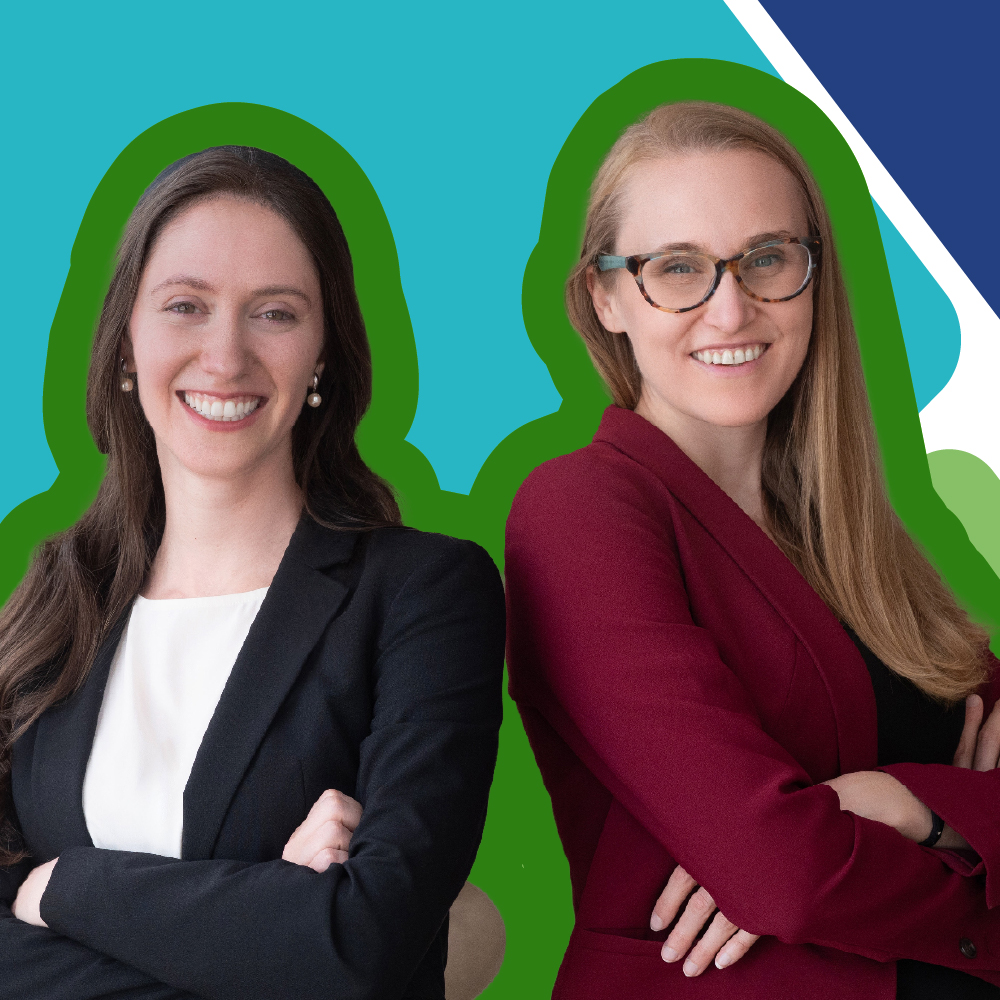
Their Story: Natalia Emanuel and Emma Harrington are the authors of IN PERSON: How Working Together Fuels Creativity, Productivity, and Growth. They received their PhDs in economics at Harvard, and both completed postdocs at Princeton. Natalia is a research economist at the NY Federal Reserve Bank, and Emma is a professor of economics at the University of Virginia. Their work has been published in top journals including Science, the Quarterly Journal of Economics, and American Economic Journals. Their research has been featured in the BBC, The New York Times, The Wall Street Journal, The Economist, The Atlantic’s Good On Paper podcast, and NPR’s PlanetMoney, among others.
Follow The Remarkable Leadership Podcast


Looking to Develop Stronger Leaders?
Want help developing the leaders in your organization? Reach out to explore how the Kevin Eikenberry Group can support your team.
Book Recommendations
Like this?
Join Our Community
If you want to view our live podcast episodes, hear about new releases, or chat with others who enjoy this podcast join one of our communities below.
Leave a Review
If you liked this conversation, we'd be thrilled if you'd let others know by leaving a review on Apple Podcasts. Here's a quick guide for posting a review.