How can leaders build organizations that remain responsive and successful through constant disruption? Kevin sits down with Ron Robinson to explore what makes a company resilient in the face of economic uncertainty, social change, climate events, and rapidly evolving technology. Ron explains why leaders must look beyond financial results and strengthen four interconnected areas of the business: finances, operations, employees, and customers. They discuss how involving employees in budgeting, problem-solving, recruiting, and process improvement can reduce costs, increase responsiveness, and create greater ownership throughout the organization. Ron also introduces the value of internal mastermind groups, where employees closest to the work meet regularly to share knowledge, identify improvements, and respond more quickly to challenges.
Listen For
0:00 Why organizations, not just people, need resilience
0:42 Housekeeping and the podcast action guide
1:29 Introducing Ron Robinson
2:15 Why Ron wrote the book
3:18 Organizational vs. individual resilience
3:51 The four disruptors
8:00 The four parts of every business
11:05 Strengthening finances through employees
13:12 Mastermind groups fix a low-margin company
15:22 Recruiting and retention
17:28 Customers, AI, and the human touch
19:18 Scorecards: how to measure resilience
23:04 Internal masterminds: Toyota and Honda
26:03 What Ron is reading
26:53 Where to learn more about Ron
27:27 The most important question: now what?
00:00:09:10 - 00:00:42:03
Kevin Eikenberry
There's plenty of talk about resilience, individually and with good reason, but far less talk about resilient organizations. It doesn't seem like that should matter, too. Well, that's our focus today, the practices of resilient companies. And we have the author of a book with that title to guide our conversation. Welcome to another episode of the Remarkable Leadership Podcast, where we are helping organizations and their leaders grow and lead more effectively and make a bigger difference across their teams, communities, and the world.
00:00:42:05 - 00:01:04:00
Kevin Eikenberry
And proudly, we've been doing that for ten years. If you're listening to this podcast, you can join us in the future. When we do these live, live streamed on several social media platforms. You can find out when that's happening, where they're happening, and how you can get connected, learn more, and interact with us sooner by joining our Facebook or LinkedIn groups.
00:01:04:00 - 00:01:29:18
Kevin Eikenberry
Just two of the social platforms where these are live stream. You just go to remarkable podcast.com/facebook or start constantly. More thing before I bring my guest in and introduce him. If you want to get more from this episode and every podcast you listen to, you can download my short practical Action guide, about how to get more from any podcast.
00:01:29:20 - 00:01:55:03
Kevin Eikenberry
So just go to Kevin. I can.com/get more. Pretty straightforward. And with that I'm going to bring in my guest. Here he is. His name is Ron Robinson. He has consulted with and helped turn around enterprises ranging from the paper fortune one. Excuse me, fortune 500 companies to mid-size organizations to startups. He's presented to audiences largest 3000 and facilitate groups as large as 300 participants.
00:01:55:05 - 00:02:13:09
Kevin Eikenberry
His book Practices of Resilient Companies overcome disruption with compassion, collaboration and knowledge provides a business model for companies and nonprofits to become resilient and succeed while navigating today's disruptive forces. Ron, welcome to the show.
00:02:13:11 - 00:02:15:19
Ron Robinson
Thank you. Nice to be here.
00:02:15:21 - 00:02:26:02
Kevin Eikenberry
Glad to have you. From the mountains of west north western North Carolina. So let's just start here. Ron. Why did you write the book?
00:02:26:03 - 00:02:51:07
Ron Robinson
I wrote the book because one day at a Chamber of Commerce meeting, the president of the Chamber of Commerce asked me wrong. Is there any way that companies can succeed with all the changes and the ecosystems that they have to work within? And I said, yep, there sure is. And I described it and I made a presentation to the chamber on it.
00:02:51:07 - 00:02:56:02
Ron Robinson
And then I thought, this would be a good book. So I wrote it.
00:02:56:03 - 00:03:18:01
Kevin Eikenberry
There you go. So that's, you know, and, as an author, I think that anyone can write a book, but writing a book that meets a need is the key. And so you started with, with a, with a, with a customer and a fundamentally, and that's a pretty good place to start. And you have woven throughout the book your experiences and lots of practical examples.
00:03:18:03 - 00:03:38:12
Kevin Eikenberry
And we're going to dive into some of that. But to me and I, I hinted at this in the open, the thing that, struck me, even as I was reviewing your book, to decide to have you on the show or not. I was struck by the idea of resilient companies or resilient organization when so much has been written about resilient people.
00:03:38:14 - 00:03:51:05
Kevin Eikenberry
Right? Leaders. So, let's talk about, why your your focus is on, organizational resilience. Let's just start there.
00:03:51:07 - 00:04:23:15
Ron Robinson
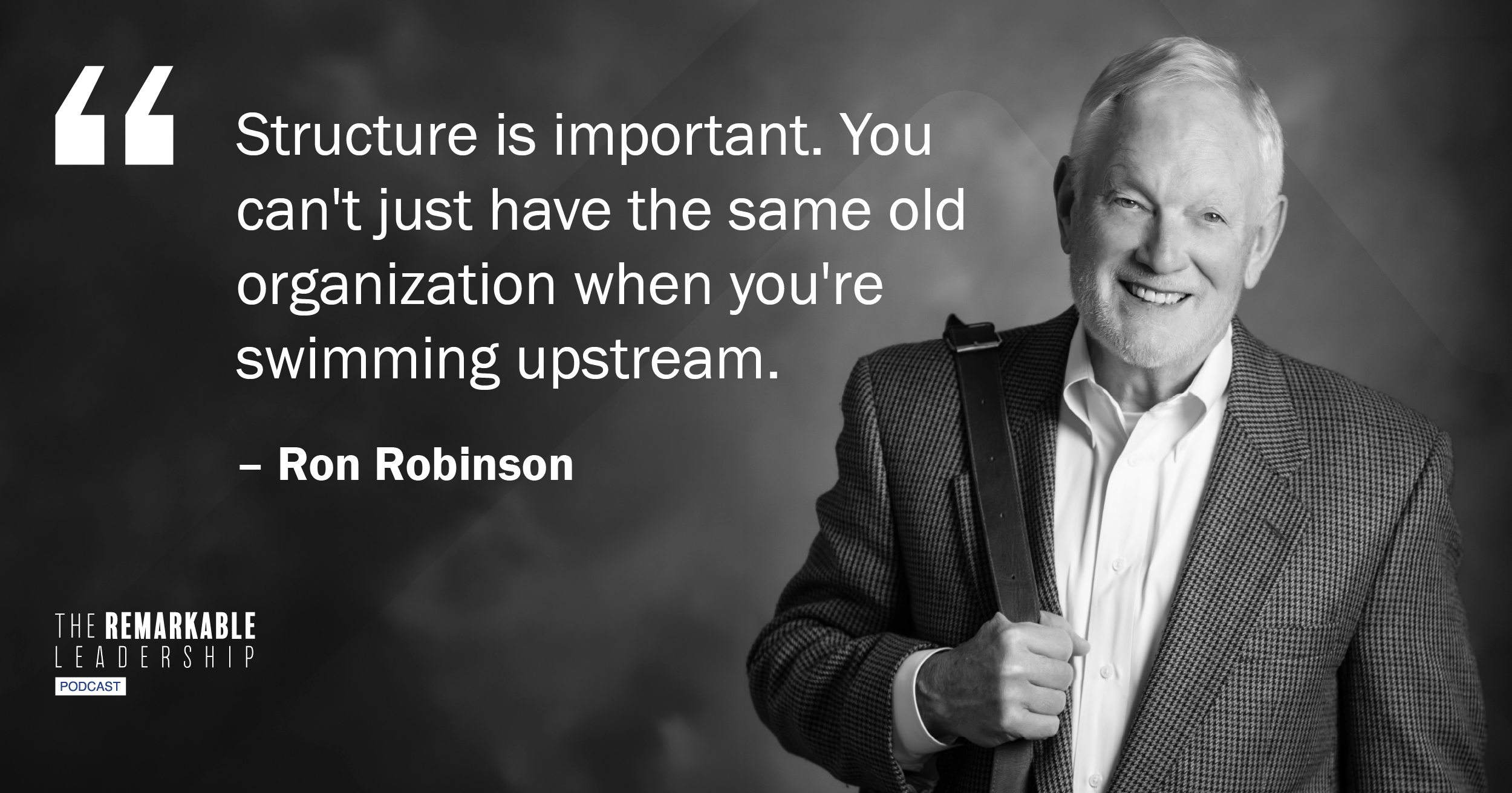
Because during the pandemic, I was asked to help a number of organizations. And when I did that, I helped the leaders first. The leaders have to know a different way of leading. And then once we worked with them, we developed a structure for the organization. Structure is important. You can't just have the same old organization when you're swimming upstream.
00:04:23:16 - 00:04:50:00
Ron Robinson
And then finally we had a strategy and we developed a strategy based on a community development model that got help and bingo. When I did that with the nonprofit, when I did that with the insurance, our organization, they both rose to the top during Covid while their competitors were struggling. And that was, at the core of it all.
00:04:50:01 - 00:05:23:15
Kevin Eikenberry
So again, the book is written from a practical perspective based on what you've actually done with organizations. And you talk about those throughout the book. But, there there's there's the question of why why this topic now? Like why? And you mentioned Covid, we're not in Covid anymore. That was obviously a disruption. But what are the what are the the reasons that make this so important today, specifically?
00:05:23:17 - 00:05:57:16
Ron Robinson
So glad you asked. I research disruption and much of the topic has been around climate and climate disasters. But when I looked at the things that were causing constant disruption, whether it's Covid or whatever, right now we've got a measles outbreak regardless of what was going on. There were four core issues that we faced continually. And Kevin, it's not Covid.
00:05:57:18 - 00:06:33:17
Ron Robinson
Do you realize during Covid, we also had social unrest? That's another disruption. Covid is part of a social issue society. The issues in society. Illness. Covid now measles. But also I realized that we also have had three recessions during this century, three recessions in two decades. That's also a disruption. And we're about ready to have another one. If you'll forgive me for saying so.
00:06:33:19 - 00:07:09:11
Ron Robinson
But then we also wound up with something called technology. And during Covid, technology was running rampant with misinformation, especially on social media. Well, we've compounded that now with not only social media, but also AI creating disruption. So the the conclusion was, Kevin, it's not just one thing anymore. There are four things that are really impacting us, and we have to be alert to all four of those.
00:07:09:13 - 00:07:35:21
Ron Robinson
Whether it's climate disaster, whether it's social unrest or social illness, whether it has to do with the economy or whether it has to do with technology, those are all impacting our businesses, not to mention our own lives nearly every day. So, Jaco, it's gone. But we're still have lingering problems with Covid, and now we're dealing with other issues as well.
00:07:35:23 - 00:08:00:11
Kevin Eikenberry
So that's the that's the friend of the book. And you say those, you know, the subtitle book is Overcome disruption. And you just identified the four, big chunks or big examples of and although you've said they're interconnected, that those four things are what we need to be preparing for. So the question is, and let's just take them each separately for a second.
00:08:00:13 - 00:08:10:03
Kevin Eikenberry
What can organizations do to prepare themselves to be more resilient? And in the face of each of those four factors?
00:08:10:05 - 00:08:35:00
Ron Robinson
Well, that's a wonderful question. And it took me, quite a bit of time on my flip charts to, to really picture that out like I should. There are four parts of a business, Kevin, and we have to be cognizant of the four parts of a business. Those four parts include, first, our financials. Many of us tend to focus just on the financials and our business.
00:08:35:00 - 00:09:01:18
Ron Robinson
We overlook the other three, quadrants in a business to our own detriment. The second quadrant has to do with our operations. How we run our operations makes a big difference in how resilient we are. Third is our employees. How we manage our employees and grow them makes a big difference in resilience. And finally, there's something that some people consider a real inconvenience.
00:09:02:00 - 00:09:36:00
Ron Robinson
It's called customers. And the way in which we deal with this inconvenience, called customers, makes a big difference in how well we become more resilient, because each of those, Kevin, we can take finance and look at how we deal with the economy, with the way in which we strengthen our financials. We can look at our operations and look at how we can be more efficient with our operations, so we can respond more rapidly to climate disasters.
00:09:36:02 - 00:10:14:01
Ron Robinson
Finally, with our employees, we can deal with the social issues in our society and our ecosystems, if you will, through the way in which we recruit, retain and grow our people. And finally, with AI disrupting everything that we live by, we can survive and thrive in the way in which we use AI with customers instead of just going back crazy, throwing in AI systems and little bots to talk to customers every time they contact a company.
00:10:14:03 - 00:10:16:21
Ron Robinson
So those things make a difference.
00:10:16:23 - 00:10:42:00
Kevin Eikenberry
Yeah. So you said that some people think of customers as an inconvenience. I think of them as the person who writes my paycheck. And so if we can get everyone thinking about it that way, we're probably going to be ahead. So, you've hinted at these four parts of the business and we've talked about the the four disruptors, if not sort of big, big ideas for disruptors.
00:10:42:00 - 00:11:05:21
Kevin Eikenberry
So let's talk a little more specifically about what are some specific things that we can do as a leader in an organization of a company, whether we're the CEO or whether we're leading a department or a team, to create more of this organizational resilience, like in, in real time, what can we actually be doing?
00:11:05:23 - 00:11:37:06
Ron Robinson
I'm going to start with finance because that's what I like to talk about. We can have stronger margins if we use our people to help us with that, rather than laying them off to have a 1% improvement in our profit margins. One company did something really radical. The plant manager realized that he had $250,000 in expenses and just material expenses.
00:11:37:08 - 00:12:02:20
Ron Robinson
So instead of firing half his mechanics, what he did was he invited him to come to a meeting. And in this meeting he said, I'm going to give you all lockers. This is in the South. You all I'm going to give you all lockers with keys and give you responsibility for managing our material costs this year. And I want you to do all the ordering for them and make the budget.
00:12:02:22 - 00:12:40:10
Ron Robinson
They did. Their budget was not 250,000. It was 100,000 at the end of the year, when they did the final year end recording, they realized that their material costs were 250,000. They weren't 100,000. There were 50,000. The mechanics on their own wanted to help the business. They did so. Shell oil, Shell Oil asked if operators on an oil rig to develop the budget for the coming year.
00:12:40:11 - 00:13:12:15
Ron Robinson
Well, this was unheard of. The management, the budgets. We don't have people doing that. She'll ask the people to do the budget. They did. They prefer they offered a budget. And at the end of the last year, after they had, proposed this budget, they were 250 million under what they had spent the year before. That's strengthening our financials.
00:13:12:15 - 00:13:41:09
Ron Robinson
It's using our people to help us think through and manage things more better. So let's move to operations. There was the company who is not doing well. It was the low margin company who made paper tubes. So this company organized its people into mastermind groups or work groups throughout its plants. At the end of the year, now, this was halfway through the year.
00:13:41:09 - 00:14:13:15
Ron Robinson
At the end of the year, they had saved this low margin company, $750,000 in their first year by using people in a different way, the same people. This was in a slow economy. We're able in this slow economy, to help the company improve and respond more rapidly to customer needs that it had. So it was actually more responsive to customer issues as well as to the financial needs of the company.
00:14:13:17 - 00:14:44:16
Ron Robinson
So that's how we get things done with climate disasters. I have a client who during Covid and a climate disaster during that time, you know, we set a record number of climate disaster. During Covid 2020, we had a record. So we were dealing with climate disasters. Then also, he put all these people together. They developed a plan for how they could do better during Covid and during this climate disaster that we were all going through.
00:14:44:18 - 00:15:22:08
Ron Robinson
When they did that, what happened was they increased their sales from 50 units a month to 80 units a month during Covid. That's faster response to customer needs. So that takes care of efficiency and customer and climate disasters. Excuse me. Now we look at our employees and George Floyd during the issues of, 2020 to today. Do you realize that we used to have six people for every open position?
00:15:22:11 - 00:15:50:07
Ron Robinson
We now have one person for every open position. We have a shrinking labor force, not just here, but around the world. The manner in which companies do better with our people makes a difference. Let me give you an example to recruit and retain people. One client decided that they would use their people to do the recruiting instead of them doing it all.
00:15:50:09 - 00:16:26:05
Ron Robinson
So they taught their people how to do interviews. Their people interviewed candidates for an open position. They made a decision on who they wanted and recommended that to the boss. The boss didn't like the person, but because they recommended him, he accepted that person. That person turned out to be the most productive person they had. And the reason why is because the employees that made the decision on this person were also the employees to help to onboard that person and train them to do the work.
00:16:26:07 - 00:16:56:22
Ron Robinson
So excuse me just a minute. We have people coming in. So that's how we deal with our employees. One of the other things we have to do is develop those employees to keep them, and to better utilize them with AI. And the way in which we do that is with adult learning theory. That means that we have to take our people and train them with people, not just online.
00:16:57:00 - 00:17:28:07
Ron Robinson
And when we use the adult learning theory with adults, we can further develop our people on the job so that they can better respond to whether it's AI, technology or other technology that they're using or implementing to help enhance the business, which gets us to customers. One of the things that can help any business with customers in AI is to do something that several companies have started learning to do.
00:17:28:09 - 00:18:00:20
Ron Robinson
These have been dealing with AI for a lot longer than a lot of us have been. But what they learned is that we can have peace with AI if we manage it with people on either end of the exchange. For example, rather than having Angelo the bot, answer the query online, a real person answers the query and says, what do you need?
00:18:01:01 - 00:18:31:15
Ron Robinson
And instead of giving a menu of things that don't meet the need of the customer, they have somebody who's listening and who can directly go. Once they diagnose the problem to AI to find solutions to that. And then with the AI finding the solution, come back to the customer and provide that solution to the customer and stay with that customer until it's resolved.
00:18:31:17 - 00:19:01:12
Ron Robinson
That is how we successfully use both. But too many of us are so enthralled with AI and Claude that they want to just use Claude instead, or another name, thinking that that's going to fix the problem. And I can't tell you how many people I've talked to who are just so frustrated right now that they would just that could spit because they cannot, for the life of them, get to a real person and get their problems resolved.
00:19:01:14 - 00:19:17:22
Ron Robinson
So that's how we deal with the technology, how we deal with the social issues, how we deal with, any kind of financial ruin in the economy and certainly how we deal with, climate.
00:19:18:00 - 00:19:39:01
Kevin Eikenberry
I appreciate you laying all that out for us. I've got a couple more questions. And, one of them is, if we're working to do the kinds of things you've been describing, Ron, how how will I or how will an individual leader know if we've made progress? Like, you've given us examples. You've laid out some some ways for us to think about this.
00:19:39:03 - 00:19:46:19
Kevin Eikenberry
How can we judge if we've become more resilient? I guess is the way I answer the question. How do we tell?
00:19:46:21 - 00:20:10:11
Ron Robinson
I am so glad you asked. There's certainly a way of doing this called scorecards. If you heard something called scorecards. Yep. Scorecards, are used in sports teams. If you've ever looked up at a basketball game, we always look up to see what the score is, right? The coach will even look up at the scoreboard to tell what score is.
00:20:10:13 - 00:20:39:13
Ron Robinson
As long as we know the score. We know how to make changes for the better. Let me give you an example. During Covid, three states pulled together. The governors of those states pulled together to start developing a common way of developing policies, developing new regulations, because they knew that nobody cared about the state line. They all moved in that whole territory.
00:20:39:15 - 00:21:04:21
Ron Robinson
One state couldn't do it. And it every morning, one of the governors reported out the number of deaths that they've had, the number of people who had reported being sick and the number of people that they had occupying their health care, operations and outside centers and inside centers. But what they did was they kept score every day.
00:21:04:21 - 00:21:38:05
Ron Robinson
We knew they knew how many deaths, how many sick people that they were dealing with, and they could tell whether or not they were having an impact based on those two numbers alone in business, one of my clients started developing scorecard, and he started measuring weekly, not monthly, weekly. The number of clients who came into his shock. He thought that he was making incredible strides with sales because the sales were up.
00:21:38:07 - 00:22:09:06
Ron Robinson
But when he tracked his customer count, his customer account was down. What was going on? He looked at his inventory and realized that his inventory costs had gone up significantly during Covid, and that he was charging more the customers that he had, and it looked like his sales were increasing. They were not. His margins were the same, but because the sales number on his register was higher, he thought that he was doing well.
00:22:09:08 - 00:22:39:10
Ron Robinson
But it was only when he tracked weekly his scores that he realized that he wasn't doing well. And guess what he started doing? He started having sales start having sales to bring in more people. He started asking people who had been out there and started offering them different, ways of coming in and having more sales. He did, but it was only through having a scorecard that he needed to do that.
00:22:39:12 - 00:23:04:01
Kevin Eikenberry
Every time around that I read a book for the show. There's usually one thing that I take from the book that I will always sort of have connected to that particular book. And you actually, in passing, mentioned that thing for me from this book. And I want to talk about this conversation, and it's the idea of internal masterminds.
00:23:04:04 - 00:23:18:04
Kevin Eikenberry
Most people, probably know what a mastermind is. You might want to comment on that briefly, but the idea, of internal masterminds and naming them that I think is worth us talking about before we start to close out.
00:23:18:06 - 00:24:07:02
Ron Robinson
Okay. Fair enough. Let's talk about Toyota and Honda. Toyota was a pioneer in developing mastermind groups or teams in an organization. They pioneered the term, subject matter expert. And subject matter expert means that the person doing the job day in and day out knows more about that job than anybody else. And if the foreman or the supervisor had been in that job and was now managing people, that supervisor had lost some of the knowledge or even currently what may be happening with that product or that process, so that that person doing it really knew more than the other people.
00:24:07:04 - 00:24:29:17
Ron Robinson
Now, if you do that and then take that group of people in that department and organize them into a group, a mastermind group, because we're using the minds that people as well as the hands of people. And if you do that and every week have a meeting with those people, ask them, what can we do better here? How can we make improvements here?
00:24:29:18 - 00:25:01:17
Ron Robinson
Or we have a disruption coming? Corporate office is coming down in three days. What do we do to make this place look better before they get here? And then use everybody to figure that out? And the reason it's faster is because they can immediately go and make the change. If I am deciding that myself and then I have to go out and tell each other person what I want and do, number one, some of them aren't going to do it.
00:25:01:19 - 00:25:31:15
Ron Robinson
And number two, the others may even misunderstand what I said, but we're much faster in our response. We're more efficient in the way we run our businesses when we have that group that meets every week and is conditioned to make decisions on how they're doing their work, and if the boss is not even there, they can get together and talk about what's going on and how we can do things better, or how can we fix something if Joe's not here or Betty Lou's not here.
00:25:31:19 - 00:25:37:16
Ron Robinson
What do we do instead? It just makes for a more efficient business.
00:25:37:18 - 00:26:03:02
Kevin Eikenberry
So obviously, the idea of process improvement teams and bringing teams together, the things that you've been talking about, Ron, I think, are well known, well established and you've described them very well. The the idea of calling them a an internal mastermind is the thing that captivated me. And I think for people who know, about the idea of, of, of a mastermind that wouldn't be inside of organization, I think that brings a new flavor to what you've described.
00:26:03:02 - 00:26:20:23
Kevin Eikenberry
And I and I appreciate you sharing it that way. So before we go, there's a couple of other questions I want to ask you. One is the one that you knew I was going to ask. And I ask every week if people are listening and that have been here before, you know, what's coming next. So, Ron, what are you reading these days?
00:26:21:00 - 00:26:34:00
Ron Robinson
It's a little book called On Tyranny by Snyder, a, a business professor in Canada who writes on, leadership on there and on tyranny.
00:26:34:00 - 00:26:53:09
Kevin Eikenberry
We will have that in the show notes, as well as link to, Ron's book, the practices or excuse me, practices of resilient companies overcome disruption with compassion, collaboration and knowledge. And I'll hold it up for those watching. Ron, where will you tell us? Where do you want people? Where do you want people working to learn more about you, about the book, etc.?
00:26:53:11 - 00:26:56:15
Kevin Eikenberry
Where do you want people to go to learn more?
00:26:56:17 - 00:27:09:20
Ron Robinson
They would enjoy going to a website called Ron speaking.com, speak with leaders on different ways that we can all become more resilient.
00:27:09:22 - 00:27:27:15
Kevin Eikenberry
Ron speaking.com. And you also have a Substack at Ron speaking that substack.com, if I remember correctly. So, so now that, we've had the chance to chat, Ron and I and I ask a question of all of you who are watching or listening. And again, this is the only other thing I ask you every week. It's simply this.
00:27:27:15 - 00:27:45:19
Kevin Eikenberry
It's the most important question I could ask you right now. Really the most important you can ask a question, you can ask yourself, which is now what? Now that you've had the chance to learn from Ron about what it means to be and how to lead a more resilient organization or team? The question is, what are you going to do?
00:27:45:21 - 00:28:04:19
Kevin Eikenberry
What action you're going to take? Just hearing this, might be interesting, might be inspiring, but it's not going to change anything in your business is going to change anything for you as a leader unless you take action. So the question is, what things did you capture in your mind or with your pen or I suppose, with your computer?
00:28:04:21 - 00:28:17:09
Kevin Eikenberry
That would lead you to take action. And it's my hope that you will do exactly that, because when you take action, this will have become truly useful for you. Ron, thank you for being here. It was a pleasure to have you. Thanks so much.
00:28:17:11 - 00:28:18:22
Ron Robinson
Thank you.
00:28:19:00 - 00:28:38:06
Kevin Eikenberry
And so, everybody, we're going to close this episode, but it's only for a short time because you know that I'll have another guest with me next week. And there's other things that you'll find here as well on the Remarkable Leadership Podcast. Make sure that you are subscribed so you don't miss any future episodes. And we'll see you again right here on the Remarkable Leadership Podcast.
Meet Ron

Ron's Story: Ron Robinson is the author of Practices of Resilient Companies: Overcome Disruption with Compassion, Collaboration and Knowledge. He has consulted with and helped turn around enterprises ranging from Fortune 500 companies to mid-size organizations to startups. He has presented to audiences as large as 3,000 and facilitated groups as large as 300 participants.
Follow The Remarkable Leadership Podcast


Looking to Develop Stronger Leaders?
Want help developing the leaders in your organization? Reach out to explore how the Kevin Eikenberry Group can support your team.
Book Recommendations
Like this?
Join Our Community
If you want to view our live podcast episodes, hear about new releases, or chat with others who enjoy this podcast join one of our communities below.
Leave a Review
If you liked this conversation, we'd be thrilled if you'd let others know by leaving a review on Apple Podcasts. Here's a quick guide for posting a review.