How can leaders make smarter decisions, motivate people, and stay effective when things get difficult? Kevin is joined by Caroline Webb to explore three dimensions of leadership intelligence: deliberate wisdom, intrinsic inspiration, and reasoned resilience. She explains why better decisions begin with intentionally widening your perspective while reducing cognitive overload, and how leaders can strengthen motivation by increasing people’s sense of competence and connection. Kevin and Caroline also discuss how AI can support better thinking without replacing human judgment, empathy, and accountability that leadership still requires.
00:00:08:15 - 00:00:39:23
Kevin Eikenberry
Check out our title today. Who doesn't want to be a more intelligent leader? If you do, keep listening. We're going to talk about some of the biggest challenges we face as leaders in some of the science backed strategies we can use to master them. How about that? Welcome to another episode of the Remarkable Leadership Podcast, where we are helping organizations and their leaders grow and lead more effectively to make a bigger difference for their teams, organizations, communities, and the world.
00:00:40:01 - 00:01:04:20
Kevin Eikenberry
So glad that you are with us. If you are listening, you could join us in the future on your favorite social media platform. To get all the information about when those shows are happening and how you can be a part of them. You can just check out our Facebook or LinkedIn groups. Just go to Kevin. Excuse me, go to remarkable podcast.com/facebook or remarkable podcast.com/linkedin to get all the scoop and to join us.
00:01:04:22 - 00:01:25:04
Kevin Eikenberry
And because you're listening to this podcast, I'd like to give you a free gift. And that is the, a short practical action guide to help you get more from any podcast, including this one. If you're listening, you can even go to this pause and go to this link right here. Kevin eikenberry.com/get more so you can get more from every podcast including this one.
00:01:25:09 - 00:01:46:02
Kevin Eikenberry
And with that, I'm going to bring in my guest. Her name is Caroline Webb. She's right here with me. Now if you're watching, she is the author of the brand new book. As we're having this conversation five days before it's officially released. She's the author of this new book, Leadership, Intelligence, and also of the best seller How to Have a Good Day.
00:01:46:04 - 00:02:09:00
Kevin Eikenberry
She's a leadership coach, economist, and speaker, known for being one of the world's leading experts in using insights from behavioral science to improve professional life. She is a global bestseller published in 18 editions over 60 countries. She's a senior advisor for McKinsey, where she previously was a partner, has been rated by thinkers 50 as one of the top 50 executive coaches in the world.
00:02:09:01 - 00:02:30:20
Kevin Eikenberry
Her book is The Cortex. Throughout the book is the core text, for Professor Jonathan Haidt, work, Wisdom and Happiness course at NYU Stern School of Business. She's also a guest lecturer at Harvard, Chicago Booth, Columbia Business School, London School of Economics, London Business School on applications of behavioral science to leadership and workplace effectiveness. She's originally from the UK.
00:02:30:23 - 00:02:45:17
Kevin Eikenberry
She has degrees in economics from Cambridge and Oxford. Clue, everyone. She's really smart. She is based in New York, but travels widely to coach clients and deliver keynote speeches. She's our guest today. Welcome, Caroline. Glad to have you.
00:02:45:19 - 00:02:48:17
Caroline Webb
Thank you so much, Kevin. What a great intro.
00:02:48:19 - 00:03:05:01
Kevin Eikenberry
Well, most of it. It's the one your mother wrote. But but listen, I am so glad that you're here. I really, really like this book. One of the best parts. Well, there's so many best parts for me about doing this podcast and having done it for ten years. I guess if it wasn't something I liked, I would have stopped.
00:03:05:03 - 00:03:28:10
Kevin Eikenberry
But one of my one of the best parts, other than getting to talk with smart people like you, is to get the chance, in most cases, to read the books before most anyone else has, which has been my case here. So the book is called leadership, Intelligence, Science. Back Strategies for mastering 21 Every Day Management challenges. So the question why now?
00:03:28:12 - 00:03:50:17
Caroline Webb
Why now? Well, I've been coaching leaders for over 25 years and always using, an approach that's been grounded in cognitive and behavioral science. I had a first career as an economist, and I always found that a little bit of understanding of the human mind made it easier for, managers and leaders to bring the best out of, the human talent around them and the human tongue in their own head.
00:03:50:19 - 00:04:16:00
Caroline Webb
I will say about eight years ago, I had been thinking about writing a leadership book to kind of distill that and make it accessible for everybody. But eight years ago, I read some work from my old firm, McKinsey, which was about automation and about human strengths that were going to survive automation that were likely to endure after, after the robots, you know, had completed their march.
00:04:16:02 - 00:04:44:19
Caroline Webb
And it was interesting. I was really stuck in my mind, the fact that judgment, critical thinking, the fact that building relationships, building trust, bringing the best out of people, helping people sort of find a way through, challenges. These came out so strongly as human strengths. And I just thought, gosh, as leaders in the coming decade, decades, we need to be able to bring the best of those human strengths out of us all the all the people we work with.
00:04:44:21 - 00:04:58:17
Caroline Webb
And that's the genesis of the book. That's where the idea came from, is human intelligence. How do we make the most of it? As leaders, as managers and for ourselves. And that's what I hope the book does, for everybody, a reason.
00:04:58:19 - 00:05:13:00
Kevin Eikenberry
So you sort of answered this, but I want to ask this question, because I think you can maybe take it a little further. What's what then, is the big that's why the book. What's the big idea of the book?
00:05:13:02 - 00:05:34:07
Caroline Webb
Well, the big idea is that we all need, as you say, you know, touches on what I just said. We all need to bring the best out of the human intelligence that we have in our teams. And, you know, for so many of us, you know, we we're not absolutely unaware of the fact that there's a human mind and that certain things get the best out of us and other people.
00:05:34:07 - 00:06:13:00
Caroline Webb
And but there's much more logic to it than perhaps is obvious. And even just understanding if you principles about how the brain processes information, reward and threat unlocks so much clarity and how you should do everything from understanding a really complex situation to leading a fantastic frank open team discussion to getting people excited about moving towards a goal, to dealing with some of the really tough stuff like leading people through uncertainty or, you know, trying to work with your team to to handle, you know, really tough failures.
00:06:13:02 - 00:06:31:09
Caroline Webb
And so much of it goes back to that understanding. So what I'm trying to do in the book is I lay out some big principles, and then I show the meat of the book is this 21 chapters that are super practical, that say, okay, now let's apply it to each of those really practical situations. What's the playbook? What are the three, 4 or 5 steps?
00:06:31:11 - 00:06:41:17
Caroline Webb
And, you know, I hope that I've broken it down in a way that people can reach for if they have three minutes before a meeting or, you know, meeting a deadline.
00:06:41:17 - 00:07:15:09
Kevin Eikenberry
But maybe, definitely, maybe you definitely did that. And I really, you know, if we go inside baseball as authors and as, as, as a, as a consumer of this kind of content, I think the chapters are really fantastic in terms of this. And they unpack and they and there's consistency across them. And, and I do believe, and I will tell everyone as I'm talking to Caroline Webb, the author of the brand new book, Leadership Intelligence, that this is a book that if you get a copy, first of all, if you're watching me right now, it's thicker than many, but it's got 21 thing, 21 challenges that we all face.
00:07:15:11 - 00:07:30:17
Kevin Eikenberry
But I think this becomes a reference book. Right? It is a book that you can certainly read all the way through. But I think it will be more useful from my perspective. I'd be interested in what you think. Yeah. As the writer, that that it becomes a reference guide. I do have something coming up in three minutes.
00:07:30:17 - 00:07:35:11
Kevin Eikenberry
Five minutes, ten minutes tomorrow. Yeah, I'm struggling with this kind of thing.
00:07:35:13 - 00:07:53:10
Caroline Webb
I love that you said that. I love that you say that because, I did write the book to be read in two different ways. There is absolutely the sitting with a beverage in a nice chair, working your way through from start to finish, maybe picking a chapter, you know, every couple of weeks and reflecting on it and, and so on.
00:07:53:16 - 00:08:18:04
Caroline Webb
But absolutely, I wanted it to have this dual use of the, the quick fire manual that sits on your desk that you can dive into and get very quick advice. I mean, I also love that you you notice the the fact that every tax is laid out exactly the same. So it's also easy to navigate. I was really trying to walk my own talk on what I know about what makes it easier for the brain to process information and and so forth.
00:08:18:04 - 00:08:22:01
Caroline Webb
So, thank you for pointing that out. It's nice to hear.
00:08:22:03 - 00:08:38:02
Kevin Eikenberry
Well, now that Kevin has gotten his gold star for the day, let's dive in. So, you know, the thing that I. Yeah, there's 21 track chapters, and we're going to we can't talk about 21 things. You'll have to buy a book and we'll we'll pick a couple. We'll talk about a couple of things. But the thing, the other thing that fascinates me is you.
00:08:38:02 - 00:08:57:13
Kevin Eikenberry
You put everything into you put the 21 into three categories. And you pick these three categories. They're actually on the they're actually on the cover of the book. And so, I want to we're going to go into the science of each of them a little bit more in a second. But before we do that, I just like you to, like, tell us what the three are.
00:08:57:15 - 00:09:09:23
Kevin Eikenberry
And how it is. Or the more interesting question to me is how did they become the buckets? Because at least one of them, I don't know that people would have immediately thought would have been one of them.
00:09:10:00 - 00:09:10:06
Caroline Webb
00:09:10:08 - 00:09:19:15
Kevin Eikenberry
Interesting that anyone would disagree with the importance but I'm not sure they would have said hey this is one of the key three things. Yeah. So why don't you talk about what the three are.
00:09:19:20 - 00:09:20:13
Caroline Webb
Okay. Sort of how.
00:09:20:13 - 00:09:22:05
Kevin Eikenberry
You came to those three.
00:09:22:07 - 00:09:44:23
Caroline Webb
Yeah. So the three are deliberate wisdom, intrinsic inspiration and reason, resilience. You can think of it like this. You know, you have to make good choices about what you and your team do. Then you have to get them excited to do it to the best of their ability. And then you have to keep people moving forward when things get tough.
00:09:45:01 - 00:09:59:10
Caroline Webb
So that's really, you know, that's the territory of wisdom, inspiration and resilience. And, you know, the science of each is is kind of elegant for those who, you know, are interested in that. You don't have to read any of the science to actually use the book.
00:09:59:12 - 00:10:00:22
Kevin Eikenberry
But it's the best part.
00:10:00:22 - 00:10:22:07
Caroline Webb
Oh, sorry, but but so those who those who like the, that science backbone, it's really clear that, when we're thinking about deliberate wisdom, these are the critical thinking habits that help us see a situation clearly and think clearly about what the options are and then, you know, make smart choices. And we get better at that.
00:10:22:07 - 00:10:44:05
Caroline Webb
If we have a little bit of appreciation of the science of how the brain processes information, and specifically the fact that we've got very limited amount of conscious attention and actually to be wise leaders and to help our teams be wise, we need to be very intentional about why we direct that small amount of conscious attention. And then intrinsic inspiration is.
00:10:44:07 - 00:10:45:08
Kevin Eikenberry
Where we can't oh yeah.
00:10:45:11 - 00:10:45:19
Caroline Webb
I know.
00:10:45:21 - 00:11:00:16
Kevin Eikenberry
I yes, agree. And by the way, I love that idea of of deliberate wisdom. We all have wisdom, like every human that's a of a certain age, I suppose, has some kinds of wisdom, but this idea of making it deliberate is so that's why I want you to stay here long.
00:11:00:18 - 00:11:01:15
Caroline Webb
Yes, yes.
00:11:01:17 - 00:11:11:06
Kevin Eikenberry
Like, okay. So, yeah, we gotta we gotta think about intentionally focusing our attention. But on what? And how do we do that. Talk about that just a little bit more.
00:11:11:06 - 00:11:29:00
Caroline Webb
Yeah, sure. Happy to. So, you know, experiential wisdom is, you know, things you've seen before and that gives you that sense of, okay, well, this is what I should do now. But the problem with it is that if you're dealing with something that's totally new, which most things are most of the time, actually, in some degree, then experience just isn't really enough.
00:11:29:00 - 00:11:48:06
Caroline Webb
We need to be able to see what's in front of us and be really smart about seeing what matters. And, because of that tiny amount of conscious attention to be to make the best choices sometimes say this again and again, all sorts of different ways we need to be able to say, I noticed what I'm thinking.
00:11:48:08 - 00:12:06:15
Caroline Webb
I'm going to take a step back and I'm going to widen my perspective. And, you know, I don't you know, there are all sorts of different ways that you can do that. I find having go to habits and or questions that you reach for again and again is the easiest thing, because this is all very unconscious. You're dealing with say you're saying, okay, I notice this is what I'm thinking.
00:12:06:19 - 00:12:26:08
Caroline Webb
Step back. How do I widen my perspective? Perhaps by saying, what am I missing? How do I check this? How do I test that? What would be a different way of seeing this? And then that plays through. As you can imagine, all the chapters about making good decisions and so on, but that's really the heart of it. But then I've just said that we've only got a tiny amount of conscious attention.
00:12:26:08 - 00:12:50:11
Caroline Webb
So, you know, hey, Caroline, you're saying I should actually try and notice more? But then, you know, how do we do that? You know, we're going to get exhausted. So the other part of the equation is you don't just widen your perspective, you lighten your cognitive load wherever you can, because most of us is frittering away our cognitive attention across so many distractions.
00:12:50:13 - 00:12:56:22
Caroline Webb
You know, I'm looking around my desk, and I have a lot of post-it notes, and, you know, there are tabs open and so on. Whether one.
00:12:56:22 - 00:13:00:10
Kevin Eikenberry
Of us want the world to see what they can't see on the.
00:13:00:10 - 00:13:02:16
Caroline Webb
Screen. I know this looks nice, right?
00:13:02:16 - 00:13:05:02
Kevin Eikenberry
This is really good, right.
00:13:05:04 - 00:13:28:17
Caroline Webb
So but the thing is, you know, all of us think that, we make fewer mistakes. We move more quickly through challenging problems, we more likely to see interesting solutions if we reduce the amount that we're multitasking. And we bring our attention to one thing at a time. So if we splinter our attention across multiple things that actually require us to think, nothing gets the full value of our intelligence.
00:13:28:22 - 00:13:42:07
Caroline Webb
And so smart leaders are really attentive to this for themselves, but also for their teams and thinking about how to how to sustain people's attention and not break it up by, you know, pinging each other all the time. For example.
00:13:42:09 - 00:14:10:05
Kevin Eikenberry
I have to tell you, when I was reading it, when I was reading that section and, thinking about that, I knew that I couldn't get through this episode, in September of 2026, when the book title is Leadership Intelligence without talking about Artificial Intelligence. And we may do that a little bit more before we're done. But but I will say that for me, one of the things that AI tools are doing for Kevin as a leader is they're helping me with that cognitive load.
00:14:10:05 - 00:14:34:02
Kevin Eikenberry
Yes, absolutely. Using it in ways very specifically to help me with that. Yes. And it's and it's really do a phenomenal job for me. I don't really hear anybody talking about that in that way. And when you said it, that was the connection I made, which to me is about deliberate wisdom, like making that connection, in that way, as an example of that, from my perspective, I agree.
00:14:34:02 - 00:14:39:12
Caroline Webb
And, you know, I would say that I can also help you with wins. And if you're intentional about it.
00:14:39:18 - 00:14:40:11
Kevin Eikenberry
100%.
00:14:40:11 - 00:15:08:01
Caroline Webb
One of the ways that I use it is to kick the tires on my thinking and tell me what I've missed and what a different perspective could be. And I do. I do find that's very helpful as long as you've done some thinking first for yourself. The way I think about it is you've got to do the first mile and the last mile, so that your framing, the issue that you're thinking about, what are the dimensions that you've got some thinking to be tested and to be tracked.
00:15:08:03 - 00:15:31:05
Caroline Webb
And then the last mile always sits with you as a leader because you're the one that takes accountability. So you really have to then, you know, close it down and go through and check and test yourself again. So, you know, I think absolutely, this is not, human intelligence on its own is the only way that, you know, we move forward is human intelligence combined with artificial intelligence and how we make the most of this.
00:15:31:07 - 00:15:46:13
Kevin Eikenberry
And and the and the human intelligences on our team. We talked about that a little bit more. The second, of the pieces is the is the excuse me, is the inspiration piece. Yeah. So give us a little of the science behind, how we spark inspiration.
00:15:46:16 - 00:16:09:01
Caroline Webb
Yeah. So this is when you think about motivation in your team. You know, sometimes we tend to think, oh, well, you know, this person is really engaged and driven, and this person does not so much not so proactive. But what's interesting is that there's the same mechanism sitting in people's minds, that links everybody, which is that the engine of motivation for all of us is our reward system.
00:16:09:01 - 00:16:13:09
Caroline Webb
The brain's reward system. And the reward system makes us want to be spoken.
00:16:13:09 - 00:16:15:12
Kevin Eikenberry
Like an economist, by the way, just say it.
00:16:15:14 - 00:16:36:08
Caroline Webb
Well, essentially, I mean, it is interesting when we think of what fuels the reward system, and we care about this because it's what makes us want things move towards and want to keep going, want to persist, of course, you know, when you think of the word reward, you think, oh, you mean money, right? And as an economist, I am contractually obligated to say, yes.
00:16:36:08 - 00:16:59:22
Caroline Webb
Money, you know, can be seen to engage the brain's reward system, but only for a short period. And then you habituate. And in any case, you know, most of us have limited budgets, right? I mean, we don't have infinite, you know, bonuses that we can pay. So it's really powerful for us as leaders to have a working understanding of the intrinsic rewards that fire up everybody's reward system.
00:17:00:00 - 00:17:22:12
Caroline Webb
And in the workplace, they tend to cluster around competence, feeling of being capable, feeling, learning if you're not already capable. And autonomy, you know, it's to get things done. This is sort of all feeds our sense of competence. And then the other big cluster of intrinsic rewards is around connection, a feeling of being useful to others, feeling of being respected by others and, you know, ideally respecting them in return and all that.
00:17:22:12 - 00:17:45:16
Caroline Webb
Yeah. Yeah. Exactly. So, you know, that's where purpose comes in. That's where belonging comes in and so on. There are lots of different words and tags and names for different pieces of this. But the science is really clear that this is, you know, a really important pair of principles to keep in mind as leader. Because if you've got someone who's not looking super fired up, the chances are there's quite a bit you can do to boost their sense of competence and connection.
00:17:45:16 - 00:18:07:17
Caroline Webb
It could be being more attentive to making sure they know what they're doing well and what they should be doing. Morals, paying attention to their development because that also fires people sense of competence. It could be thinking about, well, what do they really understand? How they work is useful. Actually, sometimes we sort of seems blindingly obvious, and sometimes it's actually not so obvious.
00:18:07:22 - 00:18:18:23
Caroline Webb
We need to pass on the nice things that we've heard other people say about what our team is doing. And, you know, that's not just a nice to have. That's not just a kind of, oh, this makes, you know, makes the team feel jolly. Its core.
00:18:18:23 - 00:18:19:16
Kevin Eikenberry
Work is.
00:18:19:16 - 00:18:35:09
Caroline Webb
Core. Exactly. It's core work, to boost people's motivation from day to day so that I think, is a really powerful package to take through everything you do from, you know, goal setting, driving change, you know, bringing the best out of your people.
00:18:35:11 - 00:18:42:05
Kevin Eikenberry
I tell I tell leaders all the time. I said, listen, if you quit paying them, they're going to quit coming to work. But the check isn't the only reason they come.
00:18:42:07 - 00:18:43:03
Caroline Webb
Right? Right.
00:18:43:03 - 00:19:00:13
Kevin Eikenberry
It's playing around with those things are and they're not all exact. They're in those two buckets of competence and connection. But but what they are for individual people at different stages or times of life are different. It's our job as leaders today to help figure those out and help them see them too.
00:19:00:15 - 00:19:24:18
Caroline Webb
Yeah. Absolutely. Right. And then reason for resilience is what happens when despite, you know, reading situations really wisely, making wise choices, firing up the team and creating really inspiring team culture that is rich in competence and connection. You hit a road bump at between all day. You know, it can be just it can be a question of workload.
00:19:24:18 - 00:19:49:04
Caroline Webb
It can be a question of something going wrong. It could be a question of facing into uncertainty. So that's where it really helps to understand how the brain processes threats. Because this newer work on this, which is interesting, which is the fact that. So first of all, when when we are facing something I'll Franco's is a threat. Brain activity rebalances to make us more jumpy and less reflective.
00:19:49:06 - 00:20:06:16
Caroline Webb
And, you know, that kind of makes sense as you're facing a kind of, you know, threat to life limb, but not so great, you know, in the conference room, because, you know, then we're we're jumping around less reflective. So you want as a leader to know exactly how to move people out of a state of, you know, defensive mode.
00:20:06:19 - 00:20:31:06
Caroline Webb
There's a threat incoming. And so much of this comes down to, can you make a situation feel slightly more manageable so it doesn't feel totally uncontrollable? A big trigger for stress may be slightly more meaningful, so it doesn't feel completely unpleasant because it's it's only when things are demanding, uncontrollable and unpleasant that we actually feel as we mount a stress response.
00:20:31:06 - 00:20:55:12
Caroline Webb
It's actually the combination of the three. So as leaders, anything we can do to chip away at that uncontrolled ability and the unpleasantness is enormously powerful. And so anything you can do to make a situation feel more manageable by helping people home in on what's known, not just what's not unknown. For example, helping people tap into their experience and their talents.
00:20:55:14 - 00:21:10:09
Caroline Webb
And, you know, anything you can do to bring the humanity out of a situation, you know, some humor, some some care, some sense of pulling together. You know, these things make a big difference. So that's what that's what tips the brain out of defensive mode. If you're really smart about it.
00:21:10:11 - 00:21:32:10
Kevin Eikenberry
You shared something a second ago I think is really important. And it's this idea and you talk about it in one of the chapters, more is this idea of when there's so much this unknown, we need to go back to what's known. And I said the same thing about change. Like when when change is upon us, we tend to think that everything's changing when that's not true either.
00:21:32:10 - 00:21:49:07
Kevin Eikenberry
So it's the same principle, right? Like let's. Okay. It's not all changing. It's not all unknown. Let's step back and say what is known. What do we know as our starting point? It gives us a chance to take a mental breath. Yes, an emotional breath, even a yes, so that we can then reframe what's left.
00:21:49:12 - 00:22:06:17
Caroline Webb
Yeah. And I think it helps us as leaders to if we're, you know, needing to lead our team through a really, you know, a tough stretch. This is good mental preparation for us to do our selves, you know. Okay. What do I know for sure. Some facts okay. Maybe I don't have all the facts, but maybe I have the timing of when I will know the facts.
00:22:06:17 - 00:22:27:10
Caroline Webb
That's that's still something to know. Maybe I know what the priority is. So. Okay, I know everything's really tough right now. I know we don't know. You know what the scale of the reorg is going to be? We will get an announcement from the board on Friday. In the meantime, our priority is to do great work for these three clients.
00:22:27:12 - 00:22:50:06
Caroline Webb
Okay, okay, that's a little bit more bounded. And there's actually a kind of fact that is also the kind of thing to know, which is also your feelings, you know, actually naming how you feel and saying, okay, I know this feels tough. I know this feels challenging is actually a way of acknowledging something that's known, which is how you feel.
00:22:50:06 - 00:23:00:01
Caroline Webb
And it's really interesting. I mean, there's lots of research to show that actually doing that, acknowledging how people feel reduces the sense of a lot.
00:23:00:03 - 00:23:25:05
Kevin Eikenberry
100%, 100%. So, which takes me back to something else. You were just saying, I think is really important, and that is that if leaders do, even if not as completely as you just described, but are doing some amount of that assessment of the change or of the unknown situation, they're doing it ahead of the team, which is useful, except they act as if in their head, as if everyone else is where they are.
00:23:25:07 - 00:23:43:02
Kevin Eikenberry
No one else is where you are. You've had this information longer. You've been processing it differently. And so you've gotten to hopefully some better place, but you can't forget that they're not there and you can't treat them like they are because they're not they can't be not.
00:23:43:05 - 00:24:06:11
Caroline Webb
Yeah. It's so true, so wise. You know, one CEO I know who's unfortunately, you know, throughout the course of her career, she's ended up having to do several rounds of layoffs. She says, you know, it's it's incredibly stressful for everybody, especially the people who are let go. Let's be clear. She says, you know, you get to the announcement and you're feeling, you know, pretty wrecked.
00:24:06:15 - 00:24:19:03
Caroline Webb
If you have any empathy, you get through it. And then for you, you've been building towards this, it's easy to then think, oh, okay, now at least we can move forward.
00:24:19:05 - 00:24:21:18
Kevin Eikenberry
But there's you starting your eyes right?
00:24:21:20 - 00:24:47:10
Caroline Webb
And she says, you know that you have to. She advises other leaders in her peer groups. She says, you've got to realize that everybody else has to catch up with where you are. You've had you've had a good long while. So think about this and to get ready for this. And they have not and that need to really leaning with the manageable and meaningful and the kindness and the clarity, is absolutely crucial in those times.
00:24:47:12 - 00:25:06:11
Kevin Eikenberry
So I'm going to make a comment to everyone who's listening. The plan that I had for this episode is not gone exactly. I mean, hasn't gone exactly like I thought it might. No, no, I don't I don't mean it that way. But here's what I mean is I kind of thought we talk about some stuff and then we get into some of the, challenges.
00:25:06:13 - 00:25:28:02
Kevin Eikenberry
We don't really have time to do that, but I don't feel bad about that at all. And here's why. Everybody. Because as you've been listening, you've gotten hints about all of the challenges and you've got hints about challenges that aren't among the 21 that Caroline picked to put in the book. So I, I don't feel bad at all that there's stuff here that I kind of thought I hoped I might get to.
00:25:28:04 - 00:25:45:18
Kevin Eikenberry
So I'm just going to do this. Caroline, is there is there something that we haven't talked about that maybe either you you'd really like people to hear or at this moment, just you feel led to let people know, like, what's one other thing that you want to share before we start to go into the back part of our company?
00:25:45:23 - 00:26:07:16
Caroline Webb
Well, I think there's there's throughout there is this interplay between leading yourself and leading others. And, you know, everything that we've talked about that is about ourselves. We can do for our teams, everything we've talked about doing for our teams, we can do for ourselves. You know, we've covered chapter 20, which is a thousand captured, captured, chapter 16, which is uncertainty, chapter 15, which is managing stress going backwards.
00:26:07:16 - 00:26:26:12
Caroline Webb
We've we've talked about, you know, anyway, the point is, you know, we've touched on quite a lot, but sometimes it's with the south angle and sometimes it's with the others angle. And actually, you know, it's a two way street. Everything that we can do to manage ourselves through this time, is going to help us be better leaders to, to our team and vice versa.
00:26:26:14 - 00:26:44:15
Kevin Eikenberry
I love that. So I guess we have to probably do one more thing about back to what I promised earlier. Like anything else you want to say? Since the book is called leadership, Intelligence, anything else you want to say about artificial intelligence, which seems like we almost have to say in 2026. I think you want to add to that before we wrap up.
00:26:44:17 - 00:27:01:06
Caroline Webb
I think you covered it really well. I mean, it's a question of being smart about how you use it because you want it to sharpen your intelligence. You don't want it to atrophy. Your intelligence. There are some things that we are distinctively good at as humans. And, you know, we want to hold on to those strengths, not let them.
00:27:01:06 - 00:27:20:19
Caroline Webb
Whether we want to have AI amplify our ability to, to to do these things. So, for example, you know, when we talk about thinking about where someone is coming from, what's making them tick, trying to figure out what might unlock their performance, you know, you can talk about that. You can type, out your situation and say, okay, competence and connection.
00:27:20:19 - 00:27:50:03
Caroline Webb
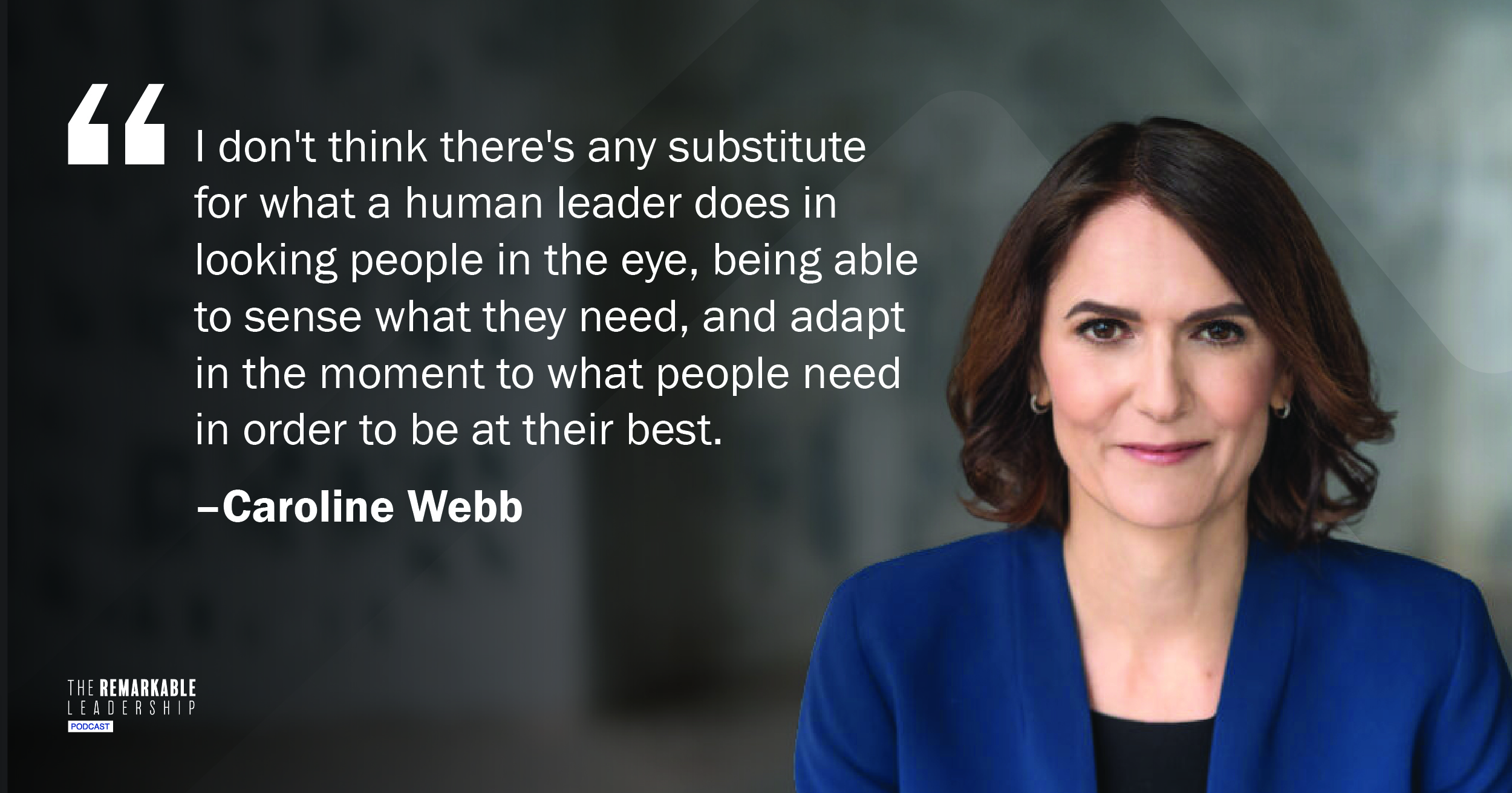
What do you think I might be missing? What might, unlock, this in this person? So I think, you know, we can be smart about seeing this as a way of deepening our thinking and widening our perspective, in all sorts of different ways. I don't think there's any substitute for what, human leader does in, you know, looking people in the eye and being able to sense what they need and adapt in the moment to what, to what people need in order to be at their best.
00:27:50:03 - 00:28:00:03
Caroline Webb
And I don't think anything is going to take that away for a very long time. But we can certainly make use of these tools to be even better at that, of that human stuff.
00:28:00:05 - 00:28:15:07
Kevin Eikenberry
I couldn't say it better. That's why I have guests. Everybody. Besides, you want to hear from me every. Every week. Anyway, so I have a question for you, Caroline. Ask everybody. And we just had a couple of minutes before we went live, but I didn't tell you I was going to ask you this. What are you reading these days?
00:28:15:08 - 00:28:35:14
Caroline Webb
So because of the work I do, I read a lot of, a lot of nonfiction every day. A lot of, you know, science studies, actually, and trying to say, okay, what's been really, you know, elegant nugget that I can share with people. But so I leave things. I read fiction, I fiction, fiction, fiction, fiction. And, there's a book I recommend, actually, I'm about to pick up again.
00:28:35:18 - 00:28:58:16
Caroline Webb
I've rarely read for the second time, but I think this is worth it. It's a book called Drayton and McKenzie, by Alexander Starrett. It's just come out in, North America. It's been it was out in the UK, quite a bit ago. And so anyone who likes fiction and likes Kevin, what you do it is a wonderful intersection because it's about two young men starting a company.
00:28:58:16 - 00:29:06:23
Caroline Webb
And there's so little representation of that in in fiction. And it's just it's very it's beautifully done. So I would I would suggest that.
00:29:07:01 - 00:29:23:20
Kevin Eikenberry
We will have a link to that in the show notes. We'll have a link of course, to Caroline's book, leadership, intelligence, science Pick Strategies for mastering 21 Everyday Management Challenges. But before we go, Caroline, where do you want to point people? Where can they learn more about your work and the book, etc.?
00:29:23:21 - 00:29:45:10
Caroline Webb
Thank you. I'd send, everybody to Caroline Webb, echo web with tubes, echo Dot dot com, and you'll find, newsletter resources, downloadable tools, that you might enjoy that will go with the book, to allow you to see how to apply the book in all sorts of different ways. And, you can also reach out to me on LinkedIn.
00:29:45:10 - 00:29:47:19
Caroline Webb
I'm also happy to see people there.
00:29:47:21 - 00:30:05:21
Kevin Eikenberry
Excellent. So before I say goodbye to Caroline and goodbye to you, I have a question for all of you as listeners and watchers. It's a question I ask every single episode. It's simple but powerful. The question is, now what? Yeah, like, what are you going to do? Not just like, well, I'm going to turn this podcast off and keep walking or riding my bike or whatever.
00:30:05:21 - 00:30:22:21
Kevin Eikenberry
And I'm not just making dinner. I don't know what you're doing. But here's the thing. Maybe you found this interesting. Hopefully you found this interesting. Maybe mildly entertaining. None of that matters. What matters is what action will you take as a result? And Caroline would like you to buy a copy of the book, and I would do.
00:30:23:00 - 00:30:43:17
Kevin Eikenberry
But I'm not just talking about that. I'm talking about what did you hear in our conversation for the last half an hour or so that you could go do something with that? You could go apply. You heard something it says that applies to me today. That's the thing that you should do. You should take some action because until you take action, this will have been a very limited value to you.
00:30:43:17 - 00:30:55:10
Kevin Eikenberry
And so I hope that you'll do that. And I hope that, so, Caroline, thank you so much for being here and helping, helping people around the world who hear us take those actions that they've chosen.
00:30:55:12 - 00:30:57:13
Caroline Webb
Thank you so much, Kevin.
00:30:57:15 - 00:31:13:15
Kevin Eikenberry
It was a pleasure to have you. It's a pleasure to have all of you as listeners and watchers. So make sure you're subscribed. You know all that. How to do that. Subscribe and all that stuff. Tell somebody else to listen to this or next week's speaking of next week. We'll be back next week with another episode of the Remarkable Leadership Podcast.
00:31:13:15 - 00:31:14:04
Kevin Eikenberry
We'll see you then.
Meet Caroline

Caroline's Story: Caroline Webb is the author of Leadership Intelligence: Science-Backed Strategies for Mastering 21 Everyday Management Challenges and How To Have A Good Day. She is a leadership coach, economist, and speaker known for being one of the world's leading experts in using insights from behavioral science to improve professional life. She is a global bestseller whose book has been published in 18 editions and in over 60 countries. She is also a senior advisor to McKinsey, where she was previously a partner, and has been rated one of Thinkers50's top 50 executive coaches in the world. Caroline's book is a core text for Professor Jonathan Haidt's 'Work, Wisdom & Happiness' course at NYU Stern School of Business, and she has also guest lectured at Harvard, Chicago Booth, Columbia Business School, London School of Economics and London Business School on applications of behavioral science to leadership and workplace effectiveness. Caroline is originally from the UK, and has degrees in economics from Cambridge and Oxford Universities. She is based in New York but travels widely to coach clients and deliver keynote speeches.
Follow The Remarkable Leadership Podcast


Looking to Develop Stronger Leaders?
Want help developing the leaders in your organization? Reach out to explore how the Kevin Eikenberry Group can support your team.
Book Recommendations
Like this?
Join Our Community
If you want to view our live podcast episodes, hear about new releases, or chat with others who enjoy this podcast join one of our communities below.
Leave a Review
If you liked this conversation, we'd be thrilled if you'd let others know by leaving a review on Apple Podcasts. Here's a quick guide for posting a review.