How can leaders turn uncertainty, which can feel like fear, into an opportunity for growth? In this episode, Kevin sits down with Dr. Rebecca Homkes to explore why volatile times require a different approach to strategy. Rebecca explains that uncertainty is not automatically bad; it is simply a set of future events that may or may not occur. Leaders have a responsibility to help their teams reframe it as a chance to learn and grow faster. Kevin and Rebecca discuss why traditional strategy tools often assume too much certainty, how language and meeting rhythms can unintentionally push teams into protection mode, and why asking “has the situation changed?” is more useful than simply asking whether we are on track. They also explore the importance of moving from survival mode to reset mode, clarifying your right to win, and recognizing that a growth mandate is also a change mandate.
Listen For
00:00 Why we hit reset to thrive in uncertain times
01:46 Meet Dr. Rebecca Homkes
03:08 Why she wrote Survive, Reset, Thrive
04:52 The big idea: uncertainty is a time to grow
05:49 What strategy is — and what never changes
08:03 Why "uncertain" doesn't have to mean "bad"
11:58 Learning velocity: the #1 differentiator
14:10 Two types of uncertainty and the paralysis trap
16:20 Planning vs. preparing
19:29 The reset: a growth mandate is a change mandate
21:00 Parallel pathing: execute while you build
23:23 Where to start
24:44 Hard resets — Starbucks, Nike, Disney
26:15 What Rebecca's reading
28:03 Where to learn more and get the book
28:38 "Now what?" — the question that matters
00:00:08:18 - 00:00:34:03
Kevin Eikenberry
The times we live in and work in today are uncertain and certainly volatile for our enterprises and for ourselves. This means that we want to figure out how to navigate it, how to succeed through it, how to do more than just survive. And if we want to do more than just survive, we have to know how to hit the reset button so we can thrive.
00:00:34:03 - 00:01:00:10
Kevin Eikenberry
And that's really our process today. That's a that's the process we're going to talk about today. We're going to talk about strategy break through strategy through that lens. And that's what we're going to do today. I'm so glad that you're here with us. Welcome to another episode of the Remarkable Leadership Podcast, where we are helping organizations and their leaders grow and lead more effectively and make a bigger difference for their teams, communities, and the world.
00:01:00:15 - 00:01:28:04
Kevin Eikenberry
If you are listening to this podcast in the future, you could join us live on your favorite social channel. When we live. Stream these to find out when that's happening so that you can get this information sooner. Get a competitive advantage. All you've got to do is go to our Facebook or LinkedIn groups. Two of the platforms in which these are live streamed just go to remarkable podcast.com/facebook or remarkable podcast.com/linkedin.
00:01:28:07 - 00:01:46:03
Kevin Eikenberry
And when you do that you'll be on the inside. If you like what you're hearing today and want help in developing your leaders in your organization, let's talk. Just reach out to info at Kevin, I can.com and we'll schedule time to learn more about your needs and how we might be able to help. And with that I'm going to bring in my guest.
00:01:46:05 - 00:02:19:18
Kevin Eikenberry
We've got our business out of the way. And so now we get on to the main event. Doctor Rebecca Humphreys is with us today. She is a high growth strategy specialist, a keynote speaker, and the founder of a boutique consultancy company that advises CEOs and executive teams focused on growth and success through uncertainty. She is faculty at Duke Corporate Executive Education, a lecturer at the London Business School, Executive Education, and an advisor and faculty at Boston Consulting Group University.
00:02:19:23 - 00:02:52:17
Kevin Eikenberry
She's also the director of the Young Presidents Association's Global Active Learning Program, former partner with Growth Ex and the faculty head of fintech accelerator Excuse me Fintech scale up accelerators. She has regularly been featured in the Harvard Business Review, CNBC, Bloomberg, including last week, fortune and Forbes. Today we're talking about her new book, survive five Reset and Thrive Leading breakthrough growth strategy in Volatile Times.
00:02:52:19 - 00:02:55:00
Kevin Eikenberry
Rebecca, welcome.
00:02:55:02 - 00:02:57:15
Dr. Rebecca Homkes
Thank you so much for having me, Kevin. It's my pleasure.
00:02:57:17 - 00:03:05:06
Kevin Eikenberry
So what I didn't ask you before we got started is where you're located today. Because you're, like, flying all around you. All these programs, like, where are you today?
00:03:05:08 - 00:03:08:11
Dr. Rebecca Homkes
So I'm joining you from South Florida today. Yes.
00:03:08:13 - 00:03:23:08
Kevin Eikenberry
From South Florida to Indianapolis to all of you. So, Rebecca, the first question is you do you've done all this stuff, right? You've worked for those organizations. Why did you write the book? Why? And why this book specifically?
00:03:23:10 - 00:03:50:17
Dr. Rebecca Homkes
So I wrote the book a couple of years ago. I always thought I wanted to write a book, but it just always becomes something you're going to get to. And then after 2020, when the survive reset, Thrive framework really crystallized, I wanted to put it together into one playbook. I realized there's tons of business and strategy books, but all of them focused on one tool at a time, which meant as a leader, you needed to read one book about innovation, one book about planning, one book about your team.
00:03:50:19 - 00:04:14:11
Dr. Rebecca Homkes
And that just got too much. No leader has time to read 20 books. And also most strategy books are built for certain times. They don't say they are, but most of the planning tools OKRs, KPIs are based for certainty. So I wanted to take that at the best out there, plus some new stuff that I added and put it into one end to end playbook with the notion of you need to grow your business through uncertain times.
00:04:14:12 - 00:04:20:13
Dr. Rebecca Homkes
It's not about just up times and down times, uncertain times. So how can we get great at that?
00:04:20:15 - 00:04:45:09
Kevin Eikenberry
So you very quickly identified or codified the two biggest challenges I've had with strategy books, however, and you said them both. One is they're not all it's not all in one place. It's they're making all these assumptions about certainty, which isn't the way the world really is. Never has been, is it now, but never really has been more about that in a second.
00:04:45:10 - 00:04:52:14
Kevin Eikenberry
What would you say is, and maybe you've already answered this, but what would you say is the big idea of the book?
00:04:52:16 - 00:05:13:23
Dr. Rebecca Homkes
That uncertainty is a great time to grow, but it's not an easy time to grow. And it requires a different playbook and a different mindset that if you're willing to approach uncertainty differently, it can be the best period of growth for your company. That's the main theme I'm trying to move away from. Be follow the market. There's downturn playbooks and upturn playbooks and say no, we are facing uncertainty.
00:05:13:23 - 00:05:18:12
Dr. Rebecca Homkes
Not black or white, good or bad, and we need to get great at that.
00:05:18:14 - 00:05:37:22
Kevin Eikenberry
I love that. What you probably don't know is my last book is called Flexible Leadership Navigate Uncertainty and Lead with Confidence. And while I'm talking about it at the individual leader level, that's one of the reasons I like the book so much. There's so many things that are in common, and I want to actually spend a good bit of our time today talking about the uncertainty piece.
00:05:37:22 - 00:05:49:19
Kevin Eikenberry
But before I do that, I should back up, and ask you, since you wrote the next book or one of the books on strategy, how you would define strategy.
00:05:49:21 - 00:06:13:07
Dr. Rebecca Homkes
So strategy, the nice, powerful thing about strategy is the definition hasn't changed. And I think this is important is that when we're facing this level of uncertainty, borderline chaos on sometimes on a day to day basis, it gets very tempting Kevin to talk about everything new. Everything's changing, everything's different, and there's power and saying what hasn't changed. And one of them that hasn't is the definition of strategy.
00:06:13:09 - 00:06:36:01
Dr. Rebecca Homkes
Strategy remains an articulation of how an organization creates value, and value creation is just driving the biggest gap possible between two things our customer client willingness to pay and our total cost of providing it for them. So think about strategy like two needles. You're trying to move one needle up, an increase willingness to pay, move one needle down and decrease costs and keep those needles apart over time.
00:06:36:03 - 00:06:59:21
Dr. Rebecca Homkes
But that upper needle is not price. Sometimes in marketing textbooks it gets simplified as price and cost. As a leader, we decide how to capture willingness to pay, which could be in higher price, but also be in more loyalty or wallet share retention and referrals. That is one of those strategic choices that we get to make. So we need to make sure we're looking at the full opportunity set of what willingness to pay might be.
00:06:59:23 - 00:07:22:18
Kevin Eikenberry
I love that you said something that I want to underline for people that in the middle of that soliloquy that is, profoundly true and not just as it relates to when things are chaotic, but any time of change that everyone wants to focus on. What's changing? Yes, in almost every case, way more is staying the same than is not.
00:07:22:20 - 00:07:34:12
Kevin Eikenberry
And we owe so much even with even with, change fatigue, simply by helping people see that not everything is changing. That is such an important point that people are really talking.
00:07:34:14 - 00:07:54:00
Dr. Rebecca Homkes
And the key role of a leader is that re anchor is that ending strategic meetings with okay, what hasn't changed? What are our anchors? You know there's some things about customer value or what makes consumers happy or what our partners need from us that are the same now as they were when the oil price was different, or when the stock market was different, or we had a different leader in place.
00:07:54:02 - 00:08:03:03
Dr. Rebecca Homkes
And it's yes, we need to build this change mentality in this change mindset, but it's just as important we provide these anchor so people can function on a day to day basis.
00:08:03:05 - 00:08:20:13
Kevin Eikenberry
Yeah. And other things haven't changed like human behavior. Yes. And a whole lot of other stuff as well. You make three propositions early in the book. And you've talked about one of them already. The strategy hasn't changed. And we can we can sort of I want to go by the other one, which is no one can predict the future like we know that.
00:08:20:13 - 00:08:40:21
Kevin Eikenberry
And we've sort of talked about that. But the first one, is really important. And that is, in my words, that uncertain doesn't have to mean bad. And yet most of the time, when people hear that word uncertain, I mean, you didn't use that word in the title. Used volatile. Yeah. But the same thing would apply there.
00:08:41:00 - 00:08:50:17
Kevin Eikenberry
Then, as marketers, you. That word works for us to get people to say, oh my gosh, I need to learn more about this. But the reality is it isn't necessarily bad.
00:08:50:19 - 00:09:17:09
Dr. Rebecca Homkes
It's not necessarily bad. And, you know, I always say, Kevin, it's not our fault. Like evolutionary times, our brains were formed to view things that we can't explain or we can't understand or we can't predict as bad. But that seeps into every bit of how we lead and how we manage and our mindset. And if you listen for it, we actually talk about it in a way that frames our brains and that when you're talking to other leaders, you might hear yourself saying things like, hey, how are you managing this uncertainty?
00:09:17:09 - 00:09:37:09
Dr. Rebecca Homkes
Or how is your team dealing with us? Uncertainty? Or how are we going to overcome this uncertainty? When we speak about uncertainty, we almost always put a word before the word uncertain. That means it's going to be bad, and that frames our brain and goes into this protectionist mindset, which then completely reduces the opportunity set of what we should be focusing on.
00:09:37:11 - 00:09:54:02
Dr. Rebecca Homkes
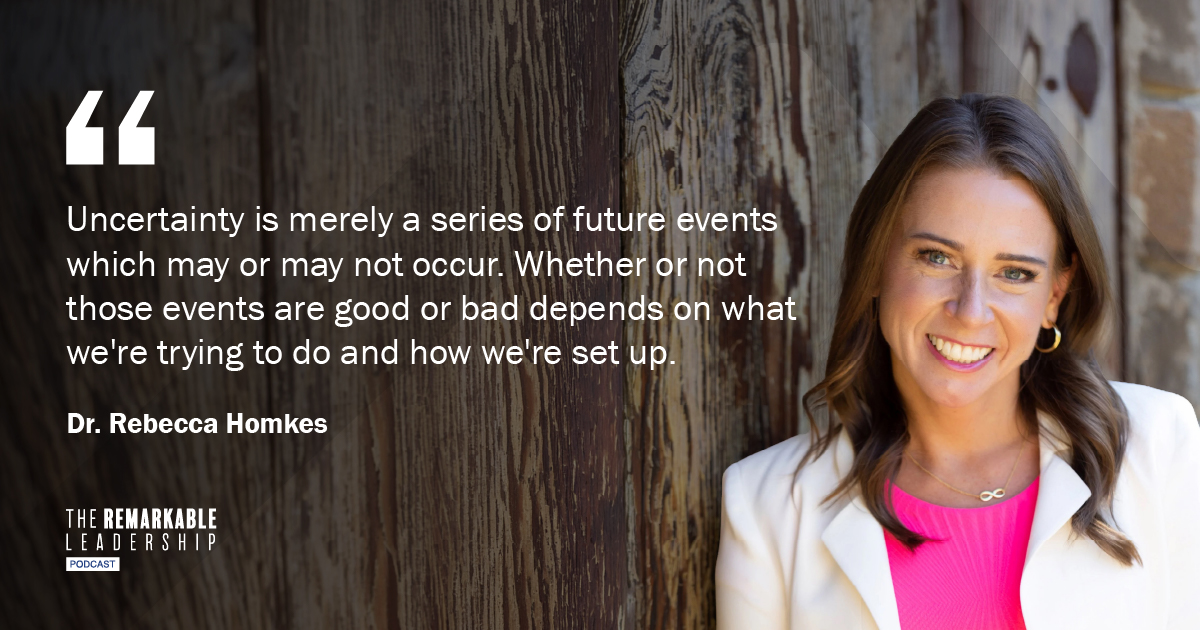
So we've got to reframe uncertainty is merely a series of future events which may or may not occur. You know, whether or not those events are good or bad depends on what we're trying to do and how we're set up. And that becomes our job as a leader. Figure out all we want to do and then get set up to succeed in that world.
00:09:54:04 - 00:10:15:11
Kevin Eikenberry
And you talk about a couple of examples in the book where, leaders made choices about what they focused on, and if they only focused on the sort of the worst case scenario, and different things happened. I'm like, like, there's a difference. That mindset matters. It's not just mental attitude. Important is that is there's more to it than that.
00:10:15:15 - 00:10:16:16
Kevin Eikenberry
Anything you want to add to that.
00:10:16:21 - 00:10:35:08
Dr. Rebecca Homkes
The mindset matters is that we don't even realize we're doing it. But in most of our organizational planning and governance systems, we are closing growth mindsets on a day to day basis. How we frame uncertainty think it's basics. Have you ever presented to a board or a leadership team? Appendix number one in the strategy is always the risk register.
00:10:35:09 - 00:10:54:03
Dr. Rebecca Homkes
Here's how everything in this could go wrong. All of these risks out there. Whereas where is the opportunity register? Where's the appendix that says, here's all the other growth opportunities in the market. We just didn't prioritize them. But hey, there's a lot more opportunities out there. You know, when we get together for a meeting, the first question we ask is, are we on track to plan?
00:10:54:05 - 00:11:13:03
Dr. Rebecca Homkes
Which if I'm on your team, instantly frames me to, I've got to justify getting back on track. Exactly that face that you just made. And whereas the question I should be asking is, has the situation changed? I'm now encouraging a brain to say, hey, I'm allowed to bring the learnings and the insights that I picked up from our customers in our market.
00:11:13:05 - 00:11:27:06
Dr. Rebecca Homkes
So everything from language in meetings to how we structure meetings to how we present reports, is framed with a very fixed mindset that the plan is perfect and we've just got to stick to it. And that's not the reality of the world that we're operating in.
00:11:27:08 - 00:11:51:19
Kevin Eikenberry
It is so, so, so, so true. One of the things I, so let's just do one other thing here. Let's talk about the idea of uncertainty, and learning. Yes. Right. Because all of us will say, well, we need to be learning, but we'll all say we need we need our people to be learning. Sometimes we may not be, but like, we think of this uncertainty thing as this big black cloud.
00:11:51:21 - 00:11:58:19
Kevin Eikenberry
And yet if we if we if we pair it with learning, we can maybe create something different. You want to add. Yeah.
00:11:58:20 - 00:12:29:08
Dr. Rebecca Homkes
You know, learning is critical. And I will make the punchline very early in our conversation. It is the number one differentiator of high performing companies is learning velocity. It's it's not you know, how much money you have. It's not when you got started. The number one differentiator is learning velocity forwards learn faster, grow faster. If you can. Just remember that like you're going to get one step ahead from this conversation and why uncertainty is such a great time to grow is that it's a great time to learn.
00:12:29:10 - 00:12:49:13
Dr. Rebecca Homkes
When uncertainty gets high something else gets high too. And that's honesty. Consumers, if you sell to consumers, are much more honest about what they value and what they don't. Customers, if you're in the B2B world, are much more clear what they need versus they don't. Vendors and partners and also employees are much more honest. Is that something called these learning loops?
00:12:49:15 - 00:13:15:23
Dr. Rebecca Homkes
These test and learns we make in the market. They're much tighter and much clearer in periods of uncertainty in frothy markets, customers will try everything, right? Because who cares, right? They've got the discretionary time, the discretionary income in uncertain markets called a push for value. But it's really this push for kind of care and certainty and differentiation. And what happens, Kevin, is that in uncertainty we default into uncertainty means downturn.
00:13:16:01 - 00:13:37:11
Dr. Rebecca Homkes
Downturn means protection. Protection means a need to focus on the basics cash and cost and operating metrics. And we turn all of our weekly meetings into operational meetings. How do we get back on track to planet? And this is why these very few companies, yes, we go into this survival mode, which we sometimes need to be in, but instead if you say, okay, well, what do we need to learn this week?
00:13:37:11 - 00:13:52:08
Dr. Rebecca Homkes
What did we learn last week? What is the key learning loop we need to close this week? We are leaning into the uncertainty as this great growth environment, and very few leadership teams have the the capability and the willingness to build the muscle to do that.
00:13:52:10 - 00:14:10:05
Kevin Eikenberry
That's so true. There's one other thing about uncertainty, and I knew I knew when I read the book, and I certainly knew when we had a short chat ahead of time that I would not get to all the stuff I want to talk to you about. But I need to ask this one more question, specifically about uncertainty, because I think it's it's critical.
00:14:10:05 - 00:14:21:21
Kevin Eikenberry
You say there are two types of uncertainty. Can you say more about that? We've been talking about one. We've really kind of talked about both, but you really haven't described you haven't defined them.
00:14:21:23 - 00:14:51:17
Dr. Rebecca Homkes
The the emotional uncertainty and the you know, there's an emotional element where it makes us uncomfortable because we can't predict the future. Right? There is another element uncertainty. That's just it's unknown. Right. And so we can't kind of build a plan to it. And the combination of this kind of mental fatigue and this emotional fatigue really puts us into this paralysis often, where we just want to wait and wait until we know more and we can overcome both this almost cognitive and this emotional paralysis of uncertainty puts us into.
00:14:51:19 - 00:14:59:11
Kevin Eikenberry
And since we can't predict the future, we're not going to know. So waiting isn't going to solve the problem. At the end of the.
00:14:59:13 - 00:15:18:11
Dr. Rebecca Homkes
Assess, well, there's two things. One, we are I helps a lot on growth strategy. It's also hurting on this element because we can go to a GPT engine and ask it a question. We will get an answer back. With such authority, we are convincing ourselves in strategy. We can predict the future and we cannot. LMS are trained on past information.
00:15:18:11 - 00:15:41:14
Dr. Rebecca Homkes
They're doing some basic reasoning. They can help ideate, they can help brainstorm, but they cannot predict the future. So we need can't rely on them to do so. But paralysis is the scariest because of what you're not doing. Like, yes, paralysis is bad because you're waiting and you're waiting for this artificial deadline where there will be certainty. But the real reason paralysis is bad for leadership teams is growth, and performance is a muscle.
00:15:41:16 - 00:16:05:13
Dr. Rebecca Homkes
As you're growing and as you're learning in the market, you're building this muscle as a team. And when you go into paralysis mode where you say, okay, let's just wait until after the summer, let's just wait till after the war ends. Let's just wait till after the Supreme Court decision. Whatever artificial deadline you're giving yourself, it's kind of like if you're a workout person, you stop working out for six months, and then you go to the gym tomorrow and want to have a great workout.
00:16:05:15 - 00:16:08:19
Dr. Rebecca Homkes
You're going to have a terrible workout, right? Because you've lost the muscle and.
00:16:08:22 - 00:16:10:07
Kevin Eikenberry
You have a different workout.
00:16:10:09 - 00:16:20:03
Dr. Rebecca Homkes
You do not feel great, right? And that's what we're doing to our teams. When we constantly go into paralysis mode, we're losing that really critical muscle.
00:16:20:05 - 00:16:33:23
Kevin Eikenberry
You you talk in the book about and I think that so often when we think about strategy, we we even call it a strategic plan. Yes, we talk about planning and you talk about preparing.
00:16:34:01 - 00:16:34:22
Dr. Rebecca Homkes
For.
00:16:35:00 - 00:16:49:21
Kevin Eikenberry
And to me, this was a really insightful thing that I sometimes struggle. Well, I'm not saying that like I have everything in the world figured out, but like I definitely struggle with this. So talk about that distinction because I think like it helps me. I think it will help a lot of people.
00:16:49:23 - 00:17:10:18
Dr. Rebecca Homkes
So there's a shift that we need to make from planning to preparing, but we're not throwing planning away like there's parts of the organization where planning is still critical. You know, where I can build a linear model that tells me what happens next, where efficiency and certainty reign, then planning is great. But when I'm not have that, when I'm facing uncertainty, I need to go into preparation mode.
00:17:10:20 - 00:17:28:05
Dr. Rebecca Homkes
And I've actually. Kevin, words matter. I've stopped calling them strategic plans. I just call them the strategy because there's something about the word plan that frames our brain. Everything in this must get done, and I don't want that frame on teams. I want to acknowledge that strategy is a living and breathing document that is going to adjust as we learn.
00:17:28:07 - 00:17:44:22
Dr. Rebecca Homkes
So in preparation mode, you're making decisions based on beliefs, not waiting for facts. Now, that sounds scary because when I said you're making decisions based on beliefs, not facts, your brain heard data and it didn't mean to. If you're thinking, hold on, why are you telling me to ignore data? I'm not. You know, data helps inform our beliefs.
00:17:44:22 - 00:18:02:00
Dr. Rebecca Homkes
But if every time you wait to make a strategic move, there's an established fact in the market, there's no insight. Everybody has the same insight. You've got to move based on beliefs. You need to sometimes set what I call direction, where I can't pinpoint exactly where I'm going to be in one year or three years. And that's okay.
00:18:02:00 - 00:18:23:14
Dr. Rebecca Homkes
Like, we need to move away from destination based strategies, where every single year needs to have this very fixed number, and instead think of holding a compass. I know I'm going in that direction and we don't know all the variables on day one is that I don't know my six perfect KPIs and day one of a growth strategy, nor should I, because I need to learn as these variables emerge as I go.
00:18:23:16 - 00:18:38:15
Dr. Rebecca Homkes
Milestones are okay versus metrics. As I'm learning what the right metrics are that I should optimize for. So we're not not moving in aligned way aligned speed is critical, but preparation mode sets us up to take advantage of all the opportunities the environment might be giving us.
00:18:38:17 - 00:18:40:23
Kevin Eikenberry
As opposed to narrowing us in to.
00:18:40:23 - 00:18:59:06
Dr. Rebecca Homkes
As opposed to narrowing. Once you've set a plan and you have a strategic plan, the notion is, I must get back and stay on track to plan. And not too long ago, I saw a board deck where the team had put in the beginning. You know, no matter what, we will remain committed to the plan. And they put this on one of the first pages as a statement of pride.
00:18:59:06 - 00:19:17:22
Dr. Rebecca Homkes
No, you should be proud of us because we're going to stay committed to the plan. And I don't think there's a scarier thing the team could have said to me, right, as a board member, because I want you not staying committed to the plan no matter what. I want you talking to your customers, your consumers, your partners, your vendors, regulators and learning and adapting this thing as we learn.
00:19:18:00 - 00:19:26:11
Kevin Eikenberry
Let's be clear, they were already freaked out to give that presentation and to have a person who is a strategy expert in the room made it even harder.
00:19:26:13 - 00:19:29:05
Dr. Rebecca Homkes
I could have been part of it as well.
00:19:29:07 - 00:19:56:04
Kevin Eikenberry
You have to grant them a little grace. So, man, I really kind of wanted to get into all the stuff on the reset. So the book is survive, reset, thrive SRT approach. We're not going to have time to get there. Really? Not in any significant way. People. Y'all are going to go buy a copy of Rebecca's book, survive, reset, Thrive Leading Breakthrough Growth Strategy in Volatile Times.
00:19:56:06 - 00:20:10:15
Kevin Eikenberry
Trust me. You want to do that? But beyond that, if if you were to give me a couple of insights. Yeah. About what we need to what what the reset looks like, what would those couple of things be?
00:20:10:17 - 00:20:37:10
Dr. Rebecca Homkes
The first thing is the reset not only matters, it is the differentiator is the most common slogan or catchphrase in a volatile world is don't just survive, thrive. Or if you want to thrive, you've got to survive. And that misses the fundamental insight that thrive comes from the willingness to do the reset. And reset means change. And I'm getting even punchier because I'm seeing leadership teams not really grasp this.
00:20:37:12 - 00:20:54:15
Dr. Rebecca Homkes
And Kevin, what I'm saying now is a growth mandate is a change mandate. Like if you want to grow through volatile times and you want to give your organization and growth mandate, you're giving it a change mandate. You are saying, I am willing and able to change the organization to do the reset that we need to thrive in the current environment.
00:20:54:15 - 00:21:00:14
Dr. Rebecca Homkes
So a growth mandate is a change mandate. The reset is the power move, and that's why it's the majority of the book.
00:21:00:16 - 00:21:16:23
Kevin Eikenberry
It is the majority of the book. Yeah. You walk us through a number of things, but then you, you know, there's a chapter, there's a piece of a chapter that's really important that says, okay, how do we execute while we're building? Like, how do we build the plane while we're flying? Because that's the other thing that happens, right?
00:21:16:23 - 00:21:32:10
Kevin Eikenberry
I find that so often the work that goes into the strategy, however people are doing it. Yeah. And then it's like like we set everything aside to do that and then we finish that and then we go and all the while we should have been executing.
00:21:32:10 - 00:21:33:12
Dr. Rebecca Homkes
Yes, yes.
00:21:33:13 - 00:21:36:00
Kevin Eikenberry
So give us a couple of thoughts about that.
00:21:36:02 - 00:22:00:02
Dr. Rebecca Homkes
So parallel path is the movement that we need to move into. So parallel path thing is a word that we stole from product development. And we started using the term to say, hey, these things we used to do in a sequential way. So step by step and we now need to do them in parallel is we need and again this goes to the fixed mindset versus growth mindset is parallel path feels uncomfortable because nothing is perfect right?
00:22:00:02 - 00:22:17:22
Dr. Rebecca Homkes
I'm starting to execute before I have all of the answers I am executing, before I have all of the perfect numbers, but this is the mode that we need to be in, because executing a strategy is about this parallel path thing, and the critical one is your beliefs. The first step of the reset is articulating your strategic beliefs.
00:22:18:00 - 00:22:38:09
Dr. Rebecca Homkes
You know, your stance and the key trend shaping the industry, whether that's the k-shaped economy, whether that's a Gen Z consumer or whether that's energy pricing, whatever these trends are most shaping your industry, setting your mid-term strategic belief, then because these beliefs for my choices, those beliefs say, hey, based in those beliefs, these are the key. Top priorities are must wins.
00:22:38:09 - 00:22:59:06
Dr. Rebecca Homkes
I'm going to choose. Then as I'm executing, I'm parallel path and I'm testing these beliefs because I'm going to get feedback and whether or not my beliefs are tracking way before I get feedback on whether or not my strategic priorities are tracking. And that feedback I bring in allows me to adjust and adapt. But the movement is really critical across all the modes.
00:22:59:08 - 00:23:17:02
Dr. Rebecca Homkes
You know, you would think, oh, folks, can't wait to get out of survival mode. So they're rushing into the reset. I actually see the opposite that we're so afraid to be the leadership team. Yes, that posture. We're so afraid to be the leadership team that loses it on our watch that we keep our organization in survival mode way longer than we should.
00:23:17:04 - 00:23:23:17
Dr. Rebecca Homkes
So we've got to master the movements across the modes just as much as the steps within one of the modes.
00:23:23:19 - 00:23:40:23
Kevin Eikenberry
So other than buying a copy of the book, which a minute. Yeah. Where do you recommend. And you know, we, I know that we have lots of different people, different places than organizations listening to us. Where do you recommend people start?
00:23:41:01 - 00:24:12:16
Dr. Rebecca Homkes
So you the first thing you start is acknowledging where you are. And there's no problem with being in the survival mode. You might be there. And the key thing is to own it, right? Because as soon as you declare you're in the survival mode, you can leave it. If you don't really call it out, you're always kind of muddling around and part of what I did not appreciate when I wrote the book was giving organizations permission to say they were in survival mode, got a lot more acceptance, because now I can show a pathway to get out.
00:24:12:18 - 00:24:32:04
Dr. Rebecca Homkes
So align with the team on where we are. And then once you've done the basics for the survival, then you can start thinking about the reset, which is going to start with your beliefs, and then you can't move out of the reset till you've really focused on what I call your right to win. That key critical differentiation you have in the market, and you've got to give it that time.
00:24:32:06 - 00:24:42:06
Dr. Rebecca Homkes
A great reset will take a couple of months, not a couple of hours, not a couple of days. You can cannot knock it out in a two day offsite. You just can't. Right? I wish you could, but you can't. So you've got to.
00:24:42:09 - 00:24:44:03
Kevin Eikenberry
Figure that out. You get.
00:24:44:04 - 00:25:03:10
Dr. Rebecca Homkes
Yeah. You're a couple of weeks or couple of months to do the reset. But I know where you are. Align in your beliefs, align on your right to win. Then the rest of the reset really falls into place. The one exception to that is if you find you're going into what I call a hard reset, and we are watching public companies go through this right now in front of us.
00:25:03:12 - 00:25:22:07
Dr. Rebecca Homkes
And a hard reset means all of our assumptions have been challenged. Our beliefs about the industry, the custom of the consumer are challenged. Our differentiation is no longer there. We need to rethink about the places that we play. All of our strategic priorities need to be reset. Now Starbucks is going through one of these. They're hoping to emerge very quickly from that.
00:25:22:11 - 00:25:38:22
Dr. Rebecca Homkes
Nike is going through one of these. Disney's about to go through a hard reset. So again, we're watching them play out in public. And you know, Dell went through a very famous one. Such a hard reset. They had to stop being a public company while they became a private company. I can name all of these examples. That's also okay.
00:25:38:23 - 00:26:03:20
Dr. Rebecca Homkes
But if as a leadership team, you find yourself in a hard reset, the first step is to declare, is this a team that wants to go through this? Because hard resets are by definition hard, and some of your colleagues might not want to be part of that journey. And that's okay. So if you find that you're in that mode as an organization, give folks the willingness and acceptance to to leave the team at that point and only go forward with those who are committed to the journey.
00:26:03:22 - 00:26:07:13
Kevin Eikenberry
And because if we don't have people that are committed any time hard, any.
00:26:07:13 - 00:26:07:22
Dr. Rebecca Homkes
Time, it's.
00:26:07:22 - 00:26:14:02
Kevin Eikenberry
Not right, it doesn't have to even be a hard reset. I think it's hard when people are committed. It's going to be way harder or much harder.
00:26:14:04 - 00:26:15:19
Dr. Rebecca Homkes
Yes.
00:26:15:21 - 00:26:24:17
Kevin Eikenberry
So I've got a question before we wrap up. The only thing you knew for sure I was going to ask you, actually. So, Rebecca, what are your reading these days?
00:26:24:19 - 00:26:44:22
Dr. Rebecca Homkes
So I am doing a lot of podcast because trying to stay on top of everything for all of my clients and things like that. I am reading 1929 by Andrew Ross Sorkin on the crash in the late 20s as my fun read. Right? Which maybe says a little bit about what I'm reading. And then I'm reading a lot of some of the hard core economics.
00:26:44:22 - 00:27:00:20
Dr. Rebecca Homkes
I'm going back to some classic trade policy right now, given everything that's going on on tariffs. But then I'm also a huge sports fan. So as a fun I love reading sports biographies and I'm an IU Hoosier. So my IU Hoosier team won the national championship series a Big ten. This one whoa.
00:27:00:20 - 00:27:03:12
Kevin Eikenberry
Whoa whoa whoa yeah. That interview is over.
00:27:03:12 - 00:27:04:07
Dr. Rebecca Homkes
Any sports.
00:27:04:07 - 00:27:10:02
Kevin Eikenberry
I yeah. Well it Rebecca, my daughter was in school of business.
00:27:10:02 - 00:27:28:06
Dr. Rebecca Homkes
Those were close then. My father was a professor at Purdue, and my sister went there. So we're also a split family. But as you know, Big Ten loves the Big Ten. So we can all be friends, especially when we had the experience that we did this year. So pretty hard core economics and then everything sports related, because I will read anything about my favorite sports teams.
00:27:28:08 - 00:27:47:14
Kevin Eikenberry
I have to just say that my daughter got married as we're having this conversation last weekend to another, IU Kelley School of, business grad and I and most of the groomsmen and some of the bridesmaids as well, graduation. There were conversations with them and me. Well, we'll just leave it at that. Everybody.
00:27:47:14 - 00:27:50:03
Dr. Rebecca Homkes
Yeah. Cream and Crimson family now. Yeah.
00:27:50:05 - 00:28:03:02
Kevin Eikenberry
No no, no, no, I have Crimson in my family. Three different things. Rebecca. Hey, where can we learn more? Where can we learn more about? Yeah. You you work. Where do you want to point people? Where do you want to go to get the book? Oh, that's.
00:28:03:02 - 00:28:20:12
Dr. Rebecca Homkes
A little late. So you can buy the book wherever you buy books, whether that's Amazon or your local bookstores. And then just go to Rebecca hum, Chess.com or survive, reset, thrive.com. So my website, you'll get to sign up to my monthly newsletter, read more short articles and videos. So Rebecca Gascon will give you all the links that you need.
00:28:20:14 - 00:28:38:16
Kevin Eikenberry
Yeah Rebecca h o m k e s yeah, dot com will get you there. So, so now, before we go, before I say goodbye to Rebecca, I have a question I'm going to ask all of you who are watching or listening. And if you've watched or listened before, you know what I'm going to ask you. So here it is.
00:28:38:16 - 00:28:56:05
Kevin Eikenberry
Because it's the most important question that I could ask you. It is now what? What are you going to do now? What ideas did you get today to say that's useful? That's helpful to me. That's great. The only thing that really matters is what are you going to do about it? Because if you don't take action on it, what's the point?
00:28:56:08 - 00:29:20:08
Kevin Eikenberry
I took as many notes today during this conversation as I can remember taking during one of these conversations in recent times. And so I've got plenty of things that I could say, but me saying it doesn't matter. The only thing that matters is that you realize what it is for you. You take action on those things because when you do that, this will be way more valuable for you than it would have been otherwise.
00:29:20:10 - 00:29:24:11
Kevin Eikenberry
Rebecca, thanks so much for being here. It's pleasure. Pleasure to have you.
00:29:24:13 - 00:29:26:13
Dr. Rebecca Homkes
Thank you for having me, Kevin.
00:29:26:15 - 00:29:45:00
Kevin Eikenberry
And so, everybody, if you enjoyed this, make sure you're subscribed so you don't miss any future episodes. And if you were listening to this thinking, we need to hear this more or talk more or think more about this in our organization. You need to reach out to Rebecca, or you need to make sure that all of those other people have a chance to listen to this conversation.
00:29:45:02 - 00:29:53:22
Kevin Eikenberry
And once you're subscribed, maybe they'll be subscribed. And if that's the case, I'll see you next week for another episode of the Remarkable Leadership Podcast.
Meet Rebecca

Rebecca's Story: Dr. Rebecca Homkes is the author of Survive, Reset, Thrive: Leading Breakthrough Growth Strategy in Volatile Times. She is a high-growth strategy specialist and the founder of a boutique consultancy firm, advising CEOs and executive teams focused on growth and success through uncertainty. She is a faculty member at Duke Corporate Executive Education, Lecturer at the London Business School (LBS) Executive Education, Advisor and Faculty at BCGU (Boston Consulting Group), and previous Fellow at the London School of Economics (LSE)’s Centre for Economic Performance. Dr. Homkes is also the director of the Young President’s Organization (YPO) global Active Learning Program (ALP); a former partner with GrowthX, a Silicon Valley investment ecosystem and innovation consultancy; and the faculty lead of fintech scaleup accelerators.
Follow The Remarkable Leadership Podcast


Looking to Develop Stronger Leaders?
Want help developing the leaders in your organization? Reach out to explore how the Kevin Eikenberry Group can support your team.
Book Recommendations
Like this?
Join Our Community
If you want to view our live podcast episodes, hear about new releases, or chat with others who enjoy this podcast join one of our communities below.
Leave a Review
If you liked this conversation, we'd be thrilled if you'd let others know by leaving a review on Apple Podcasts. Here's a quick guide for posting a review.
