How can leaders elevate their impact without sacrificing their energy, focus, and quality of life? In this episode, Kevin talks with Laurie Maddalena about what it means to become an elevated leader in today’s changing world of work. Laurie challenges the outdated belief that leadership requires constant overwhelm, availability, and personal sacrifice, and instead makes the case for leading with greater intention, self-awareness, reflection, and energy. Kevin and Laurie discuss why many leaders are promoted without real preparation, how the role shifts from doing the work to developing people, and why managers must move from being fixers to facilitators. They also discuss practical ways to protect focus and manage energy rather than just time.
Listen For
0:00 Intro: Why Leadership Must Elevate
1:36 Meet Laurie Maddalena
2:33 Why She Wrote The Elevated Leader
3:54 The Big Idea Behind the Book
6:08 What Defines an Elevated Leader
7:11 The Starbucks Barista Problem
8:14 Laurie's Own Leadership Wake-Up Call
10:34 Is Everyone Meant to Lead?
13:37 Overview of the Elevated Leadership Model
14:23 Self-Awareness, Sleep, and Energy
15:35 Why Reflection Is Undervalued
18:20 Creating Clarity and Caretaking the Culture
20:24 Energy Patterns and Productivity Sprints
23:57 Treat Your Calendar Like "Cardiologist Time"
26:16 The Problem With Open-Door Policies
27:29 What Organizations Should Do to Support Leaders
29:11 Training Leaders Like a True Profession
31:55 What Laurie Is Reading Right Now
32:43 Where to Find Laurie
33:16 Closing: What Action Will You Take?
00:00:08:21 - 00:00:41:13
Kevin Eikenberry
The context of leadership has changed and is changing, which means that the skills we must exhibit and the ways we must lead must change. To our guest today calls that change elevated leadership. When you leave today, you will have likely elevated your view of the leaders role. Welcome to another episode of the Remarkable Leadership Podcast, where we are helping organizations and leaders grow and lead more effectively to make a bigger, positive difference across their teams, organizations, communities, and the world.
00:00:41:15 - 00:01:05:00
Kevin Eikenberry
If you are listening to this podcast, you could join us in the future. Live on your favorite social platform. You can find out when they're happening, get all of the inside information and therefore join us and interact sooner. Like in the case of today, almost two months sooner before it gets released to the podcast, you can find out how we're doing it and when we're doing it on our Facebook or LinkedIn groups.
00:01:05:00 - 00:01:36:09
Kevin Eikenberry
Two of the places where this live streams just go to remarkable podcast.com/facebook or remarkable podcast.com/linked in to get all of the inside scoop and hopefully and join us in the future live later. If you like what you're hearing today and want help developing the leaders in your organization, we should chat. You can reach out to info at Kevin I can very.com, and that'll give you the chance to get scheduled on my calendar to have a conversation about what you need and how we might be able to help.
00:01:36:12 - 00:02:06:04
Kevin Eikenberry
Super excited to have you. And you're going to know why. Once I bring in my guest. So let me bring her in. Now here she is. Her name is Laurie Magdalena, and she is. Let me tell you about her. Before we get any further. She is a leadership provocateur, a speaker, a former head of HR, and the author of The Elevated Leader, which confronts outdated leadership models that reward exhaustion over effectiveness as the founder of Envision Excellence.
00:02:06:06 - 00:02:30:09
Kevin Eikenberry
Excellence. She helps managers go from the fixer to the facilitator, enabling high achieving leaders to deliver elite results without burnout. She personally intentionally caps her work week at 40 hours, demonstrating that sustainable success and elite results are not mutually exclusive, but essential to modern leadership. Laurie, welcome.
00:02:30:11 - 00:02:33:03
Laurie Maddalena
Thank you. Kevin. It's fantastic to be here.
00:02:33:04 - 00:02:50:14
Kevin Eikenberry
I'm so glad that you're here and so glad that we had the chance to chat. I've. I've been through your book, and I'm excited to to talk with you about it. I want to start with that. Because it's the book that brings you here. So why the book? Why did you write The Elevated Leader?
00:02:50:16 - 00:03:16:06
Laurie Maddalena
Well, in my work as a leadership consultant, I've just found that many managers are feeling overwhelmed, overworked, exhausted all the time. And I think there's a better way. There's a better way to be able to be more intentional with how you're leading. A lot has evolved over the past few decades of what effective leadership really is, and in many companies, those practices have not evolved with it.
00:03:16:07 - 00:03:32:16
Laurie Maddalena
And so I really wanted to share some practical strategies. There's not a lot of theory. These are things that people can put in place immediately to not only elevate their focus, their energy, but their impact and their confidence in a management role.
00:03:32:18 - 00:03:49:14
Kevin Eikenberry
You know, there's a paradox here. And I and while you didn't say it, I need to say it, and that is that, the world is changing and so we must change with it. And yet not everything about leadership is changing. But the stuff that is changing is important for us to talk about. And that's really what we're going to do today.
00:03:49:16 - 00:03:54:00
Kevin Eikenberry
From your perspective, Laurie, what's the big idea of the book?
00:03:54:03 - 00:04:26:00
Laurie Maddalena
Yeah, the big idea is that you don't have to be overwhelmed and overworked all the time, that there are practices to implement daily practices, insights, things that you can do that can help you move from being more of a fixer, which is what a lot of us were conditioned to do as leaders is to get in the trenches, fix things, make sure you're moving projects along to really leading at a different level, leading people being able to get results through people coaching, developing.
00:04:26:04 - 00:04:46:08
Laurie Maddalena
And so I share the strategies of how to do that, because I think we talk about some of these things in companies, like we should be coaching our employees or we should be leading people, but people don't always know what that means, especially if they've been in the workplace for a while. And what they did before was rewarded of making sure that work was getting done.
00:04:46:10 - 00:05:14:20
Laurie Maddalena
And now there's been a fundamental shift. And so we have some people who are even seasoned leaders who are struggling to be effective in today's environment. And so, I mean, that's the core is the practical strategies. But another reason why I wrote this book is I believe that most people want quality of life. And in the past, I think leadership equated to sacrifice, that if you are going to climb the corporate ladder, it meant that you couldn't have a great personal life.
00:05:14:22 - 00:05:34:22
Laurie Maddalena
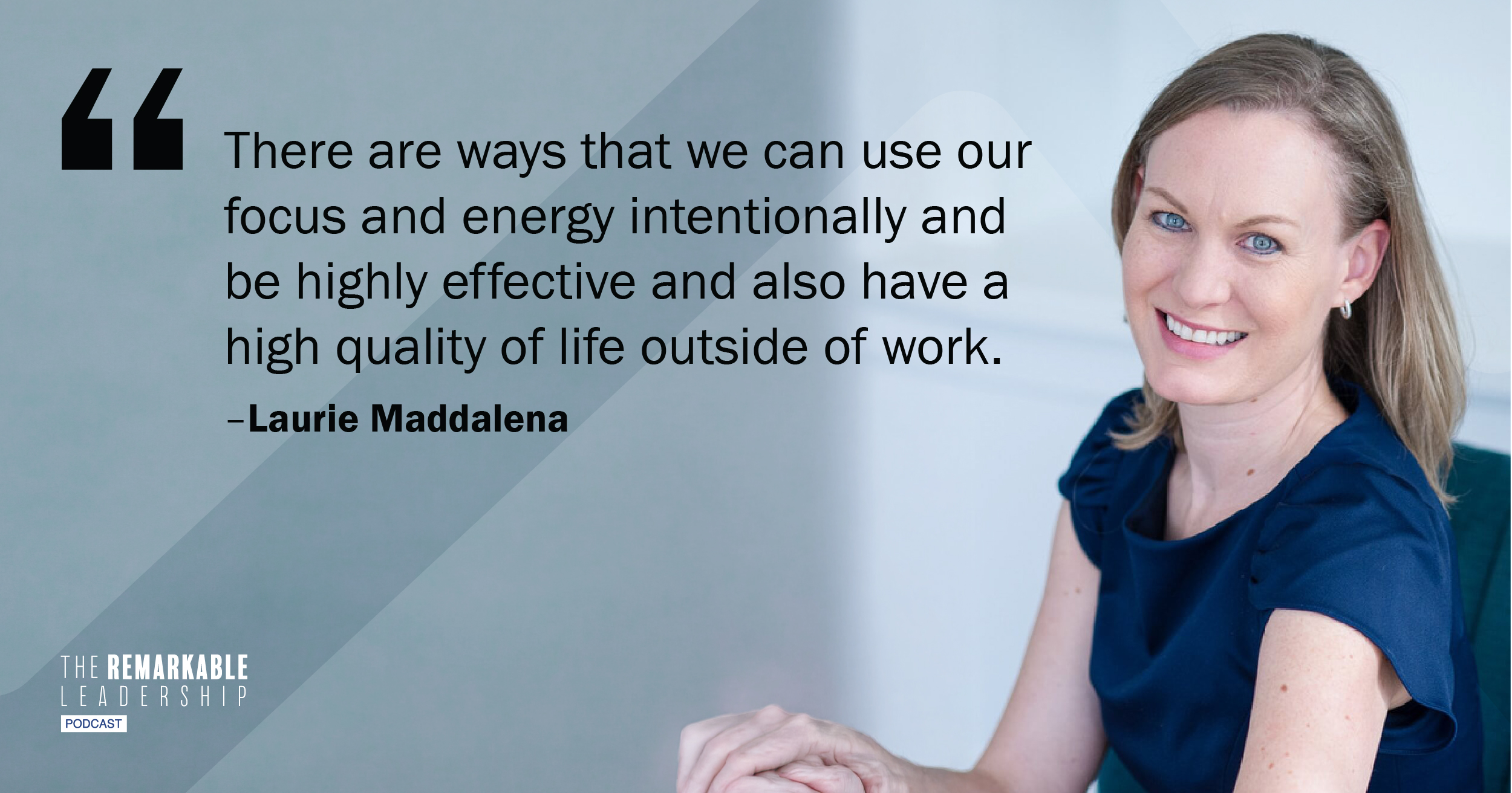
And I, I really challenge that idea that there are there's always trade offs. There are always sacrifices in these choices, but there are ways that we can use our focus and energy intentionally and be highly effective. And also have a high quality of work of of life, rather outside of work.
00:05:35:00 - 00:05:52:15
Kevin Eikenberry
When I, when I, when I think back on this book later and I don't know about the conversation, but I presume the same will be true of the conversation. When I think back on your work later, that word energy is probably going to be the word, the thing that will stand out the most to me, probably where we'll spend some of our time.
00:05:52:15 - 00:06:08:10
Kevin Eikenberry
But before we do that, you put your stake in the ground and said that elevated a leader. So describe and you've sort of headed that direction, but describe the elevated leader to us.
00:06:08:15 - 00:06:41:09
Laurie Maddalena
Yeah. The elevated leader. I think the core is they're intentional. They're intentional with how they're spending their focus and energy. They're spending a lot of that focus and energy on their team, developing their team, creating capacity on their team. So that means coaching and building ownership. And so that they can get results. Results are very important. Every organization is in business to get results, but they're spending more of their time in more strategic areas of being able to build their bench strength.
00:06:41:11 - 00:07:06:22
Laurie Maddalena
So they're not in the weeds. Being that bottleneck to their team. They feel more confident. They're impactful. They're influential because they have practices that help them lead at that level. They're not the overwhelmed, constantly busy. I mean, we all feel that way sometimes. So I want to normalize that. It doesn't mean that we'll never feel overwhelmed, but they have touchstone practices that they can come back to that keep them out of that.
00:07:06:22 - 00:07:11:00
Laurie Maddalena
Getting in the trenches and keep them at this higher level.
00:07:11:02 - 00:07:28:14
Kevin Eikenberry
Being overwhelmed. My dad used to say, Kevin, that's why you make the big bucks. I mean, in other words, there's there's there are responsibilities that come with the role. If we have the role of leader and and that, does it mean we have to settle for that being what always is the case? But we shouldn't be surprised when it is the case.
00:07:28:19 - 00:07:51:19
Kevin Eikenberry
And I think if we follow some of the practices that we're going to talk about today, it will help us all with that. You said something early in the book that made me it made me giggle. But then it made me sad because it's true. You wrote that the local versus the local barista at Starbucks receives more training in preparation than most leaders in organizations.
00:07:51:21 - 00:08:10:17
Kevin Eikenberry
I think that's true. And the reason that I say that, the reason that I share that line is that I think there are likely people listening to us that are hearing you and saying, well, why didn't I need that training? And that's a fair question. But it's in the past. The only thing now is, what do I do from here?
00:08:10:18 - 00:08:13:02
Kevin Eikenberry
And that's where I really want us to go.
00:08:13:04 - 00:08:13:13
Laurie Maddalena
Yeah.
00:08:13:13 - 00:08:14:12
Kevin Eikenberry
Comments on that?
00:08:14:14 - 00:08:34:05
Laurie Maddalena
Yeah, that was my personal experience. I mean, I remember my first time being promoted to a supervisor. I was working at an insurance company, and my manager came to me and said, we're going to hire someone and that person will report to you. And about three weeks later, we hired a woman named Pat, and no one sent me to any training.
00:08:34:06 - 00:08:56:18
Laurie Maddalena
No one even sat down with me to talk about, here's the responsibility of being a leader. So I thought that my job was, well, now I'm in charge of the work. So what do I do? I tell her what to do. I answer her questions. And this was in an environment even, this is a few decades ago where leadership was more transactional.
00:08:56:20 - 00:09:22:15
Laurie Maddalena
And, you know, it wasn't what we're talking about today, which is more of this transformational type of leadership that really involves people and coaching engagement and all these other aspects. So I think at that time you could be fairly effective in that kind of leadership. But it was very stark to me that it just never even occurred to me that my job shifted in any fundamental way, becoming a supervisor.
00:09:22:15 - 00:09:41:23
Laurie Maddalena
And I mean, even fast forward a few years from that, when I became a director of HR, I remember my manager, the VP, calling me in the office about three months into that position, and she gave me feedback. She said, Laurie, I didn't promote you to keep doing the things you were doing before. You should not be fixing payroll issues.
00:09:42:01 - 00:10:11:16
Laurie Maddalena
You should not be answering benefit questions. You have two people on your team. You need to delegate, but you need to be creating development programs. And it just had not occurred to me that when I moved into that role, that my job shifted to more leadership responsibilities. I didn't even really know what that meant. And so I think a lot of us can relate to this where we haven't been given formal training, we haven't had the experiences of what it takes to lead today.
00:10:11:18 - 00:10:34:12
Laurie Maddalena
And there's been such a shift over the past few decades that all of a sudden we're in this place where people are feeling like, how do I lead in a sustainable way? I'm not even sure what to do because the pace of change is accelerating. We have five generations in the workplace. I know you know, Kevin, from your work like this makes it a lot more complex than it was even a few decades ago.
00:10:34:14 - 00:10:58:09
Kevin Eikenberry
I think that's right. Now you make a statement. It's actually a chapter title. And I'm curious, I want to talk about this before we sort of dive in to your model. Because I think this is worth talking about. You say that not everyone is meant to be a leader. Now, I've read the chapter, so I'm not sure where that far apart, but I don't agree with that statement completely.
00:10:58:13 - 00:11:01:14
Kevin Eikenberry
So tell me what you mean by that statement.
00:11:01:14 - 00:11:17:15
Laurie Maddalena
Yeah, what I mean by that statement is that context is important. So one, I believe you can lead your life. I believe you can be a leader without authority. You can be a leader any place in the organization without authority.
00:11:17:17 - 00:11:19:10
Kevin Eikenberry
But I have a job title. In other words.
00:11:19:11 - 00:11:45:17
Laurie Maddalena
Correct. But I do not believe everyone is meant to be a leader of people. I believe that leading people takes a skill level. Sometimes the personality goes into this, but it certainly can be learned. But I think there are many people who do not feel like it's aligned with their strengths and talents. And I think a mistake we've made in organizations is we make it.
00:11:45:17 - 00:12:11:15
Laurie Maddalena
The next step in growth is always leadership. Typically, it's been leadership. I really think we need to create other paths for people that are not. And I can give a great example of this. I had someone, one of the best employees who worked on my team when I worked for a credit union. Her name is Eve. She was fantastic in her role, and I remember my CEO coming to me and saying, you know, you need to promote Eve to manager of HR.
00:12:11:15 - 00:12:28:15
Laurie Maddalena
She's amazing. And when I would sit down and talk with Eve about it, she said, Laurie, I never want your job. I don't want to lead people. I don't want to give feedback. I would not be great at handling tough conversations. It's just not what I love. Like I want to continue and develop and grow in this role.
00:12:28:15 - 00:12:47:09
Laurie Maddalena
I don't want to stay stagnant, but I don't want to be in charge of people. And I think we do a disservice sometimes. We put people in roles who it's not aligned with their talent or they didn't know what to expect. I really believe we need to give people a peek behind the curtain before they get there, so that they can opt in or out.
00:12:47:09 - 00:13:01:00
Laurie Maddalena
I mean, I can think of jobs that I wouldn't be great at, so I don't think we're all good at everything. And leadership is about understanding what it entails and choosing and making a choice to go into that type of position.
00:13:01:02 - 00:13:20:15
Kevin Eikenberry
That's actually the only place that we're in disagreement and not disagreement, but where I would say it, say it slightly differently that I believe because it's skills that anyone that chooses to can. Not everyone will choose if they don't choose with good information as you're describing, then then we shouldn't try to take them there if that's not where they want to go.
00:13:20:21 - 00:13:37:14
Kevin Eikenberry
In that regard, we are in 100% agreement. Yeah. And you know, there are lots of people here who are listening, who are thinking about leadership organizationally. And that's an important thing for you to think about. Like, do who wants to who wants to make that move and how do we develop them and who doesn't and how do we support them?
00:13:37:14 - 00:13:55:14
Kevin Eikenberry
It's really super important question. So, you talk about what you call the elevated leadership model. You talk about some things that can sabotage us, but there's sort of inside of the model when you flip them around and so I just want to go right to the model and talk about that a little bit. It's a six part model.
00:13:55:19 - 00:14:01:10
Kevin Eikenberry
I'll just let you sort of overview it. And then I'm going to take us into a couple pieces.
00:14:01:12 - 00:14:23:13
Laurie Maddalena
Yeah. So I mean the core of the model is intention that if we approach everything with intention, whether it's how we plan our day, how we go into a conversation with an employee, how we're showing up in meetings, being aware of the energy that we're bringing. So that's the core. And then I talk about the internal elements, which self-awareness is a big piece.
00:14:23:13 - 00:14:48:03
Laurie Maddalena
I believe self-awareness is one of the hallmarks of exceptional leadership. The more we get to know ourselves and other people and the impact that we have, the better that we can lead people. Energy is a huge piece of this, and I think this is a part that we often don't think about is how do we not only make sure we're taking care of ourselves so that we can show up as our best every day?
00:14:48:03 - 00:15:05:10
Laurie Maddalena
For example, I personally believe sleep is a superpower for leadership. It's a superpower for any type of role where you need to come in and the demands are high and there's a lot to take care of in a day, right? You need to have the energy for that. And I think a lot of people are running on empty.
00:15:05:15 - 00:15:35:08
Laurie Maddalena
It's also the energy that we're conveying to others. Are we conscious of that type of energy that we bring to interactions? And then one of the pieces I believe is undervalued in leadership is reflection. In today's world, we're so busy doing and reacting and being in the weeds all the time with what's coming to us, that it feels like a luxury to find time to think.
00:15:35:10 - 00:15:59:17
Laurie Maddalena
And it's essential for us as leaders to be able to step back, whether it's broadly, strategically, to look at our department and how do we continue to evolve and grow and know what's going on in the market, to even reflecting on how I'm setting up my day and how I'm going to coach my employees, or even self reflection.
00:15:59:19 - 00:16:07:20
Laurie Maddalena
And so I think that's a piece that is often put aside that we think when we have time, we'll have, you know, it.
00:16:07:21 - 00:16:32:16
Kevin Eikenberry
Has to be at the top of the list. And it's it isn't for most every leader. And yeah, that's, that's a bandwagon that I'm completely on. If we just one think about reflection simply from the perspective for all of the reasons that you just shared, but simply from the perspective of learning, like when I ask leaders, do your what do you want your team members to be learners?
00:16:32:16 - 00:16:38:19
Kevin Eikenberry
Like, yeah, well, the number one way you can influence them is through your example. Are you?
00:16:38:21 - 00:16:40:06
Laurie Maddalena
Yes.
00:16:40:08 - 00:16:50:12
Kevin Eikenberry
Right. And you don't want them to just keep plowing forward, without reflecting. And so the best way you can encourage that in them is to show them.
00:16:50:14 - 00:16:51:11
Laurie Maddalena
That's right.
00:16:51:13 - 00:17:06:16
Kevin Eikenberry
And so even if you just want to start there. Right, I mean, all of the reasons you gave thinking externally thinking, you know, thinking, thinking about how I'm going to do that moving forward. But even like, okay, how did I run that meeting yesterday? What do I want to keep doing? What do I not want to do again?
00:17:06:16 - 00:17:08:11
Kevin Eikenberry
Because Kevin, that's what's not good.
00:17:08:12 - 00:17:34:11
Laurie Maddalena
Yeah, that's a part of evolution, right. Is is reflecting on what and well what could be better. Am I continuing to grow and develop as a leader. And so and I think that most of us working in our every day, we you don't think of creative ideas when you're reacting. I know for me the place that I think of more creative, higher level ideas is when I'm a little bit farther away from my work, my everyday work.
00:17:34:11 - 00:17:58:06
Laurie Maddalena
Maybe it's on a walk, or I personally schedule a few retreats a year where I go away on my own to think strategically about my own business, because I know in my office that won't happen. And so building as leaders practice is and then even can be strategic meetings with your teams that are focused on strategy, not just on execution.
00:17:58:08 - 00:18:20:07
Laurie Maddalena
So those internal pieces I think are, are what helped fuel how we become better leaders. And then the external pieces are creating clarity. I think in today's environment with the pace of change and things are shifting a lot, priorities have to shift. I mean, I come from a time as an executive where we created 7 to 10 year business plans.
00:18:20:09 - 00:18:48:13
Laurie Maddalena
I mean, that's almost laughable. Now, I think you can have a vision and a direction, but things shift so fast that priorities are changing. We need to make sure we're creating clarity for our teams and helping connect them to how they fit into that picture. On a regular basis. Caretaking the culture is my term for all of the people human side that is so important for being able to get results.
00:18:48:13 - 00:19:12:08
Laurie Maddalena
So coaching specific feedback, developing people, building connections, showing appreciation. Traditionally things called soft skills. I like to call them essential skills. I know you've used the term human skills. You know, those to me are this is the fuel of how we get results. And that's the third one, is facilitate results. You know, every company is in business to get results, so you can't care.
00:19:12:08 - 00:19:20:20
Laurie Maddalena
Take the culture and have a great team feeling and not get results. You have to have a balance of both of those things.
00:19:20:22 - 00:19:40:18
Kevin Eikenberry
Leadership is is reaching valuable outcomes with and through others. You got to have both, for sure. I love the way that you talk about this, both internal and external. And we've talked about those things, you were talking when you were finishing up your conversation about, reflection. And recently I had Lee and Abby on with me.
00:19:40:18 - 00:20:04:03
Kevin Eikenberry
And one of the things that she and I talked about was do more. Nothing like we got to we got to find a place to put those, put that space in. And, and I think we could argue that that's actually job one, because everything else on this list cascades from that you list, we didn't talk about reflection first, but in the book you talk about it first.
00:20:04:08 - 00:20:24:09
Kevin Eikenberry
And I could make the argument that everything else, flows from that. So I love that. But I said at the beginning that I want to talk a little bit more about this energy thing. And so tell me a little bit, give people a couple of nuggets, about what we can do, because our energy is being used.
00:20:24:11 - 00:20:42:04
Kevin Eikenberry
Right. It's being sapped, by ourselves. And by others and by our context. And so, what's what are a couple of things that leaders could take away from this conversation or that organizations could take away for their leaders in this conversation, that they could go apply right away?
00:20:42:09 - 00:21:01:01
Laurie Maddalena
Yeah. I think what we talk about a lot in companies is how to manage time. You know, how do I how do I manage my time better. And I think really the discussion should be more around focus and energy. And so from a personal place, this could be understanding your own energy patterns. Some people have more energy in the morning.
00:21:01:01 - 00:21:11:18
Laurie Maddalena
Some people in the afternoon. I know for me, I personally after probably 230, starting a big project is not the best energy time for me. And I.
00:21:11:20 - 00:21:14:11
Kevin Eikenberry
Well, it's the good thing we're going to be done before 2:00 then.
00:21:14:13 - 00:21:38:07
Laurie Maddalena
That's great. That's right. Kevin and I also talk about this practice of productivity sprints. Blocking time in your calendar where you're focused on one thing where you can move that one thing in your key result area. So the most important areas and priorities for your position. And I think most people are reacting to everyday daily things and not focused on key result areas.
00:21:38:07 - 00:22:05:22
Laurie Maddalena
And so a piece of the energy is blocking that time to put full attention and energy on something that's most important in your role to get results and a lot of people are reacting. They're not intentional with that. So if you know your energy patterns and you can schedule something when you're going to have that energy to focus on one thing, not having 50 tabs open, your email open people coming in your office constantly, that's not going to work.
00:22:05:22 - 00:22:34:06
Laurie Maddalena
So it's preserving your energy for those times. And that could be even a coaching session with an employee. I'm going to schedule this at a time where I'm making the intention to go in there with the energy of being curious to listen, be present with that person, not be on my phone, not have my email open. The more we understand that about ourselves, we can really channel that in a way that's going to help us to be more productive in the ways that are possible.
00:22:34:08 - 00:22:36:08
Laurie Maddalena
I also think it. Yeah. Go ahead.
00:22:36:09 - 00:22:37:08
Kevin Eikenberry
No, please go ahead.
00:22:37:10 - 00:22:58:00
Laurie Maddalena
I was just going to say, I think it's also how we show up with our team members. And so are we putting the right amount of energy into how we run our meetings. Are they reactive based or are we being intentional with how we're using that time? So, I mean, a lot of meetings are a waste of time that people don't have a goal.
00:22:58:02 - 00:23:19:20
Laurie Maddalena
We're talking about. Yes, I know, right, Gavin. And even that if you do an inventory and audit of the meetings you have and are the right people involved, are there things that you could delegate to someone on your team? How are we using this time? Do we have an agenda with a specific goal so that you're preserving people's energy for the things that matter most?
00:23:19:20 - 00:23:42:09
Laurie Maddalena
And then I talk a lot about personal energy of, you know, I like to think of my energy in three day cycles. So if I know I have a keynote speech on a Tuesday morning, going out with friends on a Sunday night or staying up watching TV is not going to help my energy for that day because I know that it will take me three days to really, you know, preserve that energy for that.
00:23:42:09 - 00:23:57:10
Laurie Maddalena
So it's looking out. It's being more broad with your schedule of what it requires of you and calibrating how you're preparing for that so that you have the reserves to be as effective as possible.
00:23:57:12 - 00:24:17:07
Kevin Eikenberry
I want to go back to one of those. One of those pieces of energy that you talked about was the you called blocking a perfect productivity block. However, we want to talk about blocking our time. I'll just share. I want everyone who's listening to do this mental exercise with me. Yes or no? Have you ever blocked time on your calendar to work on a critical thing?
00:24:17:11 - 00:24:43:19
Kevin Eikenberry
And because I've asked hundreds and hundreds of leaders this I know that your answer likely is yes, which is great. Goes right along. But Laurie's saying it's fantastic. Second question has that block ever gotten taken off because someone needed you during that time? And I can tell you what that answer is, too. Yeah, it's yes. And so let me ask you a third question.
00:24:43:21 - 00:25:07:01
Kevin Eikenberry
The third question in this hypothetical triumvirate is if you had had had in the past some heart trouble, and so you're fine, but now you're having regular appointments with your cardiologist, would you cancel the cardiologist appointment for the thing you're taking the time that you blocked off for? And the answer to that is, again, if you're like hundreds of people I've asked is no.
00:25:07:03 - 00:25:20:17
Kevin Eikenberry
So you need to treat that time. I call it Lorraine. You need to treat it as cardiologist time like it's that important. If we don't do it, it's not going to get done or it's not going to get done with the energy and focus, as you said, that we'd like.
00:25:20:19 - 00:25:35:22
Laurie Maddalena
I love that analogy, Kevin. And it's so true because I think that we, you know, when I share this with people, sometimes they'll say, well, I try to block my time, but exactly what you said, that's why I was chuckling. It's like, but something else came up and I tell people.
00:25:35:22 - 00:25:36:16
Kevin Eikenberry
No, but.
00:25:36:18 - 00:25:49:00
Laurie Maddalena
Yeah, there's no way I'm not telling you to block time to just sit around and, you know, twiddle your thumbs. I'm not even telling you to block time to take a nap. Although that could be a very good use of time where I'm.
00:25:49:00 - 00:25:52:23
Kevin Eikenberry
Sitting there, he says you can all take a nap at work. That's where you sit.
00:25:53:01 - 00:26:16:11
Laurie Maddalena
We're blocking time to focus on the key results of our position, and I think sometimes that connection isn't happening for us because we feel like our role is to be responsive, to be available all the time, to make sure we're supporting our team. And I think we've conflated support with availability. And there are two different things.
00:26:16:13 - 00:26:25:14
Kevin Eikenberry
100%, you all could go to my blog and read what I've written, or go to YouTube and read what I've said about the problem with the open door policy.
00:26:25:17 - 00:26:53:22
Laurie Maddalena
I saw that you wrote something on this, and I this is something that I'm another maybe unpopular, opinion, but I think it's one of the worst practices we have. And I think the reason is we take it quite literally. And what meant to be a practice of making sure people have psychological safety, that they have a place to go, to share their ideas or to disagree, has turned into, I have to be available all the time.
00:26:53:22 - 00:27:10:02
Laurie Maddalena
And I think if you're a leader and you're available constantly to your staff, it's very likely you're not effective. And so no one is going to create this focus for us. We have to be the professional to create that focus for ourselves, for sure.
00:27:10:08 - 00:27:29:16
Kevin Eikenberry
So now that you've said, now that you put the onus on us as individual leaders, which I which is where it belongs, don't misunderstand. Talk to the org, talk to organizations for a minute. What what given everything we've talked about, what should organizations do to support their leaders to be more elevated?
00:27:29:21 - 00:28:06:23
Laurie Maddalena
Yeah, I think part of it is being particularly I'm, middle manager. I call this the messy middle because people are put in this position of feeling reactive to, you know, their senior leaders, and then they have a team. And I think what's happened over this evolution of leadership, of moving from being more task based to more people based, is we talk about the manager who is the working manager, and in my opinion, the working manager, which means someone is straddling doing task and also leading people no longer works.
00:28:07:01 - 00:28:23:19
Kevin Eikenberry
And so well, I don't know that it ever did. So, so before you, I, I want you to continue. But for everyone who's listening, if you're like, I don't know what you mean by that. If you've ever been on a project part time, like you're half time on this job and you're up, you're half time on the job, tell me how that feels.
00:28:23:19 - 00:28:26:02
Kevin Eikenberry
Because it's exactly what Laurie's talking about.
00:28:26:04 - 00:28:49:21
Laurie Maddalena
Yeah, I just think you. You're right. It never really worked. And it doesn't particularly work now because we've had such a shift in people focused. I mean, 30 years ago, people would stay at their company, likely for their whole career. What was valued was sacrifice, tenure, loyalty. And now we're in an environment where people will not stay just because they started their early in their career.
00:28:49:21 - 00:29:11:18
Laurie Maddalena
Right. We need to be able to engage people and create Sillman and flexibility and all these other things that are important. So engagement is a lot harder than it ever was, which is why we need to spend a lot of time with people. And so if we're expecting managers to be able to be in the trenches and fix and also lead people, it's there's just going to be overwhelm.
00:29:11:18 - 00:29:47:20
Laurie Maddalena
So, you know, I think a big piece of this is making sure we're training people. We're giving them we're treating leadership as a true profession, which is why I say the Starbucks barista gets more training than most leaders. I worked at Dave and Busters in my early 20s at a restaurant. The training and testing I had to go through before they even put me as a server on the floor was probably ten times more than I had as a leader moving into a leadership position, and so we have to treat it and think of it as setting up our managers for success if we can give them the tools.
00:29:47:20 - 00:30:12:07
Laurie Maddalena
Because often when I'm teaching people some of these tools around coaching and having challenging conversations and more confidently moving from confrontation to conversation, they're relieved. They say, okay, we don't have to do the traditional way, which is the write up in the, you know, the disciplinary action. There's a better way. And when they have those skills, they feel more confident and they're more effective and influential.
00:30:12:09 - 00:30:33:09
Kevin Eikenberry
We may end up at that place, but we can't. We can't wait until we're at that place before we do anything right, which takes so much of the pressure, off of all of that. But so, so correct. Is there before we start to wrap up, Laurie. And our time is about up. Is there anything that you wish I would have asked that I didn't?
00:30:33:11 - 00:30:57:23
Laurie Maddalena
Well, you asked about the open door policy, which I'm glad we talked about that because I don't believe in that. I think that, you know, a big premise of what I talk about is moving from fixing to facilitating, and that a lot of us were condition that our job as a manager is to fix, to move things along, to give answers, to be the all knower of everything so we can, you know, keep projects going.
00:30:57:23 - 00:31:18:14
Laurie Maddalena
And I think that's been also a fundamental shift. We can't be fixers. We need to be facilitators. And, you know, drawing back on that example I gave when I was in HR, that's really what my VP was trying to tell me, she said, I can't have you fixing being in the trenches. That's not your role anymore. And when we move into a leadership role, it fundamentally shifts.
00:31:18:16 - 00:31:36:10
Laurie Maddalena
We need to learn how to facilitate results through others. And that could be, you know, someone comes to us with a problem, an employee, what should I do? How should I handle it? We start to build not only the ownership but the critical thinking skills. And we can say something like, well, what do you think? What options have you thought of?
00:31:36:10 - 00:31:55:11
Laurie Maddalena
How might you approach this? The more we build that capacity, then we can start to lean on our teams and start to delegate and some of these other things that tend to be bottlenecks to being effective leaders. That's really the core of what helps us to be successful in today's environment.
00:31:55:13 - 00:32:04:07
Kevin Eikenberry
I would agree. So before we wrap up, I have the only question you knew for sure I would ask you is this one like, what are you reading these days?
00:32:04:09 - 00:32:26:21
Laurie Maddalena
I love to read, so I'm often reading many things. But right now I just started the book The Transformation Economy that one of my, clients recommended to me, which is really about moving from just experiences to transformation, that that's really what people are looking for. And I think in any type of business, it's very relevant. I've been really enjoying that book.
00:32:26:23 - 00:32:43:06
Kevin Eikenberry
The Transformation Economy, that'll be in the show notes. And of course, Laurie's book, The Elevated Leader will be in the show notes as well. So, Laurie, for those who are watching as I hold the book up, tell people where they can learn more about you, get connected with you, or where you want to point them. Before we get.
00:32:43:06 - 00:32:58:07
Laurie Maddalena
To Laurie maddalena.com. We also have a couple of assessments there that are complimentary for leaders around the six leadership saboteurs and moving from fixing to facilitating. And then, of course, would love to connect with anyone on LinkedIn as well.
00:32:58:09 - 00:33:16:18
Kevin Eikenberry
There you have it, everybody. So, Laura, thanks for being here. Before I go, before we go, I have a question for all of you. It's the same question that I ask you every week. If you've been here before, you know it's coming. Doesn't matter if you know it or not. The only question is, will you answer the question which is now what?
00:33:16:20 - 00:33:37:12
Kevin Eikenberry
What action will you take now? Because listening to us, enjoying this and even nodding your head, not enough. The only thing that will elevate you as a leader, the only thing that will boost your confidence. The only thing that will transform your team. The only thing that will help you become a more remarkable leader is if you take action.
00:33:37:12 - 00:34:00:00
Kevin Eikenberry
The question is, what action will that be? It's not my job or Laurie's job to tell you what that is. We've given you plenty of fodder to consider. Your job is to say, what do I take from this that I'm going to apply today, tomorrow or next week? Because until you do that, none of it will make none of the time that you just spent with us will really have made a difference.
00:34:00:02 - 00:34:02:18
Kevin Eikenberry
Laurie, thank you so much for being here. It was a pleasure to have you.
00:34:02:20 - 00:34:03:05
Laurie Maddalena
Thank you.
00:34:03:05 - 00:34:19:07
Kevin Eikenberry
Kevin, and speaking of waiting a week, all you got to do is wait one week and you can come back here for another episode of the Remarkable Leadership Podcast. I'll be here. I hope you will be too. And I hope you invite a friend to join us. For another episode of the Remarkable Leadership Podcast.
Meet Laurie

Laurie's Story: Laurie Maddalena is the author of The Elevated Leader: Boost Your Confidence and Transform Your Team by Mastering Coaching, Accountability, and Difficult Conversations. She is a leadership provocateur, confronting outdated leadership models that reward exhaustion over effectiveness. As the founder of Envision Excellence, she helps managers go from "The Fixer" to "The Facilitator," enabling high-achieving leaders to deliver elite results without burnout. A former VP of HR by age 30, Laurie is a Certified Speaking Professional and has worked directly with influencers like Brené Brown and Jack Canfield. Laurie intentionally caps her workweek at 40 hours—demonstrating that sustainable success and elite results are not mutually exclusive, but essential to modern leadership.
Follow The Remarkable Leadership Podcast


Looking to Develop Stronger Leaders?
Want help developing the leaders in your organization? Reach out to explore how the Kevin Eikenberry Group can support your team.
Book Recommendations
Like this?
Join Our Community
If you want to view our live podcast episodes, hear about new releases, or chat with others who enjoy this podcast join one of our communities below.
Leave a Review
If you liked this conversation, we'd be thrilled if you'd let others know by leaving a review on Apple Podcasts. Here's a quick guide for posting a review.
