What keeps teams stuck in the same conversations without making real progress? In this episode, Kevin talks with Gustavo Razzetti about why teams avoid the conversations that matter most and how leaders can help them move forward. Gustavo shares that silence often happens not just because people feel unsafe, but because speaking up feels pointless when nothing changes. They discuss the difference between backward talk (blame, avoidance, and groupthink) and forward talk, which helps teams address real issues, learn, and act. Gustavo also introduces the idea of conversational debt, the price teams pay for the questions they don’t ask, the ideas they don’t share, and the issues they avoid. Kevin and Gustavo discuss the three types of this debt: alignment debt, belonging debt, and collaboration debt, and why leaders must continually validate alignment, welcome healthy dissent, and create space for real progress. They also touch on how AI can amplify existing team dynamics, making groupthink and misalignment even more costly.
Listen For
0:00 Why teams get stuck and stay silent
0:36 Welcome to the Remarkable Leadership Podcast
1:32 Meet Gustavo Razzetti
2:41 Why Gustavo wrote Forward Talk
4:22 The real reason people stay silent
6:30 Forward talk vs. backward talk
9:01 False harmony and psychological safety
10:56 What is conversational debt?
12:45 Alignment debt
16:12 The illusion of alignment
17:24 Belonging debt
19:17 Collaboration debt
21:17 How AI amplifies team dynamics
25:34 One organizational next step
28:09 What Gustavo is reading
29:01 Where to find Gustavo Razzetti
29:58 Now what? Kevin's closing challenge
00:00:08:20 - 00:00:36:16
Kevin Eikenberry
Teams get stuck. They don't talk. They talk around issues. They put off what they should talk about. And all of that. Well, can be a problem. And what if we understood better why those things happen? And more importantly, how to move past those behaviors. If that sounds valuable, you're going to want to stay. Because this episode is all about helping teams get unstuck so they can get better results.
00:00:36:22 - 00:01:02:01
Kevin Eikenberry
Welcome to another episode of the Remarkable Leadership Podcast, where we are helping organizations and their leaders grow and lead more effectively to make a bigger difference across their teams, communities, and the world. If you are listening to this podcast, you can join us in the future for live episodes on your favorite social media platform and find out when that's happening, where that's happening, and how you can get involved by joining either our Facebook or LinkedIn groups.
00:01:02:03 - 00:01:32:01
Kevin Eikenberry
Just two of the platforms where we live stream these originally. Just go to a remarkable podcast economy Facebook or remarkable podcast.com/linkedin to get all the info, sign up and find out when we're doing episodes in the future. If you like what you're hearing today and want help developing the leaders in your organization, let's talk. Reach out to info at Kevin I can v.com and we'll help you schedule a time to meet to find out about your needs and see how we might be able to help.
00:01:32:02 - 00:02:04:09
Kevin Eikenberry
And with that, I'm going to bring in my guest for today. And I'm excited to have him his name is Gustavo Rossetti. He's the bestselling author of remote Not Distance, stretch for change. And now his latest book, Forward Talk The Bold New Method for Getting Teams Unstuck. Gustavo is a culture strategist, workshop facilitator and keynote speaker with over 25 years of experience, first as a marketing and advertising executive, now as the CEO of Fearless Culture, a culture design consultancy.
00:02:04:10 - 00:02:33:03
Kevin Eikenberry
He's facilitated workshops with leadership teams at Mars, Microsoft, Merck, the Inter-American development Bank, hundreds of organizations across the world. He's the creator of the culture design Canvas, now used by over a half a million practitioners. And the forward talk framework, which we're going to talk a little bit about today. His work has been featured in the New York Times and the BBC, Forbes Fortune, and he's a regular contributor to psychological excuse me, Psychology Today.
00:02:33:05 - 00:02:41:00
Kevin Eikenberry
And with that, I'm going to ask him to say hello, because we're getting ready to start.
00:02:41:02 - 00:02:46:03
Gustavo Razzetti
So hi, Kevin. Great to be here. I'm first of all, happy birthday.
00:02:46:05 - 00:03:01:10
Kevin Eikenberry
Well thank you. And I have a little bit of a delay for those of you watching this morning, I'm not exactly sure, but I apologize for that. But hopefully it won't get in our way too much. So, Gustavo, why did you write this book?
00:03:01:11 - 00:03:27:07
Gustavo Razzetti
Why not? I mean, yeah, right. No, I think that we're always looking for that big, big reason. But I think for me was more of the the sum of different events. A pattern that I've been observing with different teams that people, really smart people, were suffering not because they lack talent or ideas, but basically because they weren't having the right conversations.
00:03:27:09 - 00:03:51:14
Gustavo Razzetti
It sounds easy. It sounds even stupid. Of course they should have. But when I'm talking about conversations, I'm not talking about using the right words or coaching people how to present a complicated thing in a easier fashion. I'm talking about more systemic patterns that are basically affecting those conversations. And I thought, okay, if I seeing this pattern is way not provide a solution.
00:03:51:16 - 00:03:55:13
Gustavo Razzetti
So other teams can get unstuck as well.
00:03:55:15 - 00:04:22:03
Kevin Eikenberry
Yeah. So you talk about these patterns and that's really where we're going to spend our time today. But one of the big things you're talking about here is that teams get stuck, in part because they stay silent. And your observation is actually similar to mine, that the reason people are silent isn't always the reason that the popular press or people that do what you and I do might say.
00:04:22:04 - 00:04:30:05
Kevin Eikenberry
So let's talk about just that silence for a minute. Why is it that people stay silent?
00:04:30:07 - 00:04:59:07
Gustavo Razzetti
Yeah. And I think the belief you're addressing is in the past almost ten years. We have an increase kind of a cognitive, a trend or approach that basically people don't speak up because the environment is not psychologically safe. I'm not writing off that concept. It's important that we create the right culture, the right environment, but the other factors, right.
00:04:59:09 - 00:05:25:06
Gustavo Razzetti
And in my research, I realized that the most important reason why people stop speaking up is because it becomes pointless. They see nothing changes or nothing will change. So what's the point of taking the risk? What's the point of contributing an idea? So take for example, the annual performance reviews. As an employee, I'm asked to share what's working.
00:05:25:06 - 00:05:42:15
Gustavo Razzetti
What's not working. Do it. Have an idea to make things better. But then nothing happens. Nothing changes. Those initiatives get either shut down or ignored or the poorer guys. So people see what's the point of me contributing?
00:05:42:16 - 00:06:01:20
Kevin Eikenberry
Why would I contribute if it's not going to make any difference? Right. And so I'm right with you because, yeah, if people don't feel safe, that's a reason. But at least as big a reason is like it doesn't matter what I say, they're not going to pay attention and listen. They're going to act and they're not going to value it.
00:06:01:20 - 00:06:30:13
Kevin Eikenberry
So I might as well not say it. And if everyone's doing that, we got a serious problem, right? We got a serious problem. So the, the I, the book is called Forward Talk. And early in the book you talk about the difference between and we really sort of have to talk about this to get the, to get the point of the book crossed that that there's forward talk.
00:06:30:15 - 00:06:41:18
Kevin Eikenberry
There's also backward talk. And you're proposing that backward talk isn't always very helpful. So let's talk about what the differences between them first.
00:06:41:20 - 00:07:09:22
Gustavo Razzetti
Sure. They are basically conversations that move teams forward and common decisions that move teams backward or get them stuck right. Because they're in the past. But that's one of the two axes. So forward talk is based on a two by two matrix, right. One of the quadrants is the way out forward talk. But we have three others that are the three patterns that get teams stuck or actually circling around.
00:07:10:00 - 00:07:35:02
Gustavo Razzetti
So we consider the forward best orientation. We also have. Are we addressing the issue or are we avoiding the real issue? So to your point, there are places in which people get along. They're safe, they're nice, they move forward, but they don't really address the issue. That's one of the patterns. Group think that means that we don't. We protect the harmony of the team.
00:07:35:02 - 00:08:02:02
Gustavo Razzetti
We protect getting along, having a nice time, agreeing. So we promote consensus. And many times we choose the safest idea or the one that we really need. So it looks that we're making progress, but actually we're not having those conversations. And at some point, group thing is going to harm the quality of the work, but also at some point it's going to explode because we're not having those real issues being addressed.
00:08:02:04 - 00:08:29:22
Gustavo Razzetti
The other two parts are avoidance, avoidance get us stuck in the past because we don't address the issue. We don't have the conversations. We think that by no but but no addressing the issues that everything's going to fix on its own. But it won't, so it only gets worse. And lastly, we have blame. Blame. It's really easy to capture because we see when something goes wrong, we find who to blame.
00:08:29:22 - 00:08:56:14
Gustavo Razzetti
Who's the culprit? Who are we going to sacrifice? Right? Like the ancient populations used to sacrifice a lamb to the gods to say, hey, everything's going to go away, but firing someone, it's not going to fix the problem. So we are talking about the issue, but we get stuck into what happened versus trying to see what have we learned, what's in the system that we can fix, and how can we move forward.
00:08:56:16 - 00:09:00:18
Kevin Eikenberry
So you talk about blaming and avoidance both being about the past.
00:09:00:20 - 00:09:01:05
Gustavo Razzetti
00:09:01:07 - 00:09:19:20
Kevin Eikenberry
Groupthink is at least about the future. But in group think you talk about the idea of false harmony. And you, you said something a minute ago that maybe connects that a little bit to psychological safety. So let's talk about false harmony for a minute. What you mean by that?
00:09:19:22 - 00:09:52:15
Gustavo Razzetti
Yeah. If connecting to the first question, right, there are places that feel safe, but still nothing changes. So people contribute. My manager or my colleagues are super open minded and create the right environment, but then they don't act. Or if they do, they tend to. These myths conflict. So every time I raise something that's not positive, no, let's not let's basically do open that kind of worms or that's not the kind of things we want to have here.
00:09:52:15 - 00:10:24:15
Gustavo Razzetti
And also we try to remove conflict as if it was something negative or bad. But relationships and teams thrive in conflict. So we need to address that conflict. We need to have tensions. We need to debate ideas. We need to disagree because real disagreements elevates the quality of the work. Quick agreement. Consensus usually lowers that bar, and we agree to the easiest solutions, not to the great ones.
00:10:24:17 - 00:10:56:14
Kevin Eikenberry
Yeah, I would even call that false consensus. I mean, I think true consensus gets us to exactly what you're talking about. It's just that that's not usually what happens, right? I think I think that's that's true statement. So, maybe the, the thing, Gustavo, that I will take away from the book and this conversation, I presume the most is what I want to talk about next, you bring up this idea that I believe is yours because I've never heard it stated this way of conversation.
00:10:56:14 - 00:11:10:16
Kevin Eikenberry
National debt. What do you mean by that? We'll talk about the types of it in a minute, but whoops, I got the wrong slide up there. What do you mean by conversational debt?
00:11:10:18 - 00:11:38:18
Gustavo Razzetti
Yeah, a I wrote about it. I don't know if someone else spoke about it, but I see ideas are for people to use them, so it's not my idea now that I wrote a book, it could should become everyone's idea. And it's the notion that we pay a price for not saying the things we want to see, or we need to say we pay a price for the questions we don't ask, and even we pay a price for the ideas that we don't share.
00:11:38:20 - 00:12:08:02
Gustavo Razzetti
Not only the team gets heard, but also ourselves. When people see, I have a great idea, but no one's going to buy into it or they're not going to understand it well, you're hurting yourself, right? So inaction has consequences. Inaction. Avoidance has a price. And that price becomes worse and worse over time. So the less we address issues, the worse they become and the worse that conversational debt becomes.
00:12:08:04 - 00:12:31:22
Gustavo Razzetti
Similar to financial debt. If we don't pay our credit card statements and we don't pay our mortgage, the interest keep accruing. And I like to see that. Imagine that you get your statement on an envelope the old fashioned way, or you're checking it online, not opening that envelope, not going to your bank account doesn't mean that the issue is not there.
00:12:32:00 - 00:12:45:09
Gustavo Razzetti
We're just avoiding it. So when teams or leaders don't want to address issues, the issue should still exist. The only compound they get worse. That's conversational debt.
00:12:45:11 - 00:13:09:14
Kevin Eikenberry
So we talk about three kinds of it. And the first one is alignment debt. And, you know, alignment is one of those things that, we always talk about wanting and needing. And leaders are often focused on how do I create it? And yet you're saying, well, maybe we're not getting it, even if we think we are.
00:13:09:16 - 00:13:15:21
Kevin Eikenberry
So talk about this alignment debt as one of the types of debt.
00:13:15:23 - 00:13:45:22
Gustavo Razzetti
Yeah. There are three types of debt. I call them the ABCs. Right. Alignment a belonging and collaboration. So alignment it's a really complicated thing or complex more complicated because it's something that we should continually work on. No. But lead us one to think that all it wants on the same page, we got people to align. They think that it's convincing people about something and that once you do it, check you've done it forever.
00:13:46:00 - 00:14:11:05
Gustavo Razzetti
But alignment is a conversation. It's like a moving target. What are we trying to achieve together that we always are trying to address? Leaders and many people confuse agreement with alignment. I like to see that agreement is what's happening in the room. You and I can see, oh yeah, we agree on this topic and it feels that we are on the same page, but alignment happens after the conversation.
00:14:11:07 - 00:14:43:21
Gustavo Razzetti
Do we implement in the same direction? Are we consistent? Right. And that's the issue. Most leaders don't validate alignment when people are silent. When people nod, they assume that everyone is on the same page. And even if they are, you always need to check if people understood whether they are agreeing or aligning on. I like to see, for example, how this decision or new direction is going to impact your team's work.
00:14:43:23 - 00:14:53:05
Gustavo Razzetti
What are you going to start doing differently? That's the way to validate actions, not just direction, which is more vague in concept.
00:14:53:07 - 00:15:21:05
Kevin Eikenberry
I don't know if you wrote this, but the way I was thinking about it, and even as I'm thinking about as you're listening, as I'm listening to you here, is that oftentimes leaders think about, well, I got alignment check like it's an event. But, I think what you're saying is we need to consider it more as a journey, than than an event.
00:15:21:05 - 00:15:28:04
Kevin Eikenberry
Is that a fair state? I guess you may have written that, but that's certainly what's in my head. Agree? Disagree?
00:15:28:06 - 00:15:52:08
Gustavo Razzetti
Totally agree. It's a journey. It's not a one time event. And we might align on the long term vision for a company or purpose or strategy. But then as we start hitting the different milestone goals, the differences are going to start surfacing. So we need to constantly check are we aligning to the next milestone and so on and so forth.
00:15:52:10 - 00:16:12:19
Kevin Eikenberry
Yeah. I and I completely agree with you there. There's, there's often the illusion of alignment. And you talked about, is that illusion connected to. Well, I think we were in agreement. So therefore we are aligned. When you talk about the illusion of alignment, what are you talking about?
00:16:12:21 - 00:16:48:05
Gustavo Razzetti
Dilution is first because leaders want to hear what they want to hear, right? So they ignore questions. That's a minor thing. But also they they think that alignment means that people agree 100%. So there's this idea of disagree and commit. Leaders force agreement. They ignore dissent, they don't promote dissent, and they dismiss different perspectives. Actually, in many organizations, when you disagree, you're treated like a traitor, right?
00:16:48:05 - 00:17:24:00
Gustavo Razzetti
That you're not part of the team, that you don't want to support. The direction, that you're not on the same page on the same boat, but actually the people who bring these dissent or different points of view usually are seeing the things that other people stopped seeing or never saw. So that's the most important thing that leaders need to challenge, that people understand what they're seeing, that they totally aligned versus people saying, yes, sure, to move on in the meeting and go back to their jobs, if you know what I mean.
00:17:24:02 - 00:17:45:00
Kevin Eikenberry
Yeah, if I just shut up and they'll say anything and his meeting will be over. So which is pointing us to the second time type of conversation or that which is what you call belonging get I got maybe I don't want to share that disagreement because then I'll be ostracized psychologically. Right. So like talk about belonging that a little bit.
00:17:45:02 - 00:18:16:02
Gustavo Razzetti
Yeah. Belonging is one of the most important a human kind of a instincts. Right. Since the world became tribal, people learned that when you belong to a group, you can hunt, survive, cook everything, defend from the environment and storms other animals in much better shape. So since ancient times, we realized that being part of a group make us safer, makes us stronger.
00:18:16:08 - 00:18:45:12
Gustavo Razzetti
And sometimes it's more convenient, right? Someone's got to take care of other tasks for ourselves. So every time we create dissent or we challenge groupthink, somehow we are testing how strong that sense of belonging is. To your point, do you want to be ostracized and fired from the group? No one wants. So we're always unconsciously testing how far can we go?
00:18:45:14 - 00:19:09:19
Gustavo Razzetti
The point is, stronger teams promote people to think differently. They promote. They think that harmony. It's the result of hard conversations. Not that we need to avoid hard conversations to protect that belonging, but most in things to a point earlier, safe environment means, oh, we need to get along is you need to be all about giving kudos to each other.
00:19:09:19 - 00:19:17:10
Gustavo Razzetti
Nice feedback, but never constructive one. Never challenge our colleagues behaviors.
00:19:17:12 - 00:19:36:12
Kevin Eikenberry
There's a third kind of debt and I don't want to. I don't want us to to finish up without at least giving people the third kind of, of conversational debt. Because I do believe that this, this set of ideas is critical and hasn't really been talked about the way you're talking about it here. And that third one is called collaboration debt.
00:19:36:17 - 00:19:55:20
Kevin Eikenberry
Right. So we've got three words. Alignment. Yeah. We want that belonging. Yeah. We want that collaboration. Yeah. We want that to. And yet you're saying that often what's happening is that we're creating gaps with all three of these. So so talk a little bit more about collaboration debt.
00:19:55:22 - 00:20:24:09
Gustavo Razzetti
Yeah. So the CEO of the ABC so the the three type of that a collaboration is it's also challenging because sometimes we promote collaboration for the sake of it. There are some tasks where people and individual team contributors need to spend time on their own. True deep work, deep work, right. So not always collaboration, but sometimes people hide behind collaboration.
00:20:24:10 - 00:20:48:13
Gustavo Razzetti
So when we invite a lot of people to meetings, when we consult everyone, it's not because we want to get to better results, it's because we lack agency or we don't want to take the accountability or responsibility of making a decision. And this happens in meetings that we call a meeting. Let's say the two of us invite three other people.
00:20:48:15 - 00:21:12:12
Gustavo Razzetti
Let's make a decision. And the decision making meeting ends with no agreement and ends with, hey, let's kill another meeting and yet a meeting. So we keep procrastinating, committing to something. And that's what happens with collaboration. Then we do work, but we don't produce anything. We don't make any agreement. We don't make any progress.
00:21:12:14 - 00:21:15:19
Kevin Eikenberry
We have an activity, but we don't have accomplishment. So.
00:21:15:19 - 00:21:17:12
Gustavo Razzetti
Yet here.
00:21:17:12 - 00:21:45:22
Kevin Eikenberry
We go. And before we start to wrap up, I've got a few final things for us to chat about. You have an opinion about how, like, like, this whole conversation has been about interpersonal communication, interpersonal dynamics, behavior, all those things. And yet you have an opinion about where AI fits into all of this, that I really like us to explore for a minute before we start to wrap up.
00:21:46:00 - 00:22:14:00
Gustavo Razzetti
Sure. I think that the we need to think of AI like, an amplifier and basically it magnifies everything that exists within team dynamics, whether it's good or bad. So, you know, organizations that are suffering from groupthink, AI makes it even worse because everyone consults the same oracle, uses the same prompts, the same tools, and we all end up with the same kind of outcome.
00:22:14:03 - 00:22:54:16
Gustavo Razzetti
Right? A also, a research is showing that there's a lot of work slope, so it's easier to generate content, presentations, analysis reports, plans, whatever with AI. But most of them are really low quality. But people don't care. So in organizations that reward to your point activity over output, people are getting the but employees are getting everyone else busy because you as a leader need to review more decks, more presentation, more stuff that usually have a lot of mistakes, lot of holes that you need to take care of.
00:22:54:18 - 00:23:20:04
Kevin Eikenberry
And the thing I would add to that is, even if there aren't holes or actual mistakes, like even if you've gotten your AI skills a little bit above that, you're still basically creating the average, right? Because large language models are looking at everything, and so they're predicting back to average. And to your point, we're all going to get the same thing.
00:23:20:04 - 00:23:47:23
Kevin Eikenberry
So we're going to think we're in agreement. We must be doing something right. But we got to be really careful. I think even if we get past the holes and the mistakes that the. The content that we're looking that the model is looking at is so important. And if we're not bounding that in any way, then we're definitely going to get those what I would call average or mediocre answers.
00:23:48:01 - 00:24:19:08
Gustavo Razzetti
Sure. And also to build on the alignment conversation, one phenomenon that's happening, I recent research shows that 29%, which is a huge number, and when it comes to Gen X, that goes to 40% or close to 40% of people are boycotting their employer's AI strategy. Right. And this is new and people are not talking about it because leaders are forcing people to use more AI without really addressing what's the role of humans in AI.
00:24:19:08 - 00:24:43:03
Gustavo Razzetti
And also they see, if used AI more than others, you're going to get a bonus. If you don't, you're not going to get promotions. Or actually you could get fired. However, if you learn, if you teach your company how to use the AI to be more efficient, then you're going to get fired either way. So people are silently, instead of having these conversations in the open, they're boycotting their companies initiatives.
00:24:43:05 - 00:25:09:18
Gustavo Razzetti
They're feeding models with not so cool information. So the outcome is really bad, and then the work suffers. So they're both cutting AI. They're also sharing confidential information with platforms to record their own company. So when leaders force alignment in this case, hey, we need to use here more without having the real conversations we end up being this kind of price.
00:25:09:20 - 00:25:34:12
Kevin Eikenberry
So that last three minutes could be a whole show that we can have. We could have, but we don't have time, unfortunately, to do that today. But beyond what you just said around the organizational role with AI and being careful and intentional about that, and not sending mixed messages, what other organizational next steps would you say?
00:25:34:15 - 00:25:49:11
Kevin Eikenberry
Like, you've given a lot of things for us to think about as individual leaders, but if you had to speak to us with our organizational hats on for a minute, what would be one thing you'd want us to leave with in terms of an organizational next step?
00:25:49:13 - 00:26:12:05
Gustavo Razzetti
Yeah, I see that there are many things to get started, right. One is we talked about the buttons, both the backward and the forward talk button. So hopefully people start seeing those buttons. At least when I started doing the research and writing the book a few years ago, every time I get into a meeting, I start to identify what button is present, how it's affecting.
00:26:12:05 - 00:26:38:16
Gustavo Razzetti
So if leaders and team members become more aware, at least you know what's the thing you need to start improving. Second is people struggle. I've been holding a lot of workshops, and the first question I always get is, how do we get started? And one thing I tell people are afraid. Or maybe they think it's pointless to start these conversations, but I always feel that the rest of the people are waiting for them to do so.
00:26:38:18 - 00:27:08:19
Gustavo Razzetti
Right. If they're saying the team is not performing well. If you're having a performance issue with one team member, people know and people are anxious just as you are, and they're waiting for you to start that conversation. So wait, wait, remove that anxiety from yourself and also from people. IT research shows that we fear conversations because we think that the outcome is going to go really bad, but in most of the cases is the opposite.
00:27:08:21 - 00:27:30:18
Gustavo Razzetti
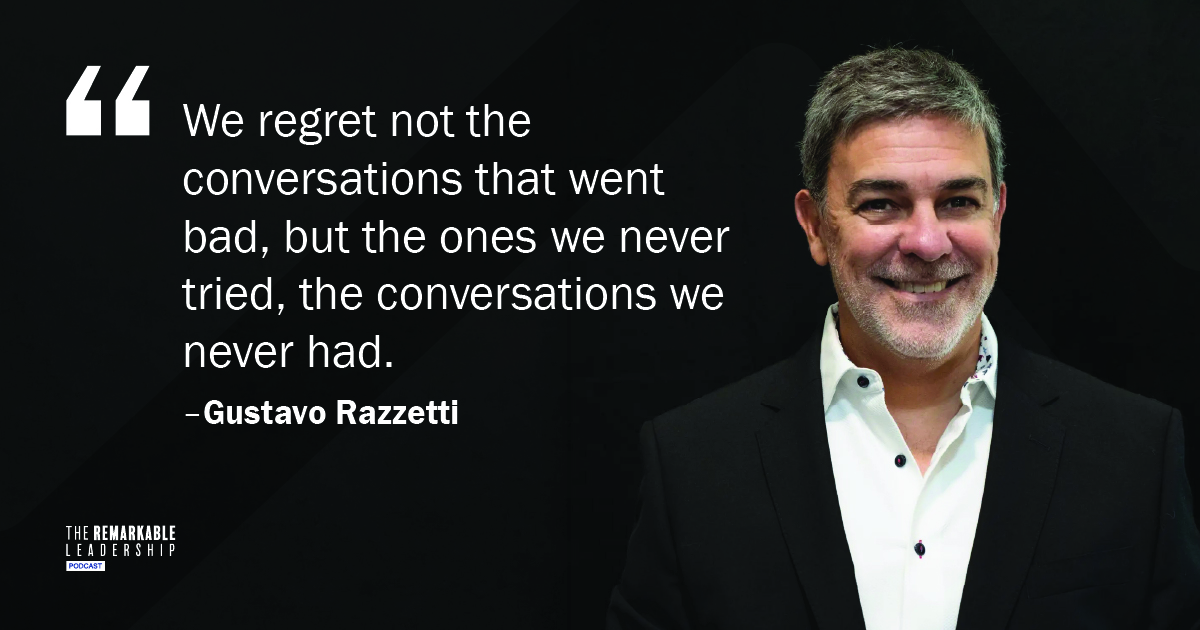
We regret not the conversations that went bad, but the ones we never tried, the conversations we never had. Yeah. Conversely, when people take the risk, when people start the conversation, trusts increases, the problems get solved and we find a way forward. So why wait?
00:27:30:20 - 00:27:53:15
Kevin Eikenberry
Yeah, I love that. And I think that that's maybe a big idea of the book for me is that, multiple times you, you said people will think other people are thinking something different than they're thinking themselves. And you just that was just an example. And, like, we sort of know what you said is true, and yet we don't think others agree.
00:27:53:15 - 00:28:09:23
Kevin Eikenberry
And so we don't have that conversation. We stay silent, we don't take action. We don't do we don't initiate. Right. Which is a big part of what you're talking about today. Before we go, Gustavo, I'm curious, what are you reading these days?
00:28:10:00 - 00:28:36:13
Gustavo Razzetti
I read a lot of random things, from more intellectual to more shallow things, and, of course, the news. But I just finished a reading for the second time. A meaningful work, a book by West Adams and Tamara Myles. Really great. That reminds us that finding means meaning at work doesn't require to change the world. Sometimes we can find meaning in day to day activities only.
00:28:36:14 - 00:28:41:12
Gustavo Razzetti
We only need to know where to look for and what to look for.
00:28:41:14 - 00:29:01:23
Kevin Eikenberry
We will have a link to meaningful work in the show. Notes. And note to all of you who are watching or listening. They have been on the show, and so we've talked about meaningful work on this show, and we'll point you to that, episode as well. Where can we learn more? Gustavo, about you, your work, your your team.
00:29:01:23 - 00:29:05:18
Kevin Eikenberry
Where do you want to point us? I hold up the book while you do that.
00:29:05:20 - 00:29:29:17
Gustavo Razzetti
Sure. I mean, if you want to find the book is available in most retailers, both online and brick and mortar, and you can go to my website, Gustavo rossetti.com with the team and you can learn more about myself, my other books, the services I provide, companies. I also have a lot of free tools that you can download and start using for your, teams.
00:29:29:19 - 00:29:39:13
Gustavo Razzetti
And lastly, let's connect on LinkedIn. The last time I checked, the only Gustavo recipe there. So it's kind of easy for you to find me.
00:29:39:15 - 00:29:58:15
Kevin Eikenberry
I think the same is true for me. We have that in common. So before we go, everyone, I have a question for all of you. I've asked my last question of Gustavo. My question now is for you. If you've been here before, you know I'm going to ask it. The question is now what? What action will you take now as a result?
00:29:58:17 - 00:30:26:23
Kevin Eikenberry
Because if you don't take any action now, nothing good will come from this conversation. It's fine to say, yep, I'm seeing blame conversations. Yep. I'm seeing avoidance. Yep, I see this conversational debt. But if I only, I'm aware of it, it's really not enough. We have to take action. So my hope is that you will think through the things from today that were most useful to you, that you can act on right away.
00:30:27:05 - 00:30:40:21
Kevin Eikenberry
Because when you do that, the chances of great value from this goes way, way up. Gustavo, thanks so much for being here. It was a pleasure to have you. Thanks for joining and sharing your your time, your talent and your wisdom.
00:30:40:23 - 00:30:44:04
Gustavo Razzetti
Thank you Kevin. Happy birthday again and thank you again for joining us.
00:30:44:04 - 00:30:58:19
Kevin Eikenberry
Well, to everybody, I hope that you enjoyed it. If you did, make sure you subscribe wherever you watch or listen because you don't want to miss any other episodes, because next week we'll be back again with another episode of the Remarkable Leadership Podcast.
Meet Gustavo

Gustavo's Story: Gustavo Razzetti is the bestselling author of Remote, Not Distant, Stretch for Change, and his latest book, Forward Talk: The Bold New Method for Getting Teams Unstuck. He is a culture strategist, workshop facilitator, and keynote speaker with over 25 years of experience—first as a marketing and advertising executive, now as CEO of Fearless Culture, a culture design consultancy. He’s facilitated more than 1,500 workshops with leadership teams at Mars, Microsoft, Merck, the Inter-American Development Bank, and hundreds of organizations across the world. Razzetti is the creator of the Culture Design Canvas, now used by over 500,000 practitioners worldwide, and the Forward Talk framework. He helps teams surface issues early, challenge groupthink, and turn avoided conversations into decisions that stick. His work has been featured in The New York Times, BBC, Forbes, and Fortune. He’s also a regular contributor to Psychology Today.
Follow The Remarkable Leadership Podcast


Looking to Develop Stronger Leaders?
Want help developing the leaders in your organization? Reach out to explore how the Kevin Eikenberry Group can support your team.
Book Recommendations
Like this?
Join Our Community
If you want to view our live podcast episodes, hear about new releases, or chat with others who enjoy this podcast join one of our communities below.
Leave a Review
If you liked this conversation, we'd be thrilled if you'd let others know by leaving a review on Apple Podcasts. Here's a quick guide for posting a review.
