How do leaders build trust in ways that strengthen people, teams, and organizational results? In this episode, Kevin talks with Dr. Dennis Reina and Dr. Michelle Reina about why trust cannot be treated as a buzzword but must be practiced every day in the small moments. They share their three dimensions of trust—character, communication, and capability—and explain how trust grows when leaders clarify expectations, honor commitments, communicate truthfully and transparently, and recognize both the current and potential strengths of others. The discussion also highlights that trust is everyone’s responsibility, even though leaders set the tone, and that organizations thrive when they intentionally connect the human need for relationships with the business need for results.
Listen For
00:00 Why Trust Matters More Than Ever
02:26 Meet Dennis & Michelle Reina
03:24 Why They Wrote The Art of Trust Building
04:12 Trust Is a Daily Practice
04:47 The Big Idea Behind Trust Building
06:05 Trust Is Always Being Built or Broken
07:08 The 3 Dimensions of Trust
08:00 Why Leaders Misunderstand Trust
10:18 Trust of Character
11:27 The Importance of Clear Expectations
13:17 Trust of Communication
15:42 Trust of Capability
17:23 The Hidden Skills Behind Trust
18:28 Trusting Potential, Not Just Performance
19:35 The Trust Assessment Tool
21:15 Building Organizational Trust
23:35 Leaders Set the Tone
24:41 Trust Is Like Oxygen
25:07 Small Moments Build Trust
26:00 What They’re Reading
27:59 Where to Learn More
28:33 Kevin’s Final Leadership Challenge
00:00:08:07 - 00:00:36:22
Kevin Eikenberry
We talk about trust so much that it is almost become a buzzword, which we cannot actually let happen. As we learn about how to build true trust, we transform our businesses and our relationships. But more than that, as we develop the art of trust, we can transform lives, teams and organizations, and perhaps even, yes, the world. Today, we are going to step back from the buzzwords and dive into the power of trust.
00:00:37:04 - 00:01:06:06
Kevin Eikenberry
Welcome to another episode of the Remarkable Leadership Podcast, where we are helping leaders, excuse me, organizations and their leaders grow and lead more effectively to make a bigger difference across their teams, communities and the world. If this is you, if you want to lead better and help the leaders in your organization do the same. Please accept my gift of action based and action guide based on the key lessons I learned from my shows during and during 2025.
00:01:06:08 - 00:01:30:21
Kevin Eikenberry
And you can get that action guide for free just by going to remarkable podcast.com/action guide. Oh, and Word Action Guide. If you were listening to this podcast in the future, you can join us live because these happen live. Today's episode happened almost exactly two months earlier than when it released on the podcast. So if you would join us live, you get the information.
00:01:30:21 - 00:01:55:22
Kevin Eikenberry
Sooner you get a further jump on being a more effective leader, making a more remarkable difference. So if you want to know how to do that, two of the platforms that we live stream on are LinkedIn and Facebook, and we have groups for both of those places where you can get all the inside scoop. Just go to remarkable podcast.com/facebook or remarkable podcast.com/linkedin to get clued in.
00:01:56:00 - 00:02:26:06
Kevin Eikenberry
Love to have you do that. And and all that. So that's our hope for you today that you will join us as I welcome in my guests. I'm going to bring them in now. There they are. Dennis and Michelle, Raina, Doctor Dennis, Raina and Doctor Michelle Raina are internationally recognized pioneers in the field of organizational trust and bestselling authors of the groundbreaking Trust and Betrayal in the workplace.
00:02:26:11 - 00:02:48:15
Kevin Eikenberry
As co-founders of Raina Trust Building. They have devoted their lives to understanding, measuring, and strengthening trust in the workplace. More than three decades of research and practice have culminated in their new book, the Art of Trust Building, and its digital companion, The Raina Trust Assessment. They'll tell you all about that later. I'm so glad to have them to join me today.
00:02:48:17 - 00:02:50:21
Kevin Eikenberry
Michelle and Dennis, welcome to the show.
00:02:50:23 - 00:02:55:00
Dr. Dennis Reina
Well, thank you so much, Kevin. It's such a pleasure to be here.
00:02:55:02 - 00:03:10:12
Kevin Eikenberry
I told them I told you guys before, it's a good thing that you like each other, because you had to get squished together to be on the camera together. And you're also not the first married couple that have been guests of mine at the same time. So, anyway, I don't know what that means to anyone except Kevin.
00:03:10:14 - 00:03:24:19
Kevin Eikenberry
Let's let's dive in. And I want to talk about the book. Obviously, you want to talk about your work for sure. But I really want to start with. Why this book, Dennis? Why this book?
00:03:24:21 - 00:03:56:22
Dr. Dennis Reina
Well, you know, work. The world of work these days is so much different and has changed so much, even in just in the last, few years, you know, with remote work as well as, you know, geographically dispersed, as well as the changing landscape, the technology, AI, etc. there are so much disruption going on in the world and in the world of work that we said we needed to write this book.
00:03:57:00 - 00:04:12:14
Dr. Dennis Reina
The importance of trust is recognized, but how to practice it each and every day, because it is truly a daily practice. That's where this book comes into play.
00:04:12:16 - 00:04:27:04
Kevin Eikenberry
You know, one of the things that you wrote in the book is that trust is a way of being, not a destination. When I tell people all the time is that in the dictionary, trust is both a noun and a verb, but the more of the verb we do, the more of the noun we get. You're not.
00:04:27:09 - 00:04:44:22
Kevin Eikenberry
So I guess I'm not completely off base with that. So I'm right with you on that, and I want to get to that word art in a second, which is the second word in the title. But Michelle, what is the big idea of the book? Dennis told us sort of why you felt that you needed to share this with the world.
00:04:45:01 - 00:04:47:19
Kevin Eikenberry
What's the big idea?
00:04:47:21 - 00:05:10:17
Dr. Michelle Reina
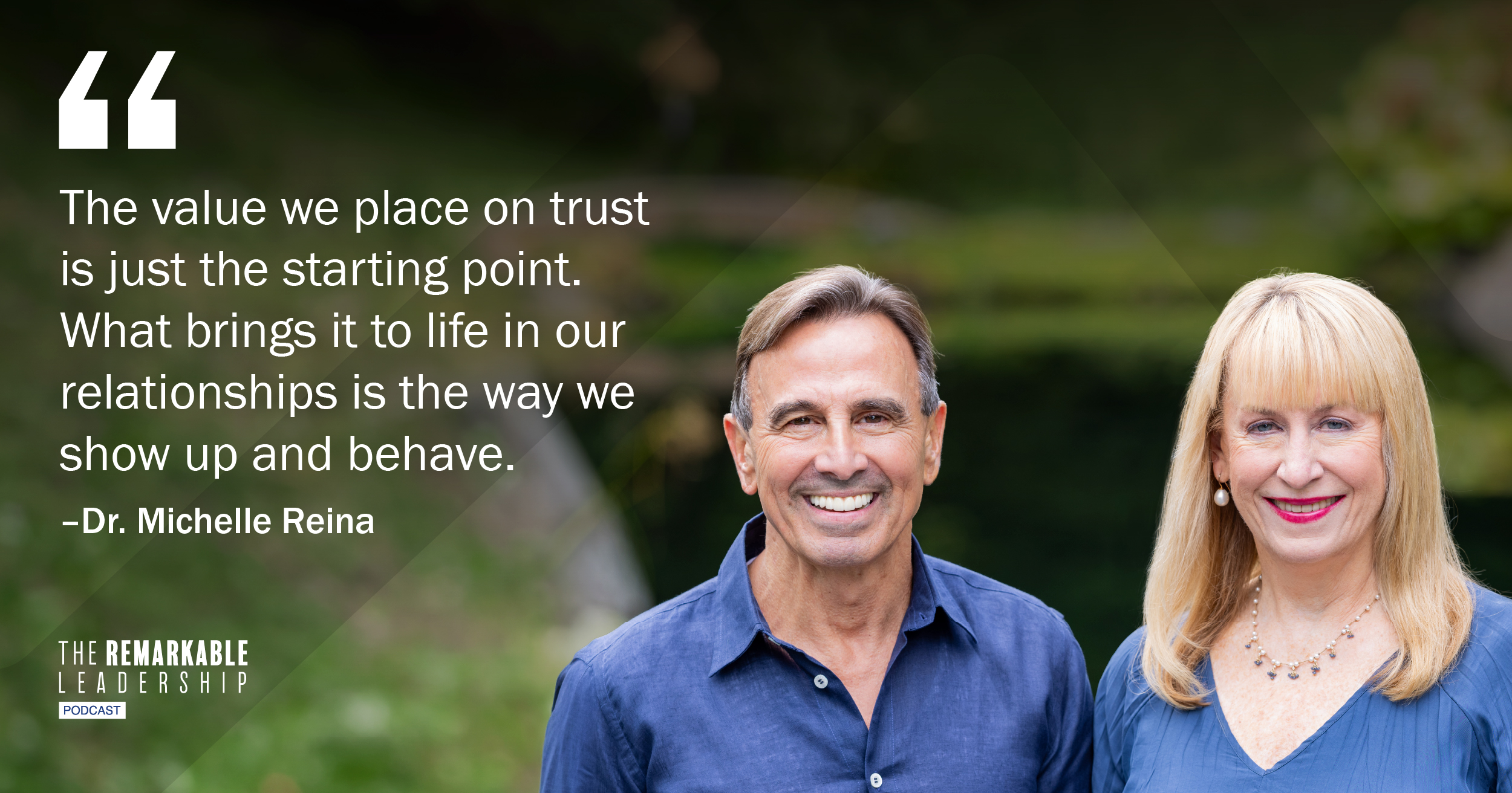
We all need trust, Kevin. We all want trust. We fundamentally believe we all deserve it. But it starts with one place and one place only. And that's each and every one of us. The value we place on trust is just the starting point. What brings it to life in our relationships is the way we show up and behave.
00:05:10:19 - 00:05:35:07
Dr. Michelle Reina
That's a little bit of an aspect of the art, because we all have control over how we choose to behave, and it's our behavior that's backed up with our attitude and our outlook that actually makes trust. What we use is the phraseology. Kevin is trust building. We don't build trust. We are in the art of trust building. We're always working at it.
00:05:35:11 - 00:05:43:02
Dr. Michelle Reina
It's always at play in this art of trust building that brings in the to our lives in a way that is sustainable.
00:05:43:04 - 00:06:05:03
Kevin Eikenberry
Would it be safe to say that? I mean, you just you just said it. We are always in the process of trust building, but we're not all doing it intentionally. I mean, the part of this point of this conversation is to do it more intentionally. But is it safe to say that we're all doing it whether we know it or not, however unsuccessfully or successfully?
00:06:05:05 - 00:06:27:00
Dr. Michelle Reina
I'd say yes and no. I'd say that there are ways that we are naturally inclined to be building trust, because as human beings, we want connection. We all want to connect with others. We all want to be trusted by others and to be trusted in return. Yet today, in this changing landscape, we are most vulnerable to trip up.
00:06:27:02 - 00:06:40:22
Dr. Michelle Reina
And there are small, subtle little ways that our behavior may actually cross trust to break down. Not only do we not intend that to happen. We're not even aware that it is happening.
00:06:41:00 - 00:06:59:15
Kevin Eikenberry
Which was kind of what I was saying. Like, we're doing stuff all the time, whether it's building or breaking. It's happening all the time. And our point today is how do we be more intentional about it and how do we how do we apply the art, as Michelle and Dennis are talking? So. So, Dennis, the book is really based around three dimensions of trust.
00:06:59:15 - 00:07:08:21
Kevin Eikenberry
And I will dive into them. But why don't you? We start by you just telling us what they are at a high level. And then we can. Then we can dive into them a little bit more.
00:07:08:23 - 00:07:32:08
Dr. Dennis Reina
Sure. So what we have found from our 35 years of research and practice in this field, Kevin, is that trust is actually three dimensions, that trust of character. We do what we say we're going to do. And then there's trust of communication. We openly, honestly and transparently speak with one another and then the third is trust of capability.
00:07:32:10 - 00:07:40:23
Dr. Dennis Reina
We acknowledge and leverage the skills of one another in service to our customers, our clients, or those we are charged to serve.
00:07:41:01 - 00:08:00:17
Kevin Eikenberry
You know, one of the things I and I love these is the three C's, as, character, communication and capability. And in my observation and, you know, working with leaders for as long as you guys have been study and trust. You can't have a conversation very long where it doesn't show up. Even if they don't use that word.
00:08:00:19 - 00:08:22:21
Kevin Eikenberry
And one of my observations is that many people tend to only frame trust, especially if it's if they feel like it's broken with someone in only one of those three dimensions. So that's you're you're nodding thoughts about that, Michelle. Is. Am I is that an accurate way? Is that line up with your research?
00:08:22:23 - 00:08:31:09
Dr. Michelle Reina
Yes. It doesn't actually two ways, Kevin, and I'm fascinated by the question. You know, in the very early stages of our research, going back many, many.
00:08:31:11 - 00:08:34:01
Dr. Dennis Reina
Years, we don't have we were five years old.
00:08:34:02 - 00:08:35:10
Dr. Michelle Reina
I was like five at the time.
00:08:35:10 - 00:08:37:14
Kevin Eikenberry
We don't have to talk about that part, guys.
00:08:37:16 - 00:08:58:07
Dr. Michelle Reina
You know, we all learn from our clients, right? And in the earlier stages of our research, Dennis and I would sit down and have dialog with leaders. And, you know, we'd ask them to share with us stories and examples of what foster trust in their relation chips. And they would actually reply with stories of what caused trust to break down.
00:08:58:09 - 00:09:22:22
Dr. Michelle Reina
The key is that, yes, we may have a bit more of a propensity. We may tend to focus our behavior. We may not be fully aware of it, but we may be more inclined to hone in on trust of character, particularly during times of change in transition, when expectations are up for grabs and people are looking for some clarity about how they're going to really work together and align around goals and objectives.
00:09:23:00 - 00:09:58:19
Dr. Michelle Reina
It's, the thing that's really important, that we'd like the listening audience to understand is that while we may focus on one particular dimension of trust and the behaviors to build that dimension, we are also supporting in enabling trust and fostered in those other dimensions because they really work hand in hand. Because as human beings and our behavior, you know, there's systems that are at play and synergistically, you know, raising the bar all the way around.
00:09:58:21 - 00:10:18:05
Kevin Eikenberry
So, so, Dennis, let's talk about the so I want to talk about the character when first and here's why. First of all it's the first one of the three. But the other reason I want to talk about it is, I wrote a book last year called Flexible Leadership. And so I spent a lot of time helping people see the difference between, yes, it's useful to be flexible, and it's useful to be consistent, right.
00:10:18:06 - 00:10:30:14
Kevin Eikenberry
Being reliable and and and helping people understand the tension between those two things. And yet all of us, as you said it, that I said, that trust of character is people doing what you say they're going to do.
00:10:30:16 - 00:10:31:10
Dr. Dennis Reina
Right? Absolutely.
00:10:31:10 - 00:10:38:09
Kevin Eikenberry
Liability. So talk more about like at work. What does that one look like? What does it what can it look like?
00:10:38:11 - 00:11:02:14
Dr. Dennis Reina
Sure. So usually it starts with expectations. So often we see that trust is actually broken because of unclear expectations or expectations. Was it met needs weren't being met. And so clearly and explicitly, clarifying your expectations is absolutely critical. And through that 100.
00:11:02:14 - 00:11:19:12
Kevin Eikenberry
Percent, I'm sorry, I have to stop you. Like, that's a soapbox. I could live on a long time because. And working with leaders for a very long time, everybody, I can tell you that leaders at every level, as long as they've been doing it, still struggle with this. It is not in people's job descriptions to read your mind.
00:11:19:15 - 00:11:27:21
Kevin Eikenberry
It's just not. So I'm sorry to interrupt it, but it's such an important it's such a foundational and important point.
00:11:27:23 - 00:11:59:13
Dr. Dennis Reina
Absolutely, absolutely. And then of course, alongside that is, establishing boundaries, which really means how it plays out in the workplace is what what's the clarity around the roles and responsibilities of my job, particularly the way the landscape is shifting and changing and that is shifting and changing. So how does that evolve? Yes, it's important to be flexible, but what are the core components or what are the core tenets of the responsibilities that I have?
00:11:59:13 - 00:12:30:06
Dr. Dennis Reina
And then of course, how we delegate and delegate isn't just about dumping it off your plate. It's really about empowering others, to learn and grow in their jobs because you're empowering them to take the role and the responsibility. I mean, ultimately, the buck falls with us as leaders, but, how do we empower them to learn and grow in their jobs and their responsibilities?
00:12:30:11 - 00:12:59:01
Dr. Dennis Reina
And then, of course, another one is and this is so foundational to trust of character keeping agreements delivering as promised, you know, keeping our word etc., and, and how we do that. And then of course, the whole notion around predictability, consistency, you know, trust is built by those small moments consistently over time.
00:12:59:03 - 00:13:17:18
Kevin Eikenberry
So, Michelle, a lot of people, when they think about trust, they think, well, I want people to be honest. I want people to be transparent, which is what you guys call trust of communication. So talk about that dimension a little more, and frame it for us around the workplace.
00:13:17:19 - 00:13:41:09
Dr. Michelle Reina
Absolutely. Yeah. I mean, there there are those core behaviors, you know, information is is king. Kevin, we know that in our shared work together is a particular today when life is moving so fast, the the transparency of information as much as in the moment, as, as as possible, people have a need for the information in, at hand that helps them work with fluidity.
00:13:41:09 - 00:14:08:11
Dr. Michelle Reina
And we know that when they don't have it, it tends to get made up. And information is so critical to what you and Dennis were just sort of bantering about a little bit, which is around managing expectations. A key aspect of transparency is, is what we call telling the truth, and that requires some real openness and a real environment of safety, because there's telling the truth about the status of projects.
00:14:08:11 - 00:14:36:19
Dr. Michelle Reina
There's telling the truth about how confident I feel. There's telling the truth about thoughts and recommendations and feelings and thoughts and concerns. And every now and then we might tend to hold back what is the truth? Or we might tend to spin that truth in provide a comfortable variation of that truth as a way of helping us to look good, helping us to be accepted, to make sure we're, you know, we're in good standing.
00:14:37:01 - 00:15:16:10
Dr. Michelle Reina
Yet the tricky part is that that rarely goes unnoticed. So it's where trust becomes vulnerable. There's going to be issues and concerns and all relationships is going to happen. There are going to be issues and concerns about what's happening in the world around us, inside of us. They're going to happen speaking with good purpose, with positive intent to get things on the table and let's work them through together rather than feeling the grass, the rumor mill and scraping in the grapevine and contributing to gossip and conjecture, it would just break trust.
00:15:16:10 - 00:15:42:02
Dr. Michelle Reina
That creates an enormous amount of distraction. And, of course, you know, feedback is so important in the spirit of helping others learn and grow. So it's how we show up, how we behave, how we speak with one another in service to one another are some really key underpinning is to trust of communication. It's where we connect more deeply on a human level.
00:15:42:04 - 00:16:14:18
Kevin Eikenberry
And the third is trust of capability. And one of the things, or so or, you know, do do I trust the other person's skills and abilities? And one of the things that I noticed and we talked with clients a lot, was during the pandemic and beyond, as we've talked with people about who are no longer working side by side, in many cases, is that this one is sometimes hard to build because we can see some of those things more clearly and not just in in jobs where we're watching people do the work, but just in general.
00:16:14:22 - 00:16:33:15
Kevin Eikenberry
We sometimes could build that easier to gather physically together in proximity than we can at distance. So then anything you want to say about that third one, I think we pretty oh, probably have a pretty good picture of what that one is, but any specifics about that in the world today that you'd want to comment on?
00:16:33:17 - 00:17:19:02
Dr. Dennis Reina
Well, obviously the trust of capability, which is our third, leg of the stool, if you will, it it really it is about acknowledging people's skills and ability, but it also it's about helping them learn and grow and grow into those skills and empowering them to make decisions and, and, or at least involving them gaining and gathering and seeking their input, till we can make the best decision given the changing landscape, given the, the you know that the floor right now is like quicksand because it's so, un uneasy and, discernible.
00:17:19:04 - 00:17:23:09
Dr. Dennis Reina
And we have to be constantly, you know, flexing and changing and growing.
00:17:23:11 - 00:18:06:17
Dr. Michelle Reina
Kevin, can I jump in real quick on this? I want to go back to the whole notion of, skills and abilities, you know, acknowledging those because so often, people associate that with the tangible, concrete skills and abilities that we can actually see. The art of trust building actually is a skill and an ability. And so sometimes there are intangible skills and abilities that we all foster, that helps us actually in our behavior, the ways that we're aware of assumptions that we might be making in how we test those assumptions, ways we may be forming judgments, and how we shift from judgment to understanding ways that we might become critical and
00:18:06:17 - 00:18:27:22
Dr. Michelle Reina
assume the worst, and we pivot into a place of compassion. Those are all skills and abilities that are not necessarily, evident on the surface level in a concrete, tangible way. The whole facet of trust building our skills and abilities.
00:18:28:00 - 00:18:53:12
Kevin Eikenberry
Yeah, I love that, and I want to go back to something Dennis said at the start of the conversation about, about capability. And that is not just where people are today or only with a backward lens, but where we believe they can get. Because if we only look backward, then we're never giving anyone that we're not. We're not considering our trust in their potential as opposed to just our trust in what we've seen up until this very instant.
00:18:53:14 - 00:19:05:08
Kevin Eikenberry
Right. And, and I think all of us would say that if the people that helped us grow and succeed only looked in the rearview mirror, we might not be in the spots that we're in today.
00:19:05:10 - 00:19:07:20
Dr. Dennis Reina
Absolutely, absolutely.
00:19:07:22 - 00:19:35:03
Kevin Eikenberry
So you guys have built a an assessment around these three dimensions? I took the assessment, by the way, but tell people, tell people about how they because hopefully at this point they're interested in understanding this better and thinking about this in terms of them building the art of trust, building for themselves around these three dimensions. Tell us a little bit more about that, how they can take advantage of that.
00:19:35:05 - 00:19:58:05
Dr. Michelle Reina
Well, the the assessment is, you know, rooted in a suite of assessments that we've had over the years, Kevin, that assesses trust and leadership and team relationships. And we've seen the value that they've they've provided to leaders and teams for many years around the world. And we wanted to bring that into the readers, to give them a starting point.
00:19:58:07 - 00:20:49:13
Dr. Michelle Reina
So the book does talk about the three dimensions of trust and, and the way that that we've all had a chance to dialog around it here. And that gives language and vocabulary and behavior. The assessment gives each person a vehicle to actually check in and into how they actually see themselves practicing those behaviors, their profile of their own trustworthiness helps them to know where trust stands right now, and how they see their own behavior, and gives them a place where they can go in focus, to continue to grow and develop, you know, help them tune into a behavior or two that they feel if they move the needle on, that, it's going to strengthen,
00:20:49:15 - 00:20:51:08
Dr. Michelle Reina
trust all the way around.
00:20:51:12 - 00:21:15:09
Dr. Dennis Reina
I like to add to that. And, and what participants get, is a very robust feedback report that really helps them, not only understand those three dimensions, but also coaching tips on where they see themselves and where they would like to go with the practice of those or the art of trust building.
00:21:15:11 - 00:21:36:19
Kevin Eikenberry
Yeah, I love that. And and so, you can learn more about that by giving a copy of their book, the Art of Trust Building. Transform Lives, teams and organizations. I went into that last word organizations. So when we have a conversation about trust, and certainly this conversation has been largely about thinking about ourselves and think about how we can build trust with those around us.
00:21:37:00 - 00:22:03:15
Kevin Eikenberry
And we've talked about how that's useful for the organization. But I want us to spend the last couple of minutes of our time talking about this from the organizational perspective, like if if I'm listening to this conversation and I'm saying, then, listen, Michelle, I love this for me, but I want to think about this for our organization. And what is some advice that you would have for us to work to work on building organizational trust?
00:22:03:15 - 00:22:12:10
Kevin Eikenberry
What can what can organizations be doing to help everyone build these skills? Either one of you want to take that?
00:22:12:11 - 00:22:34:08
Dr. Michelle Reina
Sure. I'll jump in. It begins with, you know, obviously each and every person. But from an organizational perspective, I love that question. Kevin. There's a facet that we find is extremely important for leaders to be aware of. So first, there's a fundamental leader need that leaders have for there to be a high level of trust within the organization.
00:22:34:08 - 00:23:03:20
Dr. Michelle Reina
Because all work, all work, all business is actually conducted through relationships. That's the bottom line, is people working hand in hand with one another, those individual relationships, team relationships, working across teams, across the enterprise. It's those relationships that are absolutely necessary for people to do their work and produce the best results for the organization. So there's the business need for results.
00:23:04:02 - 00:23:35:12
Dr. Michelle Reina
There's the business need right now for agility and flexibility and speed to market, etc., etc. but there's always that human need for connection. And where do people tend to look? They tend to look to their leaders. Their leaders set the tone, their leaders give the cues. It's where people tend to go. Our message in the book is that while people may tend to kind of sit back and wait and wonder and watch how their leaders are going to show up, the truth is, nobody needs to wait.
00:23:35:14 - 00:24:09:15
Dr. Michelle Reina
Everybody can take a step. Yet leaders do model and set the tone. Do they have 100% responsibility? No, but they do have responsibility to help their people grow in trust. They do have that responsibility to model and to demonstrate and to help their own people acquire the skills and the tools and the working frameworks so that they can not just talk about trust and relationships.
00:24:09:17 - 00:24:33:05
Dr. Michelle Reina
They can actually go to work and building it and enabling it and sustaining it. Because, you know, the truth is that leaders do not need a high trust environment for today. They need it for today and tomorrow. It's the long tail. That's so essential for sustainability.
00:24:33:07 - 00:24:41:16
Kevin Eikenberry
Dennis, before we start to wrap up, I'm curious if there's something that you wish I would have asked or that you would like for us to have talked about that we didn't.
00:24:41:17 - 00:24:57:23
Dr. Dennis Reina
Well, I just want to underscore what Michelle said is that, you know, with trust, it's an invisible energy force. Okay, that when it's present, nobody notices it, but when it's absent, everybody notices it and.
00:24:57:23 - 00:24:58:14
Dr. Michelle Reina
Feels it.
00:24:58:14 - 00:25:04:06
Dr. Dennis Reina
And feels it. It's kind of like oxygen, you know, we breathe.
00:25:04:08 - 00:25:07:06
Kevin Eikenberry
We're going to notice that if we don't have it, I promise you. Yeah.
00:25:07:08 - 00:25:30:20
Dr. Dennis Reina
Exactly, exactly. And that's when trust becomes, you know, something that leaders pay attention. But what they need to do is pay attention each and every day. But with those small moments and those small interactions and those small engagements on how they, show up, how they behave, how they follow through, how they and this is not just for leaders.
00:25:30:20 - 00:25:48:13
Dr. Dennis Reina
This is for everybody. You know, in the organization, because trust is everyone's responsibility. And I also just want to underscore that trust becomes that bridge between that business need for results and that human need for connection.
00:25:48:15 - 00:26:00:17
Kevin Eikenberry
Awesome. Michelle, you knew I was going to ask you this question. So here it comes. And you even took a minute to make sure you got it right, so you can give me the answer. What are you reading these days?
00:26:00:19 - 00:26:27:15
Dr. Michelle Reina
You know, there is a book that I'm reading. I'm actually rereading it. It's called The Untethered Soul, and it's written by Michael Singer. And why I love this book. In return to it every now and again. Is it it really helps us to more fully understand the relationship that we have with ourselves, because the relationships we have with other people, Kevin begins with the relationship we have with our selves.
00:26:27:17 - 00:26:56:04
Dr. Michelle Reina
One thing we didn't talk heavily about today, that's a key aspect, is that trust can be innately vulnerable. So what's fundamental to the sustaining of it is compassion. And this book really gives insight into how we can bring compassion to ourselves. And it's through bringing it to ourselves. We can extend that to other people. And that's what I love about, Michael Singer's book The Untethered Journey.
00:26:56:06 - 00:26:57:04
Kevin Eikenberry
All right.
00:26:57:06 - 00:26:59:09
Dr. Michelle Reina
Or The Untethered Soul, I apologize.
00:26:59:11 - 00:27:10:13
Kevin Eikenberry
That's what I wrote down. I was I was going to have to go figure that out for myself, the Untethered. So we'll have that in the show. Notes, as we always do. Then the same question for you. What are you reading these days?
00:27:10:15 - 00:27:41:11
Dr. Dennis Reina
Well, I'm reading eight Move and Sleep by Tom Rath, and it's really about the quality of our lives. You know, we may or may not live longer, but how, what what is the quality of our lives that we live? But it it. And if we practice, you know, eating well and and getting enough sleep and and of course, moving each and every day we will actually live a longer, healthier, more better life.
00:27:41:13 - 00:27:59:00
Kevin Eikenberry
Eat, move, sleep by Tom Rath. We've also got, we will also have in the show notes, obviously the Art of trust Building by Dennis and Michelle Raina. And so where can, Dennis, where can people go to get that assessment? Where where do you want to point people? Where where can they go to learn more about you?
00:27:59:00 - 00:28:01:20
Kevin Eikenberry
Get connected, get the book, all that stuff.
00:28:01:22 - 00:28:14:09
Dr. Dennis Reina
Well, they can first go to our website. That's Raina trust building, that's Arianna. And then of course, you know how to spell trust building.com. That's Reynolds building. There you go.
00:28:14:11 - 00:28:33:05
Kevin Eikenberry
Rena. Trust building, dot com. You can go there. You can go to the show notes. We'll have all that stuff, all the links to connect with them, to the books. We've just talked about it. I'm excited, of course, to the Art of trust building as well. Before we go and before I say goodbye to Michelle and Dennis, I want to do what I do every single episode.
00:28:33:07 - 00:28:53:22
Kevin Eikenberry
I'm reliable on this two front. Dennis, I'm going to ask all of you the question I always ask as, listening audience. And the question is, what's the question is now what? What will you do now? Because you've listened to this conversation and maybe you were enlightened by this conversation. Maybe you got some interesting ideas from this conversation.
00:28:54:00 - 00:29:19:22
Kevin Eikenberry
It doesn't matter. The only thing that matters is that you take action on what you got. Until you do that, when you until you start to remember that that trust is a way of being and not a destination. You can't you can't build the art of trust building. So I challenge you to take action on something that you mentally highlighted, something that you put in your nose if you were taking notes and take action.
00:29:19:22 - 00:29:26:00
Kevin Eikenberry
Because if you don't, it won't make any difference. Michelle and Dennis, thanks for being here. It was a pleasure to have you guys.
00:29:26:02 - 00:29:27:22
Dr. Dennis Reina
Thank you so much.
00:29:28:00 - 00:29:48:18
Kevin Eikenberry
And with that everybody, it's another episode of the Remarkable Leadership Podcast. In the books. Which means while we say goodbye today, we'll be back next week with another episode. Make sure you are subscribed wherever you're watching or listening so you don't miss that episode. And every week, because we're back every week with another episode of the Remarkable Leadership Podcast.
Meet Dennis and Michelle

Their Story: Dr. Dennis Reina and Dr. Michelle Reina are internationally recognized pioneers in the field of organizational trust and bestselling authors of the groundbreaking Trust and Betrayal in the Workplace and their latest book, The Art of Trust Building and its digital companion, The Reina Trust Assessment, a research-backed interactive tool that allows users to identify strengths and opportunities for growth on their trust journey. As co-founders of Reina Trust Building®, they have devoted their lives to understanding, measuring, and strengthening trust in the workplace. Dennis and Michelle’s shared passion for trust building emerged from a blend of personal and professional journeys. In 1999, they founded their business, Reina Trust Building®. Their research-based Three Dimensions of Trust® and Rebuilding Trust® processes have been adopted by leaders in Fortune 500 companies, government agencies, healthcare systems, and nonprofits around the globe.
Follow The Remarkable Leadership Podcast


Turning Leadership Ideas Into Action
Leadership development shouldn’t stay theoretical.
This Action Guide gives you practical tools and prompts to help you apply leadership lessons immediately — so you can lead more effectively, build stronger relationships, and make a bigger difference every day.
Book Recommendations
Like this?
Join Our Community
If you want to view our live podcast episodes, hear about new releases, or chat with others who enjoy this podcast join one of our communities below.
Leave a Review
If you liked this conversation, we'd be thrilled if you'd let others know by leaving a review on Apple Podcasts. Here's a quick guide for posting a review.
